If you’ve ever received an email with “Re:” in the subject line, you may have wondered what does re mean in email. In simple terms, “Re:” means the email is about an existing subject or conversation, making it easier for people to recognize ongoing discussions. Contrary to popular belief, it does not officially stand for “reply”—it comes from the Latin word in re, meaning “regarding” or “about.”
Quick Meaning
Here are the most common meanings of what does re mean in email:
- Regarding – Indicates the email is about a particular topic.
- Reply – Most email apps automatically add “Re:” to replies, so many people think it means “reply.”
- Continuation of a Conversation – Shows the email belongs to an existing email thread.
- Reference to the Original Subject – Helps organize related emails under one subject.
Re in email means “regarding” or “about.” It usually appears automatically when someone replies to an email, helping everyone follow the same conversation.
What Does Re Mean in Email?
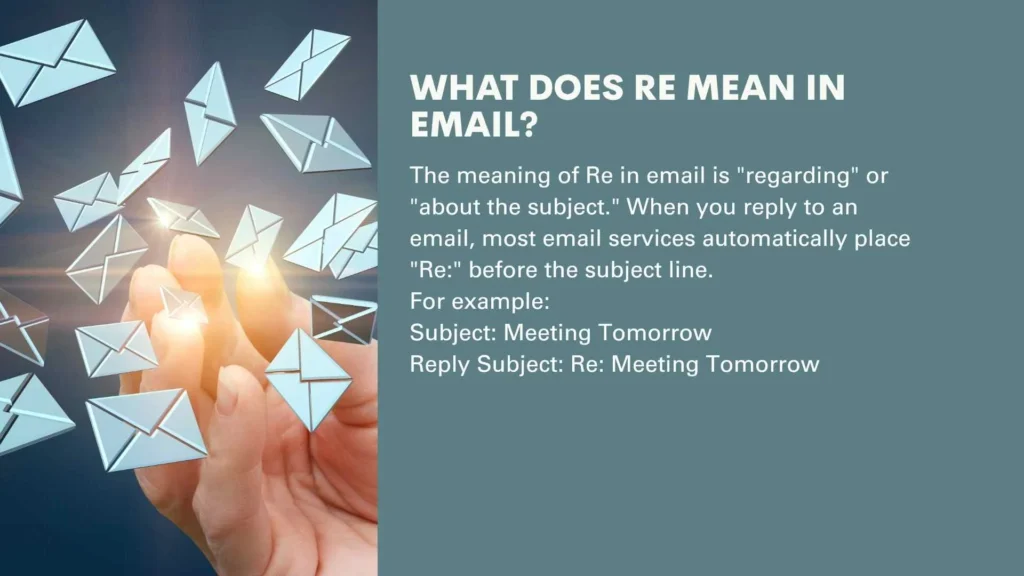
The meaning of Re in email is “regarding” or “about the subject.” When you reply to an email, most email services automatically place “Re:” before the subject line.
For example:
Subject: Meeting Tomorrow
Reply Subject: Re: Meeting Tomorrow
This tells everyone that the new email is connected to the original discussion.
Although many people believe Re stands for “reply,” the accepted explanation is that it comes from the Latin phrase in re, meaning “in the matter of.”
Full Meaning in Simple Words
In everyday language, Re simply tells the reader:
- This email is connected to a previous message.
- The topic has already been discussed.
- The sender is continuing the conversation.
Think of it as saying:
- About…
- Regarding…
- Concerning…
Instead of creating a brand-new subject, Re: keeps related emails together.
What Does Re Mean in Text?
Outside email, Re is much less common in texting.
Sometimes people use re to mean:
- Regarding
- About
- In reference to
Text Example
Alex: Re your message yesterday, I found the document.
Meaning:
“Regarding your message yesterday…”
Unlike email, most people simply write about instead of re in casual text messages.
What Does Re Mean on Social Media (TikTok, Instagram, etc.)?
On social media, Re can have different meanings depending on the platform.
TikTok
People often write:
Re: My first day at college
This means:
“I’m talking about” or “Regarding my first day at college.”
It may also appear in video captions responding to another creator.
Creators sometimes use:
Re: Last night’s event
This tells followers the post relates to a previous topic or conversation.
X (Twitter)
Users sometimes write:
Re your earlier post…
Meaning:
“I’m responding to what you posted.”
Platform-Based Examples
WhatsApp Chat Example
Emma: Re your birthday party, what time should I arrive?
Jake: Around 7 PM.
Instagram DM Example
Sarah: Re your story, where was that beach?
Mia: It was in Florida!
TikTok Comment Example
Comment:
Re the ending of this movie… I totally didn’t expect that!
Meaning:
The person is commenting regarding the movie’s ending.
Real-Life Meaning and Usage
You will most often see Re: in professional communication.
Examples include:
- Office emails
- School announcements
- Customer support emails
- Business conversations
- Government correspondence
Keeping Re: in the subject line helps everyone understand that the message belongs to an existing discussion.
Real-Life Situations Where This Term Is Used
Here are common situations where you’ll see Re:
Business Emails
Re: Marketing Budget
The team knows this email continues the budget discussion.
Customer Support
Re: Refund Request
The company is replying to your earlier request.
School Communication
Re: Parent-Teacher Meeting
The school is following up on an earlier email.
Job Applications
Re: Interview Schedule
The recruiter is responding to your interview conversation.
Legal Communication
Lawyers frequently use Re: to indicate the subject of a case or document.
Examples of Re in Email Sentences
Here are several examples:
- Re: Your application has been received.
- I’ll respond to your questions in the Re: Project Update email.
- Please keep “Re:” in the subject when replying.
- Re your request, we’ve approved the refund.
- Thanks for replying under the same Re: email thread.
- Re the meeting, we’ve changed the location.
- Re your invoice, payment has been processed.
Different Contexts of Re
| Context | Meaning | Example |
| Regarding or reply | Re: Budget Meeting | |
| Business | About a topic | Re your proposal |
| Legal | Concerning a case | Re Estate Planning |
| Academic | Regarding research | Re Assignment Submission |
| Online | Referring to previous content | Re your post yesterday |
Origin and History of the Term
Many people assume Re means Reply, but its history is older than email.
It comes from the Latin phrase:
In re
Meaning:
- In the matter of
- Regarding
- About
Long before computers existed, lawyers and businesses used Re: in letters to indicate the topic being discussed.
When email systems were created, developers continued using Re: because it already had a long history in written communication.
Why Do People Use This Word?
People use Re because it:
- Keeps conversations organized.
- Makes email threads easier to follow.
- Saves time.
- Prevents confusion.
- Helps recipients recognize ongoing discussions immediately.
Without Re:, long email conversations would become much harder to track.
Emotional & Psychological Meaning Behind This Word
Although Re has no emotional meaning itself, it affects communication by making conversations feel:
- Organized
- Professional
- Continuous
- Easy to understand
People generally trust emails more when conversations remain in one thread instead of starting new subject lines every time.
Tone Explanation
The tone of Re depends on the situation.
Formal
Very common in business emails.
Example:
Re: Quarterly Financial Report
Professional
Used by companies, schools, banks, and government offices.
Informal
Friends may also reply with Re: because their email app adds it automatically.
Slang
No.
Offensive
No.
Is It Rude to Say Re?
No.
Using Re: is completely polite.
In fact, removing it during an ongoing conversation can sometimes make email threads harder to follow.
Is Re Positive, Negative, or Neutral?
Re is completely neutral.
It doesn’t express happiness, anger, or sadness.
It simply tells readers the email relates to an existing subject.
When to Use Re
Use Re: when:
- Replying to an email.
- Continuing an existing discussion.
- Referring to an earlier topic.
- Following up on previous communication.
- Discussing the same subject.
When NOT to Use Re
Avoid Re: when:
- Starting a completely new conversation.
- Changing to an unrelated topic.
- Sending a new project or request.
- Writing a brand-new announcement.
Creating a fresh subject line is clearer in these situations.
Situations Where You Should Avoid Using This Word
Don’t use Re: if:
- The subject has changed entirely.
- You’re contacting someone for the first time.
- The old email thread is no longer relevant.
- You’re discussing multiple unrelated topics.
Starting a new thread helps prevent confusion.
Comparison Table
| Term | Meaning | Usage | Key Difference |
| Re | Regarding | Email replies | Continues an existing discussion |
| Fwd | Forward | Shares someone else’s email | Sends an existing message to another person |
| Reply | Respond to an email | Button in email apps | Action performed by the sender |
| CC | Carbon Copy | Adds additional recipients | Copies others into the conversation |
| BCC | Blind Carbon Copy | Hidden recipients | Keeps recipient list private |
Variations and Possible Meanings of Re
Depending on context, Re may refer to:
- Regarding
- About
- Concerning
- In reference to
- Reply (common misconception)
- Subject continuation
- Email thread indicator
- Legal reference
- Business correspondence marker
- Discussion topic identifier
How to Respond
Casual Replies
- Thanks!
- Got it.
- Sounds good.
- I’ll check it.
- Appreciate the update.
Funny Replies
- Message received loud and clear!
- Email ninja mode activated.
- My inbox approves.
- Thanks for keeping the thread alive!
Professional Replies
- Thank you for your response.
- I appreciate the clarification.
- I’ll review this and get back to you.
- Please let me know if you need additional information.
USA / Western Usage
In the United States, Canada, the UK, and most Western countries:
- Re: is automatically added to email replies.
- Businesses rarely remove it.
- Professionals recognize it immediately.
- It is considered standard email etiquette.
Global or Internet Usage Differences
Across the world:
- Gmail uses Re: automatically.
- Outlook uses Re: automatically.
- Apple Mail also uses Re:.
- Most email providers recognize Re: regardless of language.
Some countries may translate other email interface elements, but Re: often remains unchanged because it is an international email standard.
What Does Re Mean in Text?
In texting, Re usually means:
- Regarding
- About
- Referring to something previously mentioned
It is less common than in email and tends to appear in more formal messages.
What Does Re Mean on TikTok / Instagram?
On TikTok and Instagram, Re usually introduces a response or references another post, story, comment, or trend.
Examples include:
- Re: Your latest video
- Re the challenge everyone is doing
- Re yesterday’s livestream
In these cases, Re means “regarding” or “in response to.”
Is It Rude to Say This?
No.
Re is one of the most neutral terms used in written communication. It doesn’t carry any rude, sarcastic, or offensive meaning.
Why Do People Use This Word?
People continue using Re because it:
- Organizes email conversations.
- Makes replies easy to identify.
- Helps everyone stay on the same topic.
- Saves time by avoiding new subject lines.
- Keeps inboxes cleaner and easier to search.
Frequently Asked Questions (FAQs)
Does Re mean reply?
Not officially. While many people think it stands for reply, it actually comes from the Latin phrase in re, meaning “regarding” or “about.”
Why does Gmail automatically add Re?
Gmail adds Re: automatically whenever you reply to an email so the conversation stays organized.
Can I remove Re from an email subject?
Yes, but it’s usually better not to unless you’re changing to a completely different topic.
Is Re used only in email?
No. It also appears in legal writing, business documents, and occasionally in text messages and social media posts to mean “regarding.”
Is Re formal?
Yes. It is appropriate for both formal and informal email communication.
What is the difference between Re and Fwd?
Re: indicates a reply or ongoing discussion, while Fwd: means the email has been forwarded to another recipient.
Should I start a new email instead of using Re?
Start a new email if your message is about a completely different topic. Otherwise, keeping Re: helps maintain a clear conversation thread.
Conclusion
Understanding what does re mean in email can make your email communication much clearer. Although many people assume it stands for reply, its original meaning is “regarding” or “about.” Today, email services automatically add Re: when you respond to a message, making it easy to follow conversations and keep related emails together.
Whether you’re sending business emails, replying to a teacher, communicating with customer support, or chatting with colleagues, recognizing the meaning of Re: helps you stay organized and communicate more effectively.

James Parker is a passionate writer and language enthusiast dedicated to helping readers understand words, meanings, and communication in a simple and effective way. With years of experience in educational writing and vocabulary research, he creates easy-to-understand content that helps students, learners, and readers improve their language skills.
At MeanNings.com, James focuses on providing accurate word meanings, English vocabulary, synonyms, antonyms, and practical language guides. His writing style is clear, informative, and designed for readers of all levels.
James believes that learning language should be simple, engaging, and accessible to everyone. Through his work, he aims to make complex words easier to understand and help readers build confidence in communication.
Books by James Parker
- The Power of Words
- Mastering Everyday Vocabulary
- English Meanings Simplified
 Daniel Brooks