If you’ve ever asked what does de mean in Spanish, the short answer is that “de” is one of the most common and important prepositions in the Spanish language. It usually means “of,” “from,” “about,” or “made of,” depending on the sentence. Although it is only two letters long, its meaning changes with context.
Learning how de is used will help you understand Spanish conversations, books, songs, social media posts, and everyday expressions much more naturally.
What Does De Mean in Spanish Mean (Quick Meaning)
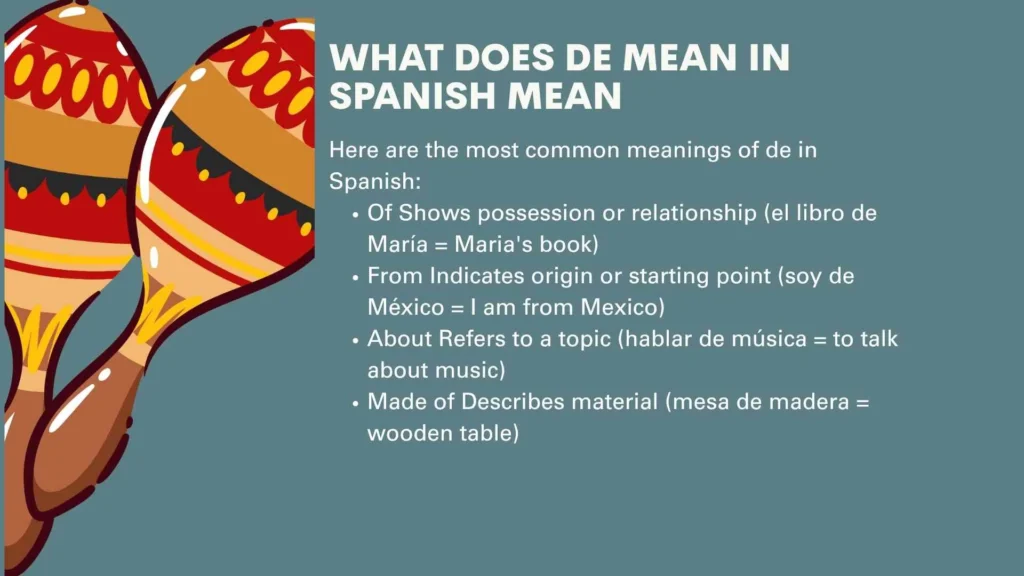
Here are the most common meanings of de in Spanish:
- Of Shows possession or relationship (el libro de María = Maria’s book)
- From Indicates origin or starting point (soy de México = I am from Mexico)
- About Refers to a topic (hablar de música = to talk about music)
- Made of Describes material (mesa de madera = wooden table)
In most situations, de means “of” or “from,” but its exact meaning depends on the sentence.
What Does De Mean in Spanish Mean?
The question what does de mean in Spanish asks about the meaning and use of the Spanish word de.
Unlike many English words, de is not a noun or verb. It is a preposition, meaning it connects words and explains relationships between people, places, things, or ideas.
Some of its most common uses include:
- Showing ownership
- Explaining where someone is from
- Describing what something is made of
- Talking about a subject
- Showing time or quantity in certain expressions
Because Spanish uses prepositions differently than English, de can have several English translations depending on the context.
Full Meaning in Simple Words
Think of de as a connector word.
It links one word to another and tells you how they are related.
For example:
- Libro de Ana = Ana’s book
- Casa de mi amigo = My friend’s house
- Soy de España = I am from Spain
- Hablo de deportes = I talk about sports
Instead of memorizing one translation, it is better to understand the relationship it creates between words.
What Does De Mean in Spanish Mean in Text?
When chatting online or texting in Spanish, de keeps its normal grammatical meaning.
It is not an internet abbreviation or texting slang.
Examples:
Text Message:
¿De dónde eres?
Meaning:
Where are you from?
Another example:
Estoy hablando de ti.
Meaning:
I’m talking about you.
In text conversations, de works exactly as it does in spoken Spanish.
What Does De Mean in Spanish Mean on Social Media?
On TikTok, Instagram, Facebook, and X, de is still simply a Spanish preposition.
People use it naturally in captions, comments, hashtags, and memes.
Examples include:
- Amor de mi vida
- Café de Colombia
- Fan de Taylor Swift
- Video de vacaciones
Unlike many internet abbreviations, de has no special slang meaning on social media.
WhatsApp Chat Example
Carlos: ¿De dónde vienes?
Sofia: Vengo de casa.
Meaning:
Carlos: Where are you coming from?
Sofia: I’m coming from home.
Instagram DM Example
Message:
Me encantó la foto de tu viaje.
Meaning:
I loved the photo from your trip.
TikTok Comment Example
Comment:
Ese video de cocina quedó increíble.
Meaning:
That cooking video turned out amazing.
Real-Life Meaning and Usage
Spanish speakers use de hundreds of times every day.
You’ll hear it in:
- Schools
- Restaurants
- Airports
- Movies
- Music
- Family conversations
- News reports
- Business meetings
Because it appears in almost every conversation, mastering de is one of the biggest steps toward speaking natural Spanish.
Real-Life Situations Where This Term Is Used
Here are common situations where you’ll hear de.
Talking About Where Someone Is From
- Soy de Texas.
- Ella es de Argentina.
Showing Ownership
- El coche de Juan.
- La mochila de Emma.
Discussing Topics
- Hablar de política.
- Pensar de otra manera.
Describing Materials
- Camisa de algodón.
- Mesa de vidrio.
Giving Measurements
- Una botella de agua.
- Un kilo de arroz.
Examples of What Does De Mean in Spanish in Sentences
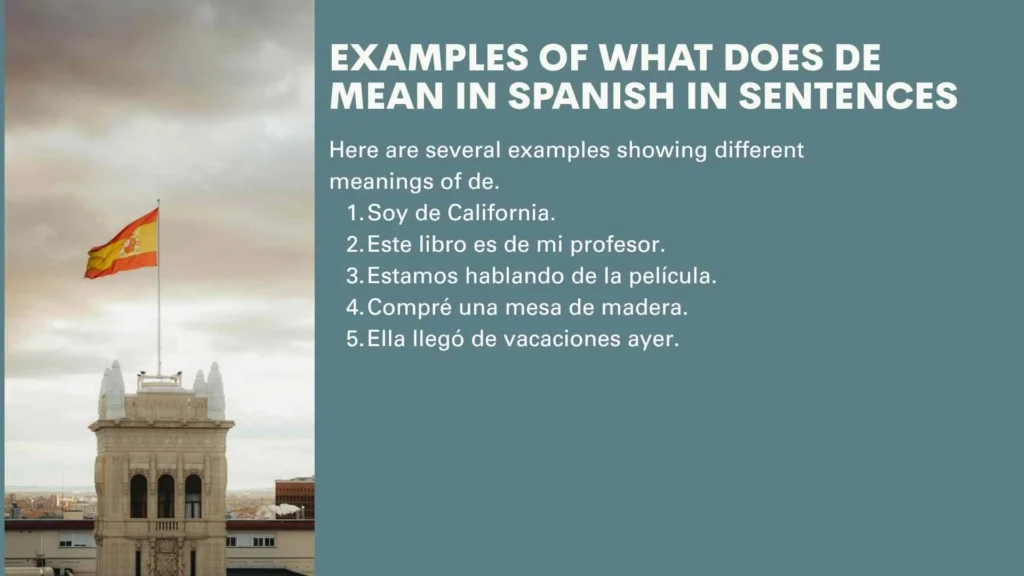
Here are several examples showing different meanings of de.
- Soy de California.
- Este libro es de mi profesor.
- Estamos hablando de la película.
- Compré una mesa de madera.
- Ella llegó de vacaciones ayer.
- Un vaso de leche está sobre la mesa.
- Es una canción de Shakira.
- La casa de mis abuelos es muy grande.
Each sentence uses de slightly differently while keeping the same connecting function.
Different Contexts of What Does De Mean in Spanish
Casual Conversations
Friends use de naturally in everyday speech.
Example:
Soy de Nueva York.
Academic Writing
Students use de in essays, reports, and research papers.
Example:
Historia de España.
Professional Settings
Business professionals use it in presentations and emails.
Example:
Informe de ventas.
Online Communication
Social media users include de in captions and comments.
Example:
Fotos de verano.
Origin and History of the Term
The Spanish word de comes from the Latin preposition dē, which also meant “from,” “of,” or “concerning.”
As Latin evolved into Spanish over many centuries, de remained one of the language’s most frequently used words.
Today, it appears in nearly every type of Spanish writing, from novels to text messages.
Why Do People Use This Word?
People use de because Spanish grammar requires it to connect ideas clearly.
It helps express:
- Ownership
- Origin
- Relationships
- Materials
- Topics
- Quantities
- Descriptions
Without de, many Spanish sentences would sound incomplete or incorrect.
Emotional & Psychological Meaning Behind This Word
Unlike emotional words such as “love” or “hate,” de has no emotional meaning by itself.
Instead, it helps express emotions through larger phrases.
For example:
- Amor de madre
- Lleno de felicidad
- Miedo de perder
In these expressions, the emotion comes from the surrounding words—not from de itself.
Tone Explanation
The tone of de depends entirely on the sentence.
Formal
- Informe de investigación
- Carta de presentación
Informal
- Soy de aquí.
- Vamos de compras.
Slang
De itself is not slang.
However, it often appears inside slang expressions.
Rude or Offensive
No.
The word de is never considered rude or offensive on its own.
Is It Rude to Say This Word?
No.
De is one of the most neutral words in Spanish.
It is appropriate in:
- Schools
- Workplaces
- Government offices
- Family conversations
- Social media
- Formal writing
There are no situations where de becomes offensive by itself.
Is This Word Positive, Negative, or Neutral?
De is completely neutral.
It has no positive or negative meaning on its own.
Its emotional tone depends on the rest of the sentence.
For example:
Positive:
- Lleno de alegría.
Negative:
- Murió de tristeza.
Neutral:
- Soy de Canadá.
When to Use What Does De Mean in Spanish
Use de when you want to express:
- Ownership
- Origin
- Material
- Topic
- Quantity
- Description
- Time in certain expressions
Examples:
- Libro de historia
- Vengo de casa
- Taza de café
When NOT to Use What Does De Mean in Spanish
Avoid using de when another Spanish preposition is required.
For example:
Incorrect:
- Voy de Madrid.
Correct:
- Voy a Madrid.
Another example:
Incorrect:
- Pienso de hacerlo.
Correct:
- Pienso hacerlo.
Learning which preposition fits each verb is an important part of Spanish grammar.
Situations Where You Should Avoid Using This Word
Do not insert de randomly into sentences simply because English uses “of.”
Spanish grammar has specific rules.
Examples include:
- Certain verbs that never require de
- Fixed expressions with different prepositions
- Some idioms that omit prepositions entirely
Reading and listening to native speakers will help you learn these patterns naturally.
Comparison Table
| Term | Meaning | Common Usage | Key Difference |
| de | Of, from, about | Shows relationships | Most flexible Spanish preposition |
| desde | Since, from | Starting point in time or place | More specific than de |
| por | By, through, because of | Cause, movement, exchange | Expresses reason or route |
| para | For, in order to | Purpose or destination | Focuses on goals or recipients |
Variations and Related Meanings
Depending on the sentence, de may mean:
- Of
- From
- About
- Made of
- Because of (in some expressions)
- During (certain phrases)
- Belonging to
- Related to
- Concerning
- Part of
Each meaning depends on grammar rather than the word itself changing.
How to Respond
Casual Replies
- Sí, soy de México.
- Es de mi hermano.
- Hablo de música.
Funny Replies
- Soy de otro planeta.
- Ese café es de otro nivel.
- Vengo de una misión secreta.
Professional or Mature Replies
- Soy de Chicago y trabajo aquí.
- El informe es de nuestro departamento.
- La información es de una fuente confiable.
Cultural Usage
USA / Western Usage
In the United States, many Spanish learners first encounter de in school, language apps, or conversations with native Spanish speakers.
Because Spanish is widely spoken across the country, understanding de is essential for everyday communication.
Global or Internet Usage Differences
Across Spanish-speaking countries, de keeps the same basic meaning.
Regional accents may change pronunciation slightly, but the grammatical function remains consistent whether you’re in:
- Spain
- Mexico
- Colombia
- Argentina
- Peru
- Chile
- Puerto Rico
What Does De Mean in Spanish Mean on TikTok and Instagram?
On TikTok and Instagram, de is simply part of normal Spanish writing.
Examples include:
- Video de hoy
- Outfit de verano
- Fan de este cantante
- Fotos de vacaciones
It does not carry a hidden internet meaning.
Is It Rude to Say It?
No.
The word de is completely safe in every setting because it is simply a standard Spanish preposition.
Any offensive meaning comes from the surrounding sentence—not from de itself.
Why Do People Use This Word?
Spanish speakers use de because it makes sentences clear and grammatically correct.
Without it, many ideas involving ownership, origin, materials, and descriptions would be difficult to express naturally.
Frequently Asked Questions
Does de always mean “of”?
No. While “of” is its most common translation, de can also mean “from,” “about,” “made of,” or other related ideas depending on context.
Is de a verb or a noun?
No. It is a preposition.
Is de used in every Spanish-speaking country?
Yes. It is a core part of Spanish grammar worldwide.
Is de considered slang?
No. It is standard Spanish.
What is the difference between de and desde?
De generally means “of” or “from,” while desde emphasizes a starting point, often translated as “since” or “from.”
Why does de have so many meanings?
Like many prepositions, de changes meaning depending on the words around it rather than having just one fixed English translation.
Can I translate de the same way every time?
No. The best translation depends on the context of the sentence.
Conclusion
If you’ve been wondering what does de mean in Spanish, the answer is that de is one of the most common and versatile prepositions in the language. It usually means “of,” “from,” “about,” or “made of,” but its exact meaning depends on the sentence. Rather than memorizing a single translation, focus on how de connects ideas such as ownership, origin, topics, and materials. Once you understand these patterns, you’ll find it much easier to read, write, and speak Spanish with confidence.