If you have heard someone say “dale” in a Spanish conversation, song, TikTok video, or text, you may wonder what it means. What does dale mean in Spanish? Most often, it means “go ahead,” “come on,” “go for it,” or “okay,” depending on the context. It can also have a more literal grammatical meaning related to the verb dar, meaning “to give.”
What Does Dale Mean in Spanish?(Quick Answer)
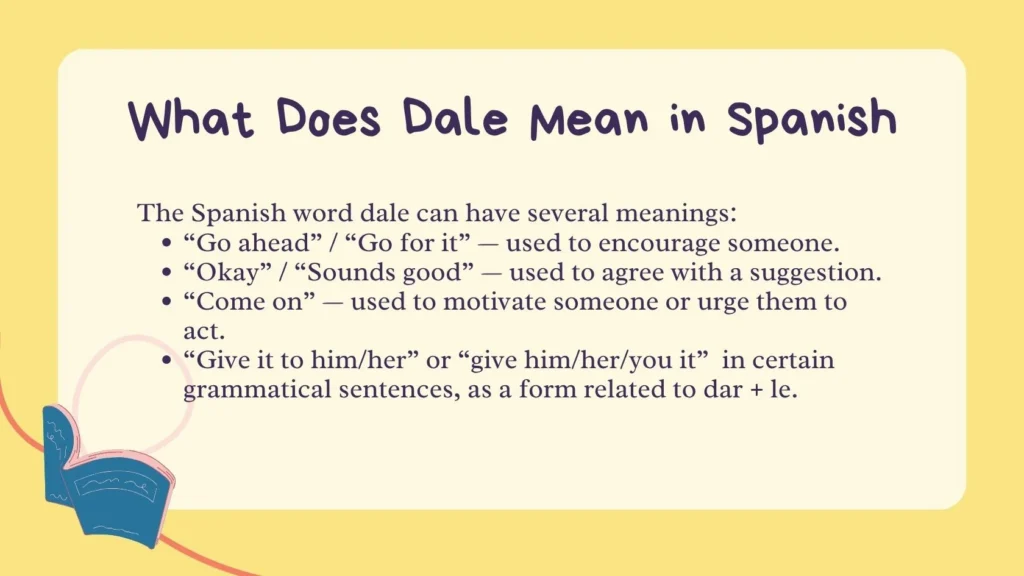
The Spanish word dale can have several meanings:
- “Go ahead” / “Go for it” — used to encourage someone.
- “Okay” / “Sounds good” — used to agree with a suggestion.
- “Come on” — used to motivate someone or urge them to act.
- “Give it to him/her” or “give him/her/you it” — in certain grammatical sentences, as a form related to dar + le.
Featured-snippet answer: In casual Spanish, especially in many Latin American contexts, “¡Dale!” commonly means “go ahead,” “come on,” “go for it,” or “okay.” The exact English translation depends on the situation and tone.
What Does Dale Mean in Spanish?
Dale is a highly flexible Spanish expression. When people use it by itself—especially as “¡Dale!”—it often works like an interjection rather than a word that should be translated literally.
For example:
¿Quieres ir al cine? — ¡Dale!
“Do you want to go to the movies? — Sure!”
But:
¡Dale, tú puedes!
“Come on, you can do it!”
The same Spanish word produces two different English translations because context changes its meaning. SpanishDictionary describes dale as an informal interjection used for encouragement and agreement.
The Literal Grammar Behind Dale
There is also a grammatical explanation. Dale can be understood as the command form of dar (“give”) combined with the indirect-object pronoun le (“to him,” “to her,” or sometimes “to you” depending on the construction).
The Royal Spanish Academy gives examples such as “Dale otra oportunidad”, meaning “Give him/her another chance.”
So, there is an important difference:
- ¡Dale! → often an informal expression such as “Go ahead!”
- Dale otra oportunidad. → literally, “Give him/her another chance.”
Full Meaning in Simple Words
Think of dale as a flexible conversational word whose meaning changes with the situation.
If your friend says:
“I’m thinking about asking her out.”
You might reply:
“¡Dale!”
Here, it means:
“Go for it!”
If someone asks:
“¿Nos vemos a las ocho?”
“Should we meet at eight?”
You can answer:
“Dale.”
Here, it means:
“Okay” or “Sounds good.”
If someone is moving too slowly, “¡Dale!” can also mean something closer to “Come on!” or “Let’s go!”
This flexibility is one reason the expression appears so often in informal Spanish conversations.
What Does Dale Mean in Text?
In texting, dale is often a quick way to show agreement, encouragement, or readiness.
For example:
“Want to grab coffee later?”
“Dale.”
Meaning:
“Sure.”
Another example:
“I’m going to apply for the job.”
“¡Dale!”
Meaning:
“Go for it!”
Because texting removes facial expressions and vocal tone, the surrounding message matters. A simple “dale” can sound friendly, enthusiastic, neutral, or impatient depending on what comes before and after it.
WhatsApp Chat Example
Friend: ¿Vamos a cenar esta noche?
You: Dale, a las ocho.
English:
Friend: “Want to go to dinner tonight?”
You: “Sure, at eight.”
Here, dale means “okay” or “sounds good.”
Instagram DM Example
Friend: Estoy pensando en subir este video.
You: ¡Dale! Está buenísimo.
English:
Friend: “I’m thinking about posting this video.”
You: “Go for it! It’s really good.”
Here, dale expresses encouragement.
TikTok Comment Example
Creator: ¿Hago una segunda parte?
Comment: ¡Dale!
English:
Creator: “Should I make a part two?”
Comment: “Yes!” / “Go for it!”
On social media, users may use dale as a short, energetic reaction.
What Does Dale Mean on TikTok, Instagram, and Social Media?
On TikTok, Instagram, YouTube, and other social platforms, dale usually keeps its everyday conversational meanings.
Depending on the post, it can mean:
- “Yes!”
- “Go for it!”
- “Do it!”
- “Come on!”
- “Let’s go!”
- “Okay!”
- “Sounds good!”
You may also encounter it in Latin music, sports content, memes, and motivational videos. Its energetic sound makes it useful when someone wants to encourage action.
A key point is that dale is not automatically “Spanish slang.” It has ordinary grammatical uses as well as colloquial interjectional uses. Calling every use “slang” can make the word seem more unusual than it actually is.
Real-Life Meaning and Usage
In everyday conversation, dale is especially useful when someone needs a quick response.
Imagine a friend asks:
“Can I call you later?”
You could answer:
“Dale.”
That means something like:
“Sure.”
Now imagine your friend is nervous about performing on stage.
“¡Dale! ¡Tú puedes!”
This means:
“Come on! You can do it!”
The speaker’s tone is important. A warm, excited “¡Dale!” feels encouraging. A sharp “¡Dale!” may sound like someone is telling another person to hurry up.
Real-Life Situations Where Dale Is Used
You can hear or see dale in several situations:
Agreeing With a Plan
¿Vamos mañana? — Dale.
“Are we going tomorrow? — Sure.”
Encouraging Someone
¡Dale, no te rindas!
“Come on, don’t give up!”
Telling Someone to Continue
Dale, sigue hablando.
“Go ahead, keep talking.”
Urging Someone to Hurry
¡Dale, que llegamos tarde!
“Come on, we’re going to be late!”
Supporting a Team or Performer
¡Dale, equipo!
“Come on, team!”
Examples of Dale in Sentences
Here are several realistic examples:
- ¡Dale, tú puedes hacerlo! — “Come on, you can do it!”
- ¿Quieres venir con nosotros? — Dale. — “Do you want to come with us? — Sure.”
- Dale otra oportunidad. — “Give him/her another chance.”
- ¡Dale, vamos a empezar! — “Come on, let’s start!”
- ¿Nos encontramos a las siete? — Dale. — “Should we meet at seven? — Okay.”
- ¡Dale con todo! — “Give it your all!”
- Dale, cuéntame qué pasó. — “Go ahead, tell me what happened.”
Notice how the English translation changes even though the Spanish word remains dale.
Different Contexts of Dale
| Context | Likely Meaning | Example |
| Casual conversation | Okay / sure | “¿Vamos?” — “Dale.” |
| Encouragement | Go for it | “¡Dale, inténtalo!” |
| Motivation | Come on | “¡Dale, puedes hacerlo!” |
| Texting | Okay / sounds good | “Te llamo después.” — “Dale.” |
| Social media | Yes / do it | “¿Parte 2?” — “¡Dale!” |
| Literal grammar | Give him/her/you it | “Dale otra oportunidad.” |
Origin and History of the Term
The grammatical form dale comes from dar, the Spanish verb meaning “to give,” combined with le, an indirect-object pronoun. The RAE’s Diccionario del estudiante gives examples of dar constructions such as “Dale otra oportunidad” (“Give him/her another chance”).
Over time, ¡dale! also developed and became established as a colloquial interjection used for encouragement and agreement. Spanish-language dictionaries describe these conversational meanings, including “go ahead,” “come on,” “go for it,” and “okay.”
Why Do People Use This Word?
People use dale because it is short, expressive, and flexible.
Instead of saying a longer phrase such as “Yes, that sounds like a good idea,” someone can simply say:
“Dale.”
Likewise, instead of saying “You should definitely try it,” they can say:
“¡Dale!”
The word can communicate agreement, energy, encouragement, or urgency with very little effort.
Emotional & Psychological Meaning Behind Dale
The emotional meaning depends strongly on tone.
A cheerful “¡Dale!” can communicate:
- enthusiasm
- support
- confidence
- excitement
- encouragement
A short, impatient “Dale, dale” can instead communicate urgency.
So, when interpreting a Spanish message, don’t translate the word alone. Look at the entire sentence and the relationship between the speakers.
Tone Explanation: Formal, Informal, Slang, or Offensive?
Dale is generally informal and conversational when used as an interjection.
It is common in friendly speech and casual messaging. It is not inherently vulgar or offensive.
However, it may not be the best choice in every formal situation. In professional writing, a more precise expression such as de acuerdo (“agreed/okay”) may sound more appropriate.
Is Dale Rude to Say?
No, “dale” is not inherently rude.
Its tone depends on context.
For example:
“Dale, gracias.”
can sound casual and friendly.
But:
“¡Dale, apúrate!”
can sound impatient because the speaker is urging someone to hurry.
The word itself is not offensive. The surrounding words, voice, and situation determine the tone.
Is Dale Positive, Negative, or Neutral?
Dale is usually positive or neutral, particularly when it means “okay,” “sure,” or “go for it.”
It can become more forceful when used to pressure someone:
“¡Dale, dale!”
In that situation, the feeling may be closer to “Come on, hurry up!”
Therefore, there is no single emotional label for dale. Context controls its meaning.
When to Use Dale
Use dale when you are in an informal conversation and want to:
- agree with an idea
- encourage someone
- show enthusiasm
- tell someone to continue
- respond quickly to a suggestion
- motivate someone
If you’re learning Spanish, listening to the surrounding conversation is the best way to determine which meaning is intended.
When NOT to Use Dale
Avoid using it when you are unsure whether the person will understand the colloquial expression.
For formal emails, academic papers, legal documents, or highly formal professional communication, choose a more exact expression.
For example, instead of casually writing:
Dale.
you might write:
De acuerdo.
“Agreed.”
The more formal expression makes your intention clearer.
Situations Where You Should Avoid Using This Word
You should be cautious with dale when:
- You are speaking in a very formal setting.
- You are communicating with someone unfamiliar with informal Spanish.
- You need a precise translation.
- The situation is sensitive and an overly casual response could sound dismissive.
- You are not sure whether the speaker means “okay,” “go ahead,” or the literal dar + le construction.
Dale vs. Similar Spanish Terms
| Term | Meaning | Usage | Key Difference |
| Dale | Okay, go ahead, come on | Casual | Very flexible and energetic |
| Vale | Okay, all right | Casual | Especially associated with Spain |
| De acuerdo | Agreed, okay | Neutral/formal | More direct and formal |
| Vamos | Let’s go, come on | Casual | Focuses more on going/starting |
| Adelante | Go ahead, proceed | Neutral | More literal and sometimes more formal |
One important cultural point: vale is strongly associated with Spain, while dale is widely heard in Latin American Spanish and other Spanish-speaking contexts. Regional preferences can vary, so a phrase that sounds natural in one country may sound less typical in another.
5–10 Common Variations of Dale
Here are useful forms and expressions you may encounter:
1. ¡Dale!
“Go ahead!” / “Okay!”
2. Dale, dale
“Come on!” / “Hurry up!” / “Keep going!”
3. Dale pues
“Okay then” / “Go ahead then.”
4. Dale con todo
“Give it your all.”
5. Dale que puedes
“Come on, you can do it.”
6. Dale otra oportunidad
“Give him/her another chance.”
7. Dale de comer
“Give him/her something to eat.”
8. Dale una oportunidad
“Give him/her a chance.”
These examples show why translating dale word-for-word can sometimes create confusion. The phrase around it matters.
How to Respond to Dale
If someone sends you “dale”, your response depends on what they mean.
Casual Replies
If someone means “okay,” you could respond:
- “Perfect!”
- “Sounds good!”
- “See you then.”
- “Awesome.”
Funny Replies
If a friend says “¡Dale!” to encourage you, you could jokingly reply:
- “Okay, okay, I’m doing it!”
- “Say less!”
- “Challenge accepted!”
Professional or Mature Replies
If the conversation is professional, respond clearly:
- “Sounds good.”
- “Understood.”
- “Agreed.”
- “That works for me.”
USA / Western Usage
For English speakers in the United States, dale is most likely to appear when interacting with Spanish speakers, Latino communities, Spanish-language music, or online content.
It may also appear in bilingual conversations where Spanish and English are mixed naturally.
For an English speaker, the easiest way to remember it is:
Dale = “Okay” when agreeing + “Go for it” when encouraging.
That simple rule will correctly interpret many casual conversations.
Global and Internet Usage Differences
Spanish is spoken across many countries, and conversational vocabulary can vary by region.
The exact feel of dale may therefore differ between countries. Some speakers use it heavily as an agreement marker, while others may use it more often for encouragement or urgency.
Online culture also makes short expressions travel quickly. Social media, music, sports, and messaging can expose English-speaking audiences to expressions that originated in particular Spanish-speaking communities.
This is why you should avoid assuming that every Spanish-speaking country uses dale in exactly the same way.
A Simple Decision Guide: Which Meaning Does Dale Have?
When you see dale, ask:
Is it followed by another phrase?
↓ Yes → Check the grammar.
“Dale otra oportunidad.” → “Give him/her another chance.”
↓ No
Is someone agreeing with a suggestion?
→ Yes: “Okay / sure / sounds good.”
Is someone encouraging another person?
→ Yes: “Go ahead / go for it / come on.”
Is someone being urged to hurry?
→ Yes: “Come on / let’s go / hurry up.”
This quick decision tree can help you avoid translating every dale as simply “give.”
Common Misconceptions About Dale
“Dale Always Means Give”
Not necessarily. While the form has a grammatical connection to dar (“to give”), ¡dale! is also commonly used as a conversational interjection.
“Dale Is Always Slang”
Not exactly. Its interjectional use is colloquial, but dale also appears in ordinary grammatical constructions.
“Dale Always Means Okay”
No. Okay is only one possible meaning. Depending on context, it can mean “go ahead,” “come on,” or “go for it.”
“Dale Is Offensive”
Generally, no. It is not inherently offensive. Tone and surrounding words can make a particular sentence impatient or forceful, but the word itself is normally harmless.
FAQs About Dale in Spanish
What does “dale” mean in Spanish slang?
In casual Spanish, dale can mean “go for it,” “come on,” “go ahead,” or “okay.” Its exact meaning depends on the context and tone.
What does “dale” mean in text?
In texting, dale commonly means “okay,” “sure,” or “sounds good.” It can also encourage someone to do something.
What does “dale” mean on TikTok?
On TikTok, dale often means “yes,” “go for it,” “do it,” or “come on.” A comment like “¡Dale!” can show support for a creator.
Is “dale” Spanish for “okay”?
It can be. In informal conversation, dale is commonly used to express agreement, similar to “okay,” “sure,” or “sounds good.”
Does “dale” mean “go ahead”?
Yes. “¡Dale!” is frequently used to encourage someone to proceed, so “go ahead,” “go for it,” and “come on” are common English translations.
Is “dale” rude?
Usually not. It is normally casual and friendly, although a forceful “¡Dale!” can sound impatient when someone is being rushed.
Why do Spanish speakers say “dale” so much?
Because it is short and versatile. A single word can express agreement, encouragement, motivation, or urgency, depending on the context.
References
- Real Academia Española (RAE) — Diccionario del estudiante, entry for dar, including examples such as “Dale otra oportunidad.”
- SpanishDictionary.com — Spanish-English explanations and examples for ¡Dale!, including its conversational meanings “go ahead,” “come on,” “go for it,” and “okay.”
- Larousse Spanish-English Dictionary — Additional treatment of dale as an interjection and its colloquial usage.
Conclusion
So, what does dale mean in Spanish? The answer depends on context, but in casual conversation, “¡Dale!” most often means “go ahead,” “go for it,” “come on,” or “okay.” It can express encouragement, agreement, or urgency.
The easiest way to understand it is to look at what the speaker is doing with the word. If they are supporting someone, think “go for it.” If they are agreeing to a plan, think “okay.” If they are pushing someone to act, think “come on.”
That context-based approach is much more accurate than translating dale as one fixed English word.