
If you’re wondering what does castrate mean, the term generally refers to removing or disabling the reproductive organs of a male human or animal, making reproduction impossible. The word can also be used figuratively to describe taking away someone’s power, strength, authority, or effectiveness.
Understanding the meaning of castrate depends on the context. In medical, veterinary, and agricultural settings, it has a literal meaning. In conversations, media, and online discussions, it may be used metaphorically.
Quick Meaning
- Medical/Veterinary Meaning: To remove a male’s testicles or stop reproductive ability.
- Animal Care Meaning: A procedure performed on male animals to control breeding and behavior.
- Figurative Meaning: To weaken, limit, or remove someone’s power or influence.
- Informal Usage: Sometimes used as an exaggeration to describe severe restrictions or loss of control.
What Does Castrate Mean?
The word castrate is most commonly associated with a medical or surgical procedure that prevents a male from reproducing. This can involve removing the testicles or using other methods that eliminate reproductive function.
However, in everyday speech, people often use the word in a non-literal way. For example, someone might say a rule or policy “castrates creativity,” meaning it severely limits freedom or effectiveness.
Simple Definition
Castrate means to remove or eliminate a male’s reproductive ability, or figuratively, to take away power, strength, authority, or effectiveness.
Full Meaning in Simple Words
In simple language, castrate means making a male unable to have children.
For animals such as dogs, cats, horses, cattle, and sheep, castration is a common veterinary procedure. It is often done to:
- Prevent unwanted breeding
- Reduce aggressive behavior
- Improve animal management
- Support health in certain cases
When used figuratively, the word does not refer to a physical procedure. Instead, it means:
- Taking away authority
- Reducing effectiveness
- Limiting freedom
- Weakening influence
For example:
“The new regulations castrated the team’s ability to innovate.”
In this sentence, nobody underwent surgery. The speaker means the regulations greatly reduced the team’s effectiveness.
What Does Castrate Mean in Text?
When someone uses castrate in a text message, they are usually using it figuratively rather than literally.
The sender may mean:
- To weaken someone
- To remove authority
- To make something less powerful
- To severely limit someone’s options
Text Example
Person A: The company removed all decision-making powers from the manager.
Person B: They basically castrated his role.
Meaning: They removed most of his authority.
What Does Castrate Mean on Social Media (TikTok, Instagram, etc.)?
On platforms like TikTok, Instagram, X, Facebook, and Reddit, the term often appears in discussions about:
- Politics
- Sports
- Entertainment
- Relationships
- Business decisions
Users typically use it metaphorically to describe situations where power, freedom, or effectiveness has been reduced.
Common Social Media Meaning
“To strip someone or something of power, influence, confidence, or effectiveness.”
Example
“The update completely castrated the game’s best feature.”
Meaning: The update weakened or ruined an important feature.
Platform-Based Examples
WhatsApp Chat Example
Alex: Did they approve your project?
Jake: Not really. They removed half the features.
Alex: Sounds like they castrated the whole idea.
Meaning: The project lost much of its original strength.
Instagram DM Example
User 1: Why is everyone complaining about the new app update?
User 2: Because it castrated all the useful tools.
Meaning: The update significantly reduced functionality.
TikTok Comment Example
Comment: “The new rules completely castrated the creativity of content creators.”
Meaning: The rules greatly limited creative freedom.
Real-Life Meaning and Usage
The word castrate appears in several real-world situations.
Medical Context
Doctors may discuss castration in historical, medical, or legal contexts.
Veterinary Context
Veterinarians commonly use the term regarding male animals.
Agricultural Context
Farmers often castrate livestock for breeding management and behavioral control.
Figurative Context
Writers, journalists, politicians, and everyday speakers use the word to describe reduced power or effectiveness.
Real-Life Situations Where This Term Is Used
Here are some common situations where the word appears:
Animal Care
A veterinarian recommends castrating a male dog to prevent unwanted breeding.
Farming
A farmer castrates certain livestock to improve herd management.
Politics
A commentator claims a law castrates the authority of a government agency.
Business
An employee says new policies castrate innovation within a company.
Entertainment
Fans argue a remake castrated the original story’s impact.
Examples of Castrate in Sentences
- The veterinarian recommended castrating the male dog.
- Farmers sometimes castrate livestock for management purposes.
- Critics argued the new policy would castrate local authority.
- The budget cuts castrated the department’s ability to operate effectively.
- Many fans felt the remake castrated the emotional power of the original movie.
- The restrictions castrated creative freedom within the organization.
- The company was accused of castrating employee independence.
Different Contexts of Castrate
Medical Context
Refers to eliminating reproductive ability through medical procedures.
Veterinary Context
Used for domestic animals and livestock.
Academic Context
May appear in biology, history, medicine, or sociology discussions.
Political Context
Used metaphorically to describe reduced authority.
Online Context
Often used as a dramatic way to describe weakening or limiting something.
Casual Conversation
People may use the word figuratively to emphasize a major loss of power or effectiveness.
Origin and History of the Term
The word castrate comes from the Latin word castrare, meaning “to cut” or “to prune.”
Historically, castration has been practiced for thousands of years in different cultures for:
- Animal management
- Religious practices
- Social control
- Musical traditions in certain historical periods
Over time, the word expanded beyond its literal meaning and became a metaphor for removing power, influence, or strength.
Why Do People Use This Word?
People use castrate because it conveys a strong sense of reduction or loss.
The word often communicates that something has been:
- Severely weakened
- Restricted
- Limited
- Stripped of effectiveness
Because of its intensity, it creates a stronger impact than words like “reduce” or “limit.”
Emotional & Psychological Meaning Behind This Word
When used metaphorically, the word often carries emotional weight.
It can suggest feelings such as:
- Powerlessness
- Frustration
- Humiliation
- Restriction
- Loss of control
Because of these associations, the term can sound strong or emotionally charged.
Tone Explanation
Formal Usage
Common in medical, veterinary, and academic discussions.
Informal Usage
Used metaphorically in conversations and online discussions.
Slang Usage
Not typically considered slang, but it may appear in casual internet language.
Strong or Offensive Usage
In some contexts, people may find the word harsh because of its graphic literal meaning.
Is It Rude to Say This Word?
Not necessarily.
The word is not considered profanity or a swear word. However, because it refers to reproductive organs and can sound graphic, some people may view it as uncomfortable or inappropriate in certain settings.
Generally Acceptable In
- Veterinary discussions
- Medical conversations
- Academic writing
- Historical contexts
Use Caution In
- Professional meetings
- Formal business communication
- Sensitive personal conversations
Is This Word Positive, Negative, or Neutral?
| Context | Tone |
| Medical | Neutral |
| Veterinary | Neutral |
| Academic | Neutral |
| Political | Usually Negative |
| Social Media | Often Negative |
| Personal Conversations | Usually Negative |
Most figurative uses have a negative tone because they describe loss or limitation.
When to Use Castrate
Use the word when discussing:
- Veterinary procedures
- Animal breeding control
- Medical topics
- Historical discussions
- Strong metaphorical reductions in power or effectiveness
When NOT to Use Castrate
Avoid the word when:
- A softer term would be more appropriate
- Communicating with children
- Writing customer-service messages
- Speaking in highly formal business settings
- Discussing sensitive personal topics
Situations Where You Should Avoid Using This Word
- Workplace disagreements
- Professional emails
- Customer complaints
- School presentations for younger students
- Sensitive family discussions
In these situations, words like “limit,” “reduce,” “weaken,” or “restrict” may be better choices.
Comparison Table: Castrate vs Similar Terms
| Term | Meaning | Usage | Key Difference |
| Castrate | Remove reproductive ability or power | Medical and figurative | Strongest and most specific |
| Neuter | Prevent reproduction | Veterinary use | Broader and often gender-neutral |
| Sterilize | Make unable to reproduce | Medical and scientific | Focuses on reproduction only |
| Weaken | Reduce strength | General language | Less intense |
| Restrict | Limit actions or options | Formal and casual | Does not imply complete loss of power |
Variations and Related Meanings
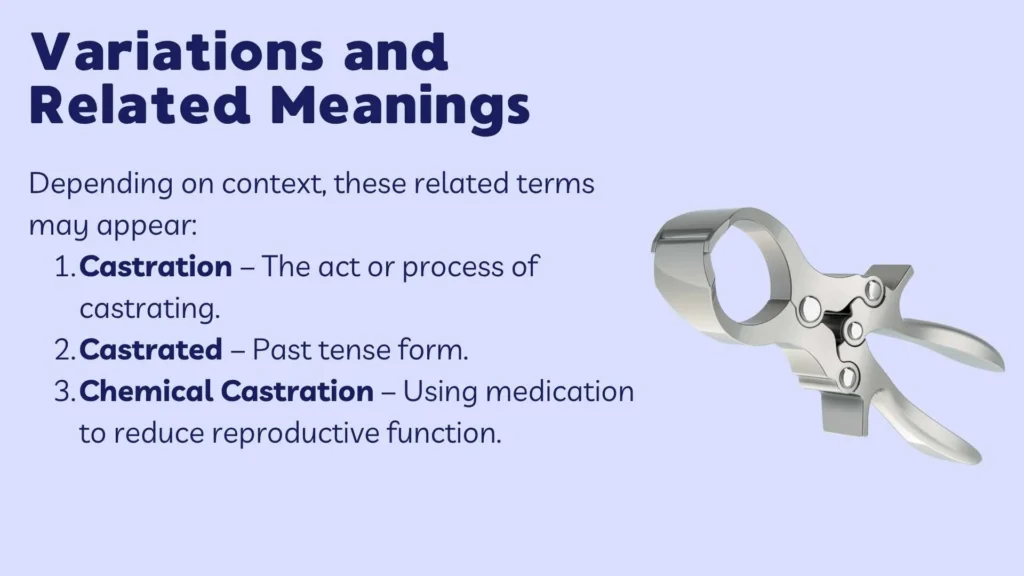
Depending on context, these related terms may appear:
- Castration – The act or process of castrating.
- Castrated – Past tense form.
- Chemical Castration – Using medication to reduce reproductive function.
- Surgical Castration – Physical removal of reproductive organs.
- Neutering – Common veterinary term.
- Sterilization – Preventing reproduction.
- Figurative Castration – Removal of power or authority.
- Political Castration – Reduction of political influence.
- Institutional Castration – Weakening an organization’s authority.
- Symbolic Castration – Psychological or metaphorical loss of power.
How to Respond When Someone Uses This Word
Casual Replies
- “Yeah, that definitely weakened things.”
- “Sounds like they removed most of the power.”
- “That’s a huge downgrade.”
Funny Replies
- “Looks like it lost all its superpowers.”
- “Talk about a dramatic nerf!”
- “That feature didn’t survive the update.”
Professional or Mature Replies
- “It appears the changes significantly reduced effectiveness.”
- “The revisions limited its original capabilities.”
- “The organization lost much of its operational authority.”
USA / Western Usage
In the United States and other Western countries, the term is most often used:
- In veterinary medicine
- In farming and agriculture
- As a metaphor in politics, business, and media
Americans commonly understand both the literal and figurative meanings.
Global and Internet Usage Differences
Online communities frequently use the word metaphorically.
Examples include:
- “The update castrated the software.”
- “The policy castrated free expression.”
- “The sequel castrated the original storyline.”
Internet users often use the term dramatically for emphasis.
Frequently Asked Questions (FAQs)
What does castrate mean in simple words?
It means making a male unable to reproduce, or figuratively removing power, strength, or authority.
What does castrate mean in text messages?
Usually, it means weakening or limiting someone or something rather than referring to a medical procedure.
Is castrate a bad word?
No. It is not profanity, but some people may consider it strong or graphic.
What does castrate mean in slang?
In informal usage, it often means to weaken, restrict, or remove someone’s influence or effectiveness.
Is castrate the same as neuter?
Not exactly. Castrate specifically refers to male reproductive ability, while neuter is a broader veterinary term.
Why do people use castrate metaphorically?
Because it strongly communicates the idea of losing power, authority, or effectiveness.
What is the opposite of castrate?
Depending on context, opposites may include empower, strengthen, enhance, restore authority, or enable reproduction.
Conclusion
Understanding what does castrate mean is important because the word has both literal and figurative uses. Literally, it refers to eliminating a male’s ability to reproduce, commonly in medical, veterinary, or agricultural contexts. Figuratively, it means reducing power, authority, effectiveness, or influence.
Whether you encounter the term in a text message, social media post, news article, or everyday conversation, the context usually makes the intended meaning clear. Knowing the difference between the literal and metaphorical definitions helps you understand and use the word appropriately.