If you’ve ever wondered what does boba mean, the simple answer is that boba usually refers to the chewy tapioca pearls found in bubble tea, a popular drink that originated in Taiwan. In everyday conversation, many people also use the word boba to describe the entire bubble tea drink rather than just the pearls themselves.
The meaning of boba can vary slightly depending on the context, but it is most commonly associated with flavored tea drinks, café culture, and social outings. Understanding how the term is used in text messages, social media posts, and real-life conversations can help you interpret it correctly.
Quick Meaning of Boba
Here are the most common meanings of boba:
- Tapioca pearls – Chewy balls made from tapioca starch that are added to drinks.
- Bubble tea – A popular tea-based beverage that often contains boba pearls.
- Boba tea culture – A social and food trend centered around bubble tea shops.
- Internet or cultural slang (less common) – In some online discussions, “boba” may carry cultural or social meanings beyond the drink.
Boba most commonly means the chewy tapioca pearls used in bubble tea. Many people also use the word to refer to the entire bubble tea drink. In texting and social media, boba usually refers to getting, drinking, or discussing bubble tea.
What Does Boba Mean?
The most common definition of boba is the small, chewy tapioca pearls added to milk tea, fruit tea, and other specialty beverages.
Over time, the word evolved, and many people now use boba as a shorthand way to refer to the entire bubble tea drink.
For example:
- “Let’s go get boba.”
- “I had boba after work.”
- “This boba shop is amazing.”
In these examples, the speaker is usually referring to bubble tea rather than only the pearls.
Full Meaning in Simple Words
In simple terms, boba is a sweet and chewy topping that goes inside bubble tea drinks.
Think of it this way:
- Coffee often comes with cream.
- Ice cream may come with sprinkles.
- Bubble tea often comes with boba.
The pearls create a unique texture that many people enjoy. Because bubble tea became so popular, the word “boba” eventually became a nickname for the drink itself.
What Does Boba Mean in Text?
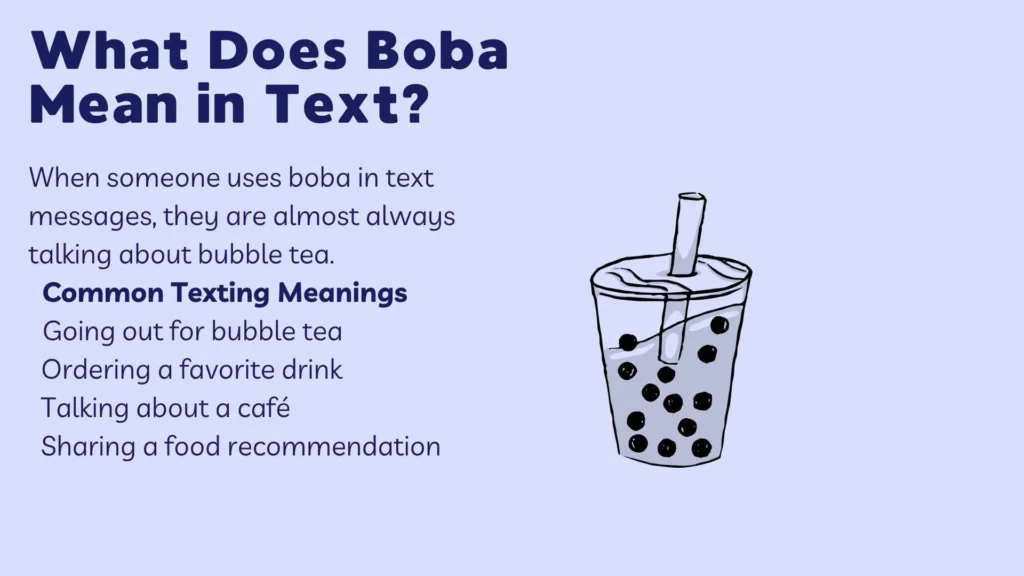
When someone uses boba in text messages, they are almost always talking about bubble tea.
Common Texting Meanings
- Going out for bubble tea
- Ordering a favorite drink
- Talking about a café
- Sharing a food recommendation
Text Message Examples
Friend: Want to get boba later?
You: Sure! What flavor are you getting?
Friend: I found a new boba place downtown.
You: Let’s try it this weekend.
In texting, there is usually no hidden meaning behind the word.
What Does Boba Mean on Social Media (TikTok, Instagram, etc.)?
On social media, boba is frequently associated with:
- Food reviews
- Drink recipes
- Lifestyle content
- Café recommendations
- Trend videos
Creators often post videos showing different flavors, toppings, and bubble tea shops.
WhatsApp Chat Example
Alex: Are you free after class?
Sarah: Yes! Want to grab boba?
Alex: Absolutely. Let’s go.
Instagram DM Example
User A: That drink looks amazing!
User B: It’s brown sugar boba. You should try it.
TikTok Comment Example
Video: Trying every bubble tea flavor this month.
Comment: The mango boba is definitely the best one!
Real-Life Meaning and Usage
In real life, boba is much more than a drink.
For many people, it represents:
- Hanging out with friends
- Relaxing after school or work
- Exploring new cafés
- Trying new flavors
Just as people often meet for coffee, many younger adults and students meet for boba.
Real-Life Situations Where This Term Is Used
Meeting Friends
“Let’s get boba after the movie.”
Studying
“We spent three hours studying while drinking boba.”
Dating
“She suggested meeting at a boba café.”
Social Media Posts
“Best boba in Los Angeles!”
Family Outings
“The kids wanted boba after dinner.”
Examples of Boba in Sentences
Here are several examples showing how the word is commonly used:
- I ordered a large taro boba with less sugar.
- My favorite café sells fresh boba every day.
- We stopped for boba on our way home.
- She posted a picture of her strawberry boba on Instagram.
- Brown sugar boba is one of the most popular flavors.
- I introduced my friends to boba last weekend.
- The new boba shop has a huge menu.
- We always get boba after soccer practice.
Different Contexts of Boba
Casual Context
This is the most common usage.
Example:
“Let’s grab some boba.”
Food and Beverage Context
Used in cafés, restaurants, and menus.
Example:
“Would you like extra boba in your drink?”
Online Context
Used in reviews, recommendations, and food discussions.
Example:
“This shop serves the best boba in town.”
Cultural Context
Represents an important part of Taiwanese food culture.
Example:
“Boba became popular worldwide after starting in Taiwan.”
Business Context
Used by beverage brands and food companies.
Example:
“The company launched a new boba product line.”
Origin and History of the Term
The history of boba starts in Taiwan during the 1980s.
Bubble tea was created by combining sweet tea with chewy tapioca pearls. The drink quickly became popular because it offered a unique combination of flavor and texture.
As bubble tea spread across Asia and eventually reached North America, Europe, and other regions, the word boba became widely recognized.
Today, thousands of bubble tea shops operate around the world, making boba a global food trend.
Why Do People Use This Word?
People use the word boba because it is:
- Short
- Easy to remember
- Widely understood
- Part of modern food culture
Instead of saying:
“Let’s go buy bubble tea.”
Many people simply say:
“Let’s get boba.”
The shorter phrase feels more natural in everyday conversation.
Emotional & Psychological Meaning Behind This Word
Although boba is just a drink, it often carries positive emotions.
Many people associate it with:
- Fun experiences
- Friendships
- Relaxation
- Rewards after work or school
- Personal enjoyment
For some people, grabbing boba has become a comforting routine similar to getting coffee.
Because of these positive associations, the word often creates feelings of happiness and anticipation.
Tone Explanation
Is Boba Formal or Informal?
The word is generally informal.
| Tone Type | Fits Boba? |
| Formal | Rarely |
| Informal | Yes |
| Friendly | Yes |
| Slang | Sometimes |
| Professional | Occasionally |
Most people use the term in casual conversations.
Is It Rude to Say This Word?
No.
Boba is not considered rude, offensive, or inappropriate.
It is simply a common food-related term.
The only exception is that certain internet discussions may use “boba” in cultural or political slang, but this usage is much less common than the beverage-related meaning.
Is This Word Positive, Negative, or Neutral?
Positive
Most uses of boba are positive because people associate it with enjoyable drinks and social experiences.
Neutral
When discussing menus, ingredients, or recipes.
Negative
Rarely negative unless used in specific online debates.
Overall, the word is generally viewed positively.
When to Use Boba
Use the word when:
- Talking about bubble tea
- Ordering drinks
- Discussing cafés
- Recommending beverage shops
- Making social plans
Examples
- “Let’s get boba.”
- “What’s your favorite boba flavor?”
- “This boba shop is excellent.”
When NOT to Use Boba
Avoid using the term when:
- Your audience may not know what it means.
- Formal writing requires more explanation.
- You need maximum clarity.
In those situations, “bubble tea” may be the better choice.
Situations Where You Should Avoid Using This Word
Formal Academic Writing
Some readers may not recognize the term.
Professional Reports
Use “bubble tea beverage” instead.
Technical Food Documentation
More precise descriptions may be needed.
International Audiences
Some regions are more familiar with “bubble tea” than “boba.”
Boba vs Similar Terms
| Term | Meaning | Usage | Key Difference |
| Boba | Tapioca pearls or bubble tea | Casual conversation | Most common everyday term |
| Bubble Tea | Tea drink with toppings | Formal and casual | Refers to the complete beverage |
| Tapioca Pearls | Chewy starch balls | Ingredient descriptions | Refers only to the pearls |
| Milk Tea | Tea mixed with milk | Beverage menus | May not contain boba |
| Fruit Tea | Fruit-flavored tea drink | Café menus | Often served without pearls |
Variations and Possible Meanings of Boba
Depending on the situation, boba can refer to different products or styles.
1. Traditional Boba
Classic black tapioca pearls.
2. Brown Sugar Boba
Pearls coated in brown sugar syrup.
3. Mini Boba
Smaller versions of traditional pearls.
4. Popping Boba
Fruit-filled spheres that burst when bitten.
5. Crystal Boba
Translucent pearls with a softer texture.
6. Boba Tea
Another name for bubble tea.
7. Milk Tea Boba
Milk tea served with tapioca pearls.
8. Fruit Boba
Fruit-flavored bubble tea combinations.
9. Slang or Cultural Boba
Less common internet-related usage.
10. Frozen Boba Drinks
Bubble tea blended with ice.
How to Respond When Someone Mentions Boba
Casual Replies
- “Sounds good!”
- “I’m in.”
- “What’s your favorite flavor?”
- “Let’s go.”
Funny Replies
- “You had me at boba.”
- “Only if I get extra pearls.”
- “Boba is always the answer.”
Professional or Mature Replies
- “That sounds enjoyable.”
- “I’d be happy to join.”
- “Let’s schedule a time.”
USA / Western Usage
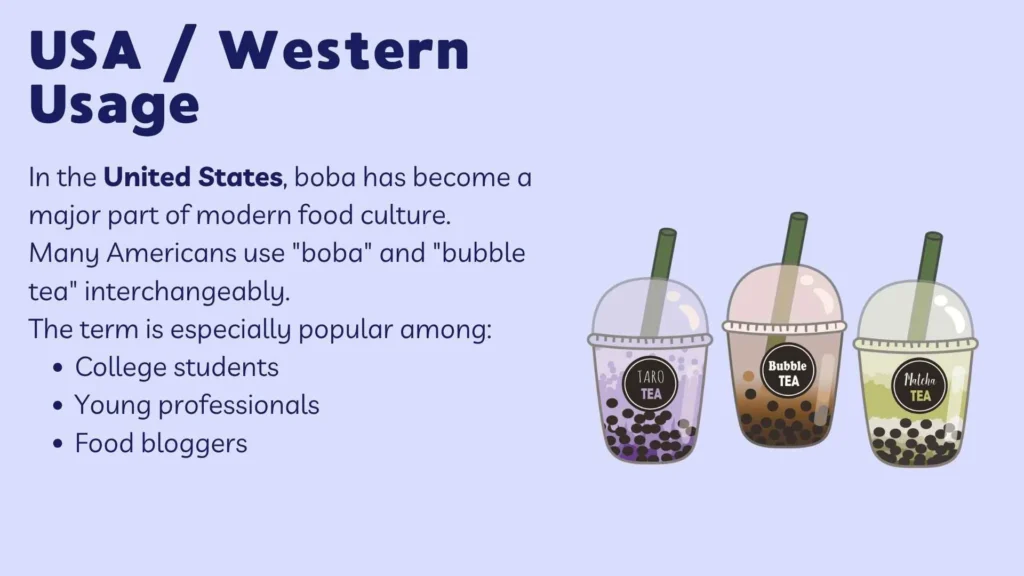
In the United States, boba has become a major part of modern food culture.
Many Americans use “boba” and “bubble tea” interchangeably.
The term is especially popular among:
- College students
- Young professionals
- Food bloggers
- Social media creators
In many cities, dedicated boba shops are as common as coffee shops.
Global or Internet Usage Differences
Taiwan
Often associated with the drink’s origins and traditional preparation.
United States
Commonly used to describe the entire beverage.
Europe
Usually connected to bubble tea cafés.
Internet Communities
Can occasionally carry cultural meanings beyond the drink itself.
Asia
The distinction between pearls and the beverage may be clearer depending on the region.
What Does Boba Mean in Text?
To summarize, what does boba mean in text?
Most of the time, it means:
- Bubble tea
- Going out for bubble tea
- Discussing favorite drinks
- Recommending a café
Example:
“Let’s get boba after work.”
Meaning:
“Let’s go buy bubble tea after work.”
What Does Boba Mean on TikTok / Instagram?
On TikTok and Instagram, boba usually appears in:
- Drink reviews
- Food trends
- Recipe videos
- Café recommendations
- Lifestyle content
The word almost always refers to bubble tea rather than internet slang.
Is It Rude to Say This?
No. Boba is a neutral and widely accepted term.
Most people view it as a simple reference to bubble tea or tapioca pearls.
There is nothing offensive about using the word in normal conversation.
Why Do People Use This Word?
People use boba because:
- It’s shorter than saying “bubble tea.”
- It’s trendy and recognizable.
- It reflects modern food culture.
- It’s easy to say and type.
- It connects with a popular beverage trend.
FAQs
What does boba mean in slang?
In most situations, boba is not slang. It refers to bubble tea or tapioca pearls. However, some online communities may use the word in cultural or political discussions.
Is boba the same as bubble tea?
Not exactly. Boba originally referred to the pearls, while bubble tea refers to the drink. Today, many people use the terms interchangeably.
What does boba mean in text messages?
It usually means bubble tea or plans to get bubble tea.
Why is bubble tea called boba?
The drink became closely associated with its chewy tapioca pearls, leading many people to use “boba” as shorthand for the entire beverage.
What is popping boba?
Popping boba consists of juice-filled balls that burst in your mouth when bitten.
Is boba healthy?
It depends on the ingredients, sugar level, and serving size. Some versions contain significant amounts of sugar and calories.
Where did boba come from?
Boba originated in Taiwan and later became popular around the world.
Conclusion
Understanding what does boba mean is easier than it might seem. In most cases, the term refers to the chewy tapioca pearls used in bubble tea or the bubble tea drink itself. Whether you’re reading a text message, browsing TikTok, chatting with friends, or visiting a café, boba is usually connected to one of the world’s most popular tea-based beverages. Its rich history, unique texture, and strong connection to social culture have made it a beloved drink trend across the United States and beyond.