
If you’re wondering what does coarse mean, the simple answer is that coarse describes something that is rough, not smooth, or lacking refinement. The word can describe physical objects like fabric or sand, as well as someone’s language, behavior, or sense of humor. Understanding the meaning of coarse depends on the context, but it almost always suggests something that is rough, crude, or not finely made.
Quick Meaning
What does coarse mean? Here are the most common meanings:
- Rough texture – Something that isn’t smooth, such as coarse sand or coarse fabric.
- Rude or vulgar language – Speech or jokes that are crude or offensive.
- Unrefined behavior – Actions or manners that lack politeness or sophistication.
- Large particles – Used for things like coarse salt, coarse sugar, or coarse pepper.
- Coarse means rough, not smooth, or lacking refinement. It can describe textures, language, behavior, or materials with large particles. Depending on the context, it may refer to something physically rough or socially crude.
What Does Coarse Mean?
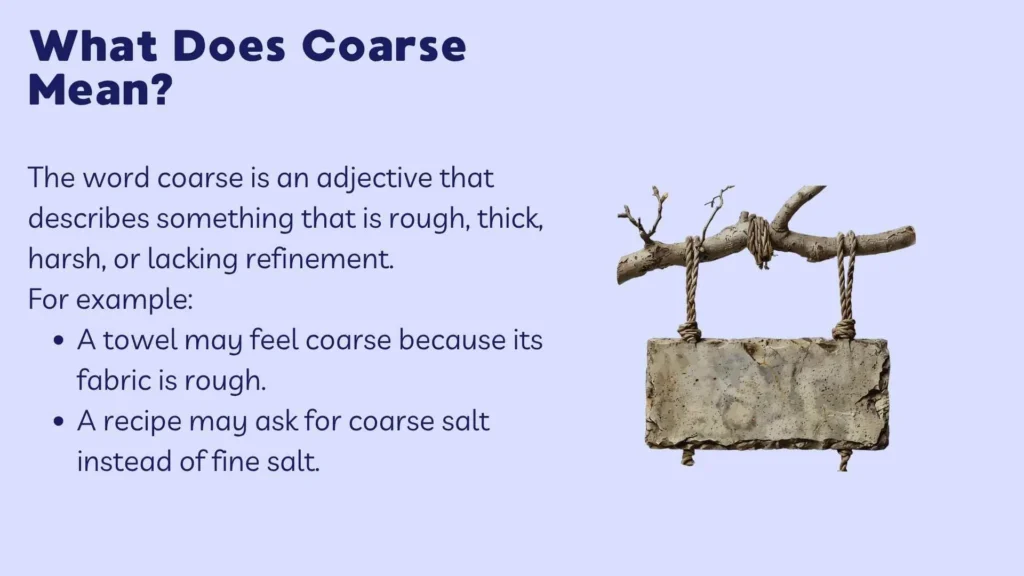
The word coarse is an adjective that describes something that is rough, thick, harsh, or lacking refinement.
Unlike words that have only one meaning, coarse can be used in several different situations.
For example:
- A towel may feel coarse because its fabric is rough.
- A comedian may tell coarse jokes that contain offensive language.
- A recipe may ask for coarse salt instead of fine salt.
Although the situations are different, they all share one idea: something that isn’t smooth, delicate, or refined.
Full Meaning in Simple Words
The easiest way to understand coarse is to think about its opposite.
| Coarse | Opposite |
| Rough | Smooth |
| Thick | Fine |
| Crude | Refined |
| Harsh | Gentle |
Imagine touching a soft blanket and then touching rough sandpaper.
The blanket feels smooth.
The sandpaper feels coarse.
Now imagine hearing two jokes.
- One is clean and polite.
- The other contains offensive language.
The second joke could also be described as coarse.
So the word can describe both physical things and people’s words or actions.
What Does Coarse Mean in Text?
When someone uses coarse in a text message, they usually mean that something is crude, rude, or inappropriate.
Unlike internet abbreviations like LOL or BRB, coarse is not slang or an acronym. It keeps the same meaning online that it has in everyday English.
Example
Friend 1: Did you watch that stand-up comedy show?
Friend 2: Yeah, but the humor was a little coarse.
Meaning:
The jokes contained rude or vulgar language.
What Does Coarse Mean on Social Media (TikTok, Instagram, etc.)?
On social media, coarse usually describes content that is:
- Crude
- Vulgar
- Unfiltered
- Rough-looking
- Lacking polish
Creators sometimes warn viewers that a video contains coarse language.
Others use the word to describe rough textures in DIY, pottery, woodworking, cooking, or fashion videos.
WhatsApp Chat Example
Alex: Did your parents like the movie?
Sam: Not really. They thought the language was too coarse.
Instagram DM Example
Emma: How do you like this handmade sweater?
Lily: I love the color, but the material feels a bit coarse.
TikTok Comment Example
“Funny creator, but some of the jokes are pretty coarse.”
Meaning:
The humor includes rude or adult language.
Real-Life Meaning and Usage
People use coarse in everyday conversations more often than many realize.
You may hear it while talking about:
- Clothing
- Food
- Hair
- Building materials
- Comedy
- Movies
- Manners
- Art
For example:
A hairstylist may describe someone’s hair as coarse.
A chef may ask for coarse black pepper.
A movie review may warn viewers about coarse language.
Real-Life Situations Where This Term Is Used
Shopping
“This towel feels too coarse.”
Cooking
“Use coarse sea salt for grilling.”
Hair Care
“Coarse hair usually needs extra moisture.”
Movie Reviews
“The film contains coarse language.”
Parenting
“My kids aren’t allowed to watch shows with coarse humor.”
Workplace
“The manager asked everyone to avoid coarse jokes during meetings.”
Examples of Coarse in Sentences
Here are several examples that show different meanings of coarse.
- The beach has coarse sand instead of soft sand.
- Her coarse hair takes longer to dry.
- Please use coarse salt for this recipe.
- His coarse language offended several people.
- The blanket felt too coarse against my skin.
- The comedian is famous for coarse humor.
- That rope is made from coarse fibers.
- The fabric looks beautiful but feels coarse.
Different Contexts of Coarse
Casual Conversation
People often use coarse to describe rough textures or rude behavior.
Example:
“That sweater feels coarse.”
Academic Writing
Scientists use the word to describe large particles.
Examples include:
- Coarse soil
- Coarse grains
- Coarse sediment
Cooking
Chefs regularly use the word when discussing ingredients.
Examples:
- Coarse pepper
- Coarse sugar
- Coarse salt
Fashion
Fabric experts may describe materials as:
- Fine wool
- Coarse wool
Online Reviews
People often write:
- “Contains coarse language.”
- “Coarse humor.”
- “Coarse jokes.”
Origin and History of the Term
The word coarse has been used in English for hundreds of years.
Originally, it referred to ordinary cloth that wasn’t finely woven. Over time, its meaning expanded to include anything rough, thick, or lacking refinement.
Eventually, people also began using it to describe speech, manners, and behavior.
Today, it is one of the most versatile descriptive words in English.
Why Do People Use This Word?
People choose the word coarse because it is more specific than simply saying “rough.”
It tells listeners exactly what kind of roughness is being discussed.
Someone might use it because they want to describe:
- Rough materials
- Thick textures
- Large particles
- Crude jokes
- Vulgar language
- Poor manners
Emotional & Psychological Meaning Behind This Word
When coarse describes behavior, it often carries a mild emotional judgment.
Calling someone’s humor coarse suggests that it is:
- Less refined
- Slightly offensive
- Immature
- Not appropriate for every audience
However, the word usually isn’t as harsh as calling someone rude or offensive.
Instead, it suggests that their behavior could be more polished.
Tone Explanation
Is Coarse Formal or Informal?
It works in both.
You can hear it in casual conversations and professional writing.
Is It Slang?
No.
It is a standard English adjective.
Is It Offensive?
The word itself isn’t offensive.
However, it often describes offensive language or behavior.
Is It Rude to Say This Word?
Generally, no.
Using the word coarse is perfectly acceptable.
For example:
- “The fabric feels coarse.”
- “The movie contains coarse language.”
These are neutral descriptions.
However, calling a person coarse can sound insulting because it suggests they lack manners or refinement.
Is This Word Positive, Negative, or Neutral?
It depends on the situation.
| Situation | Tone |
| Coarse salt | Neutral |
| Coarse sugar | Neutral |
| Coarse fabric | Neutral |
| Coarse hair | Neutral |
| Coarse language | Negative |
| Coarse jokes | Negative |
| Coarse behavior | Negative |
When to Use Coarse
Use coarse when talking about:
- Rough textures
- Thick hair
- Large grains
- Cooking ingredients
- Crude humor
- Vulgar language
- Unrefined behavior
When NOT to Use Coarse
Avoid using coarse when:
- Someone simply disagrees with you.
- A material is smooth.
- A person is only being direct rather than rude.
- You mean “mean,” “cruel,” or “aggressive.”
Those words have different meanings.
Situations Where You Should Avoid Using This Word
You should be careful when describing:
- Someone’s appearance
- Their social background
- Their culture
- Their education
Calling a person coarse may come across as disrespectful or judgmental.
Instead, describe the specific behavior rather than labeling the person.
Coarse vs Similar Words
| Word | Meaning | Common Usage | Key Difference |
| Coarse | Rough or unrefined | Texture, language, behavior | Covers both physical and social meanings |
| Rough | Not smooth | Surfaces, weather | More physical than social |
| Crude | Basic or vulgar | Humor, language, ideas | Stronger negative meaning |
| Vulgar | Offensive or indecent | Speech, jokes | Focuses mainly on offensiveness |
| Grainy | Full of visible particles | Images, food, sand | Refers mostly to texture |
Variations and Different Meanings of Coarse
Here are common ways the word appears.
1. Coarse Hair
Hair that is thick and rough.
2. Coarse Salt
Large salt crystals used in cooking.
3. Coarse Sugar
Sugar with larger crystals.
4. Coarse Pepper
Pepper ground into larger pieces.
5. Coarse Language
Speech containing swear words or vulgar expressions.
6. Coarse Humor
Comedy based on crude or offensive jokes.
7. Coarse Fabric
Material that feels rough.
8. Coarse Texture
A rough or uneven surface.
9. Coarse Sand
Sand with large grains.
10. Coarse Behavior
Manners that seem rude or lacking sophistication.
How to Respond When Someone Uses This Word
Casual Replies
- “Yeah, I noticed that too.”
- “It was a little rough.”
- “I agree.”
Funny Replies
- “It wasn’t coarse—it was sandpaper!”
- “Guess subtle humor took the day off.”
Professional or Mature Replies
- “I understand your point.”
- “The language may not be appropriate for everyone.”
- “I’ll keep that in mind.”
Cultural Usage
USA / Western Usage
In the United States, coarse is commonly used in:
- TV ratings
- Movie reviews
- Product descriptions
- Cooking
- Hair care
- Fashion
- Everyday conversations
Americans often say:
- Coarse language
- Coarse sea salt
- Coarse hair
Global and Internet Usage
Across the internet, coarse usually means:
- Crude humor
- Offensive language
- Rough texture
- Unfiltered content
Most English-speaking countries use the word in the same way.
What Does Coarse Mean in Text?
In texting, coarse means something is rough, rude, crude, or lacking refinement. It is not a texting abbreviation or internet slang.
What Does Coarse Mean on TikTok / Instagram?
On TikTok and Instagram, coarse often describes:
- Adult humor
- Vulgar jokes
- Offensive comments
- Rough-looking materials
- Unpolished content
Is It Rude to Say This?
No. The word coarse itself is not rude. However, using it to describe a person’s behavior or personality may sound critical because it suggests they lack politeness or refinement.
Why Do People Use This Word?
People use coarse because it clearly describes something that is:
- Rough
- Thick
- Large-grained
- Harsh
- Crude
- Unrefined
It is more precise than simply saying “bad” or “rough.”
Frequently Asked Questions (FAQs)
1. What does coarse mean in simple words?
It means rough, not smooth, or lacking refinement in texture, speech, or behavior.
2. What does coarse mean in slang?
Coarse is not slang. It is a standard English word that may describe crude humor, vulgar language, or rough textures.
3. What does coarse mean in text?
In text messages, it usually means rude, crude, or inappropriate—not an abbreviation or acronym.
4. Is coarse a negative word?
Not always. It is neutral when describing physical textures like coarse salt or coarse fabric, but it becomes negative when describing language or behavior.
5. What is the opposite of coarse?
Common opposites include:
- Fine
- Smooth
- Soft
- Refined
- Polished
6. What does coarse language mean?
Coarse language refers to speech that includes rude, vulgar, or offensive words or expressions.
7. Can coarse describe hair?
Yes. Coarse hair means thick hair strands that often feel rougher than fine hair.
Conclusion
Understanding what does coarse mean is easier once you know that the word always points to some form of roughness or lack of refinement. It can describe physical textures like coarse sand, coarse fabric, or coarse salt, as well as speech and behavior, such as coarse language or coarse humor. The exact meaning depends on the context, but the core idea remains the same.
Whether you’re reading a product description, a movie review, or a social media comment, knowing the definition of coarse, what does coarse mean in text, and how it’s used in everyday English will help you understand conversations more confidently and use the word correctly yours