Have you ever seen someone comment “L” on TikTok, Instagram, or in a text message and wondered what it means? The answer is simple: L usually stands for “Loss” and is used to describe a failure, mistake, disappointment, or unsuccessful outcome. If you’re searching for what does l mean, understanding how people use it online and in real life can help you follow modern internet conversations more easily.
Whether it’s a lost game, an embarrassing moment, or a rejected date request, people often say someone “took an L” when things didn’t go their way.
Quick Meaning
- Loss – The most common meaning of L.
- Failure – A mistake or unsuccessful result.
- Disappointment – Something that did not go as planned.
- Taking an L – Experiencing a setback, rejection, or embarrassment.
In modern slang, L means “Loss.” People use it in text messages, gaming, sports, and social media to describe a failure, defeat, rejection, or embarrassing situation.
What Does L Mean?
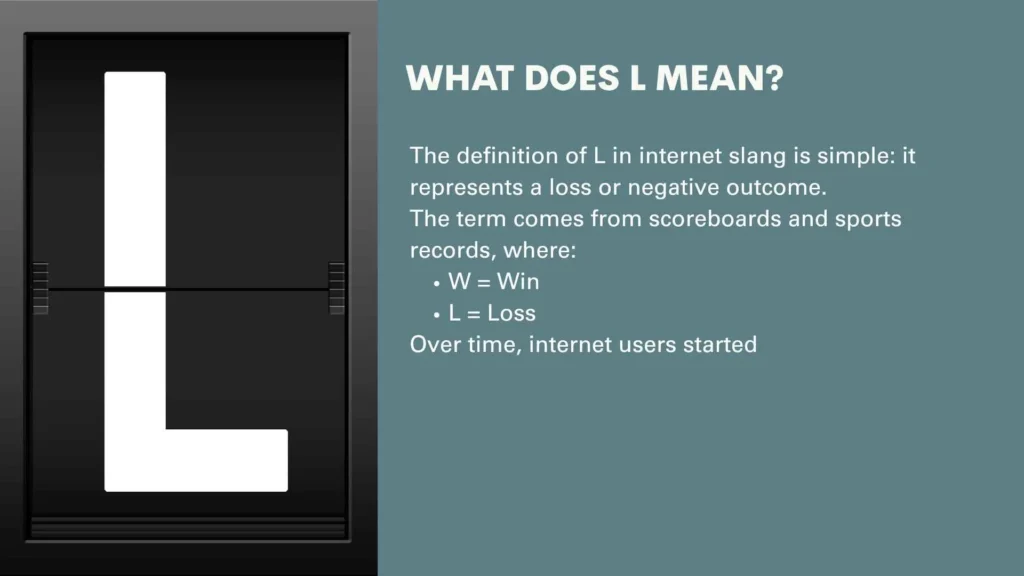
The definition of L in internet slang is simple: it represents a loss or negative outcome.
The term comes from scoreboards and sports records, where:
- W = Win
- L = Loss
Over time, internet users started using the single letter L to describe almost any type of failure, whether serious or humorous.
Simple Example
- Your favorite team loses a game → That’s an L.
- You miss your flight → That’s an L.
- You accidentally send a text to the wrong person → That’s an L.
Today, the meaning of L extends far beyond sports and is part of everyday online language.
Full Meaning in Simple Words
In simple English, L means something went wrong or someone failed at something.
It doesn’t always refer to a major problem. Sometimes people use it for small inconveniences and funny mistakes.
For example:
- Forgetting your homework
- Losing a video game
- Missing a bus
- Getting turned down on a date
- Making an embarrassing mistake
When someone says:
“I took an L today.”
They usually mean:
“I had a bad experience today.”
What Does L Mean in Text?
When used in texting, L usually means a loss, failure, or unfortunate event.
Because texting is fast, people often use a single letter instead of typing an entire sentence.
Text Message Examples
Friend: I forgot my wallet at home.
You: That’s an L.
Friend: I studied all night and still failed.
You: Tough L.
Friend: She left me on read.
You: Massive L.
In text conversations, L is often used jokingly rather than seriously.
What Does L Mean on Social Media?
Social media has helped make L one of the most popular slang terms online.
You’ll frequently see it on:
- TikTok
- Snapchat
- YouTube
- X (Twitter)
- Gaming communities
Users often post “L” in comments when reacting to mistakes, failures, or embarrassing moments.
What Does L Mean on TikTok?
On TikTok, L is commonly used in comments under videos showing:
- Failed challenges
- Awkward situations
- Bad decisions
- Embarrassing moments
TikTok Example
Video: Someone falls while attempting a dance trend.
Comments:
- “Huge L.”
- “Common L.”
- “That’s embarrassing.”
In this case, commenters are pointing out the failure humorously.
What Does L Mean on Instagram?
On Instagram, people use L in:
- Comments
- Stories
- DMs
- Meme pages
Instagram Example
Post: Someone shows a failed cooking attempt.
Comment: “Big L but at least you tried.”
Here, L refers to the unsuccessful result.
What Does L Mean on X (Twitter)?
On X, users often use L when discussing:
- Sports teams
- Celebrity controversies
- Online arguments
- Political debates
Example:
“Another L for that team this season.”
Platform-Based Examples
WhatsApp Chat Example
John: I missed my train again.
Mark: Bro, that’s a huge L.
John: Worst morning ever.
Instagram DM Example
Emma: I accidentally liked a photo from 2019.
Sarah: That’s definitely an L.
Emma: I’m so embarrassed.
TikTok Comment Example
Video: Someone drops their phone into a swimming pool.
Comment: “Massive L.”
Real-Life Meaning and Usage
Although L started as internet slang, many people now use it in face-to-face conversations.
You may hear friends say:
- “I took an L today.”
- “That exam was an L.”
- “Our team caught an L.”
The term is especially common among teenagers and young adults.
Real-Life Situations Where This Term Is Used
Sports
A team loses an important game.
Example:
“We took an L in the championship.”
Dating
Someone gets rejected.
Example:
“He took an L when she said no.”
School
A student performs poorly on a test.
Example:
“That math quiz was a complete L.”
Work
A project fails.
Example:
“The proposal turned into an L.”
Gaming
A player loses a match.
Example:
“Another L in ranked mode.”
Examples of L in Sentences
Here are common ways people use L in conversation:
- I forgot my presentation today and took an L.
- Our team caught a big L last night.
- Missing that opportunity was a huge L.
- He took the L and moved on.
- That’s the biggest L I’ve seen this week.
- I overslept and missed my interview—major L.
- She admitted her mistake and accepted the L.
- Getting rejected felt like an L at first.
- We took an unexpected L in the finals.
- That decision turned into a public L.
Different Contexts of L
Casual Conversations
Friends use L for everyday mistakes.
Example:
“You forgot your keys again? L.”
Gaming Culture
Gamers often use L after losing.
Example:
“We took the L.”
Sports Discussions
Fans use L to refer to losses.
Example:
“Another L for the home team.”
Online Discussions
Commenters use L to criticize poor decisions.
Example:
“That’s a rare L from him.”
Academic Context
L is rarely used in academic writing because it is informal slang.
Origin and History of the Term
The origin of L comes from traditional sports scorekeeping.
For decades:
- W represented a win.
- L represented a loss.
As online gaming became popular in the 1990s and 2000s, gamers adopted the terms.
Later, social media users expanded the meaning beyond sports and gaming.
Today, L can refer to:
- Losing
- Failing
- Embarrassing moments
- Rejections
- Bad decisions
Why Do People Use This Word?
People use L because it is:
- Short
- Easy to type
- Funny
- Relatable
- Widely understood online
Instead of writing:
“That was a disappointing outcome.”
People simply write:
“L.”
The message is instantly understood.
Emotional & Psychological Meaning Behind This Word
The popularity of L reflects how modern internet culture talks about failure.
People often use the term to:
- Laugh at mistakes
- Reduce embarrassment
- Connect with others
- Make setbacks feel less serious
In many cases, saying “I took an L” is a humorous way of accepting failure and moving forward.
Tone Explanation
Is L Formal or Informal?
L is considered highly informal slang.
Tone Breakdown
| Tone Type | Common? |
| Informal | Yes |
| Slang | Yes |
| Humorous | Very Common |
| Sarcastic | Sometimes |
| Formal | No |
Is It Rude to Say This Word?
Usually, no.
Most people use L jokingly.
However, it can become rude when used to mock someone else’s struggles or failures.
Usually Not Rude
- Talking about yourself
- Friendly jokes
- Sports discussions
Can Be Rude
- Bullying someone
- Public humiliation
- Mocking serious problems
Context matters.
Is This Word Positive, Negative, or Neutral?
The meaning of L is generally negative because it represents a loss or failure.
However, the tone can vary.
| Situation | Tone |
| Friendly joke | Neutral |
| Sports result | Neutral |
| Making fun of someone | Negative |
| Self-deprecating humor | Neutral |
When to Use L
Use L when:
- Talking with friends
- Commenting on social media
- Discussing sports
- Discussing gaming
- Referring to small failures
Examples
- “That was an L.”
- “Huge L.”
- “I took the L.”
When NOT to Use L
Avoid using L in:
- Business emails
- School essays
- Job interviews
- Professional presentations
- Formal communication
Formal alternatives include:
- Loss
- Mistake
- Setback
- Failure
Situations Where You Should Avoid Using This Word
You should avoid saying L when:
- Someone is grieving
- Discussing serious accidents
- Talking about illness
- Addressing clients
- Speaking in professional settings
Using slang in serious situations can seem insensitive.
L vs Similar Terms
| Term | Meaning | Common Usage | Key Difference |
| L | Loss or failure | Social media and texting | Most modern slang version |
| W | Win or success | Online slang | Opposite of L |
| Fail | Unsuccessful attempt | General conversation | More direct |
| Loss | Defeat | Formal and informal | Standard English |
| Fumble | Missed opportunity | Dating and social situations | More specific |
Possible Meanings and Variations of L
Depending on context, L can have different forms.
1. L
Basic loss or failure.
2. Take the L
Accept defeat gracefully.
3. Huge L
A major failure.
4. Big L
A significant setback.
5. Common L
A mistake someone frequently makes.
6. Rare L
An unusual failure from someone usually successful.
7. Unexpected L
A surprising loss.
8. Personal L
An individual mistake.
9. Public L
An embarrassing failure seen by many people.
10. Daily L
A small everyday setback.
How to Respond to L
Casual Replies
- “Yeah, I know.”
- “It happens.”
- “I’ll bounce back.”
- “That’s true.”
Funny Replies
- “The L chose me.”
- “Adding this to my collection of Ls.”
- “Professional L taker.”
- “I stay losing.”
Professional or Mature Replies
- “I’ll learn from it.”
- “Every setback teaches something.”
- “I’ll do better next time.”
- “It was a learning experience.”
Cultural Usage
USA and Western Usage
In the United States, L is extremely common among:
- Teenagers
- College students
- Gamers
- Sports fans
- Social media users
It is often paired with W.
Global Internet Usage
Thanks to social media, people worldwide understand the meaning of L.
It is commonly used in:
- Europe
- Asia
- South America
- Online gaming communities
- International meme culture
Frequently Asked Questions
What does L mean in slang?
L means loss, failure, defeat, or disappointment.
What does taking an L mean?
Taking an L means experiencing a setback, rejection, or failure.
What is the opposite of L?
The opposite is W, which stands for win.
What does huge L mean?
A huge L refers to a major mistake, embarrassment, or failure.
Is L an insult?
Sometimes. It depends on how it is used and who it is directed toward.
Why do gamers say L?
Gamers use L to represent losing a match or competition.
What does common L mean?
It refers to a mistake or failure that someone regularly makes.
Conclusion
Understanding what does L mean is important because it is one of the most common slang terms used online today. In most situations, L means “loss” and refers to a failure, setback, rejection, mistake, or embarrassing moment. Whether you see it in a text message, TikTok comment, Instagram post, gaming chat, or everyday conversation, the term is usually a quick and humorous way to describe something that didn’t go well. Knowing the meaning, tone, and proper usage of L will help you better understand modern internet culture and communicate more naturally online.