If you’re wondering what does digital mean, the simple answer is that digital refers to information, technology, devices, or communication that use electronic signals and computer-based systems instead of physical or analog methods. In today’s world, the word “digital” is used everywhere—from smartphones and social media to banking, education, and entertainment.
Understanding what does digital mean can help you better understand how modern technology works and why so much of our daily life now happens online.
Quick Meaning
Here are the most common meanings of digital:
- Technology-based: Related to computers, smartphones, and electronic devices.
- Online or internet-based: Connected to websites, apps, or online services.
- Electronic information: Data stored, processed, or shared electronically.
- Modern communication: Messages, media, and content delivered through digital platforms.
Digital means using electronic technology to create, store, process, or share information. It commonly refers to computers, smartphones, the internet, digital media, and online communication.
What Does Digital Mean?
The meaning of digital is closely connected to technology and electronic systems.
When something is digital, it exists in an electronic format rather than a physical one. For example:
- A printed photograph is physical.
- A photo stored on your phone is digital.
Similarly:
- A paper book is traditional.
- An eBook is digital.
Today, the term is often used to describe modern technologies that rely on computers, software, and internet connections.
Full Meaning in Simple Words
In simple language, digital means anything that uses electronic technology to work, store information, or communicate.
Think about your everyday activities:
- Sending a text message
- Watching videos online
- Using social media
- Shopping on websites
- Reading online articles
All of these are examples of digital activities.
A simple way to remember it is:
If it happens through a computer, smartphone, internet connection, or electronic device, it is usually digital.
What Does Digital Mean in Text?
When people use the word digital in text messages, they usually mean something online, electronic, or technology-related.
Example
Friend 1: “Did you submit the application?”
Friend 2: “Yes, I sent a digital copy.”
In this conversation, digital copy means an electronic version rather than a printed document.
Common Text Meanings
- Online version
- Electronic format
- Computer-based file
- Internet-related activity
What Does Digital Mean on Social Media (TikTok, Instagram, etc.)?
On social media, the word digital often refers to:
- Digital content
- Digital creators
- Digital marketing
- Digital art
- Digital products
Creators frequently use the term when discussing online businesses, technology, or internet-based careers.
WhatsApp Chat Example
Alex: “Can you send the contract?”
Jordan: “Sure, I’ll send the digital version.”
Instagram DM Example
User 1: “Did you buy the course?”
User 2: “Yes, it’s completely digital.”
TikTok Comment Example
Creator: “I sell digital planners online.”
Commenter: “That’s awesome! I love digital products.”
Real-Life Meaning and Usage
The word digital appears in many areas of daily life.
Examples include:
- Digital payments
- Digital banking
- Digital learning
- Digital marketing
- Digital photography
- Digital communication
Many services that once required physical interaction now operate digitally.
For example:
- Letters became emails.
- CDs became music streaming.
- Paper maps became GPS apps.
Real-Life Situations Where This Term Is Used
Education
Students use digital textbooks, online classes, and educational apps.
Business
Companies rely on digital marketing, websites, and cloud software.
Banking
People transfer money using digital banking platforms.
Entertainment
Movies, music, and games are often consumed digitally.
Healthcare
Doctors use digital records and telemedicine services.
Shopping
Consumers purchase digital products and shop online.
Examples of Digital in Sentences
Here are some examples:
- “The company switched to digital records last year.”
- “I downloaded a digital copy of the book.”
- “Digital marketing is important for modern businesses.”
- “She creates digital art using a tablet.”
- “Most banking transactions are now digital.”
- “The school introduced digital learning tools.”
- “Digital communication makes remote work easier.”
Different Contexts of Digital
The meaning of digital can vary slightly depending on context.
| Context | Meaning |
| Technology | Electronic systems and devices |
| Business | Online operations and marketing |
| Education | Electronic learning resources |
| Media | Content created or shared online |
| Communication | Electronic messaging and interaction |
| Finance | Online banking and payments |
Although the context changes, the core idea remains connected to electronic technology.
Origin and History of the Term
The word digital comes from the Latin word digitus, meaning “finger.”
Originally, the term related to counting using fingers.
As technology evolved, engineers began using the word digital to describe systems that process information using numbers, especially binary numbers (0s and 1s).
The rise of computers in the twentieth century transformed digital into one of the most important words in technology.
Today, we live in what many people call the Digital Age.
Why Do People Use This Word?
People use the word digital because it quickly describes technology-based activities and systems.
Reasons include:
- It is easy to understand.
- It distinguishes electronic formats from physical ones.
- It reflects modern technology.
- It describes online communication and services.
The term has become a major part of everyday language.
Emotional & Psychological Meaning Behind This Word
The word digital often carries emotional associations.
For many people, it represents:
Convenience
Digital tools save time and effort.
Innovation
The term often suggests progress and modernization.
Connectivity
Digital technology helps people stay connected globally.
Efficiency
Digital systems can automate tasks and improve productivity.
However, some people also associate digital life with:
- Screen fatigue
- Information overload
- Reduced face-to-face interaction
Because of this, the emotional meaning can be both positive and negative depending on personal experiences.
Tone Explanation
Is Digital Formal or Informal?
The word digital works in both formal and informal settings.
Formal Usage
- Business reports
- Academic writing
- Professional presentations
- Government documents
Informal Usage
- Social media posts
- Text messages
- Everyday conversations
Tone Characteristics
- Neutral
- Professional
- Modern
- Informative
Is It Rude to Say This Word?
No.
The word digital is completely neutral and appropriate in nearly every situation.
It is not:
- Offensive
- Insulting
- Vulgar
- Rude
People use it regularly in schools, workplaces, and casual conversations.
Is This Word Positive, Negative, or Neutral?
Generally, digital is considered neutral.
Positive Associations
- Innovation
- Convenience
- Speed
- Accessibility
Negative Associations
- Privacy concerns
- Excessive screen time
- Technology dependence
Overall Classification
Most people view the term as neutral to positive.
When to Use Digital
Use the word digital when discussing:
- Technology
- Computers
- Online services
- Electronic documents
- Internet communication
- Modern business systems
Examples
- Digital marketing
- Digital payments
- Digital learning
- Digital products
- Digital content
When NOT to Use Digital
Avoid using digital when referring exclusively to physical or non-electronic items.
For example:
- A handwritten letter is not digital.
- A printed newspaper is not digital.
- A physical painting is not digital unless it was created electronically.
Situations Where You Should Avoid Using This Word
You may want to avoid unnecessary use of digital when:
- The technology aspect is irrelevant.
- Simpler wording is clearer.
- The audience may not understand technical language.
In many cases, saying “online” or “electronic” may be easier for some audiences.
Comparison Table: Digital vs Similar Terms
| Term | Meaning | Usage | Key Difference |
| Digital | Electronic and computer-based | Technology, business, media | Broadest technology term |
| Online | Connected to the internet | Websites and web services | Requires internet access |
| Electronic | Powered by electricity | Devices and systems | Broader than internet-based tools |
| Virtual | Existing in a digital environment | Meetings, events, worlds | Focuses on simulated experiences |
| Analog | Traditional non-digital systems | Audio, equipment, media | Opposite of digital |
Variations and Related Meanings of Digital
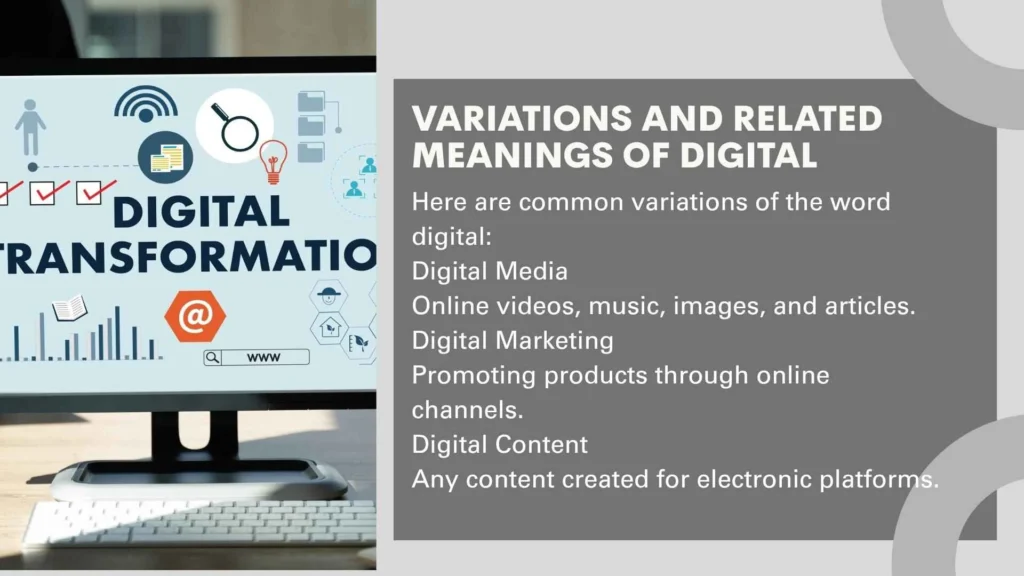
Here are common variations of the word digital:
Digital Media
Online videos, music, images, and articles.
Digital Marketing
Promoting products through online channels.
Digital Content
Any content created for electronic platforms.
Digital Product
Downloadable goods like eBooks or templates.
Digital Art
Artwork created using technology.
Digital Communication
Emails, texts, video calls, and messaging.
Digital Transformation
Businesses adopting modern technology.
Digital Currency
Electronic forms of money.
Digital Literacy
The ability to use technology effectively.
Digital Identity
A person’s online presence and information.
How to Respond When Someone Uses the Word Digital
Casual Replies
- “That makes sense.”
- “Everything is digital these days.”
- “Technology keeps changing fast.”
Funny Replies
- “If it’s not digital, does it even exist anymore?”
- “My entire life is basically digital now.”
- “I think even my coffee is going digital.”
Professional or Mature Replies
- “Digital solutions can improve efficiency.”
- “That’s a smart use of technology.”
- “The digital approach seems more practical.”
USA / Western Usage
In the United States and many Western countries, digital is used constantly in everyday life.
Common phrases include:
- Digital marketing
- Digital payments
- Digital media
- Digital education
- Digital business
The word is strongly associated with innovation and technological advancement.
Global or Internet Usage Differences
Around the world, the meaning of digital remains mostly the same.
However, usage may vary based on technology adoption and internet access.
In online communities, digital can also refer to:
- Digital careers
- Digital entrepreneurship
- Digital products
- Digital nomad lifestyles
Despite regional differences, the core meaning remains technology-focused.
What Does Digital Mean in Text?
To summarize:
When someone says digital in a text message, they usually mean:
- Electronic
- Online
- Computer-based
- Internet-related
There is usually no hidden slang meaning.
What Does Digital Mean on TikTok / Instagram?
On TikTok and Instagram, digital often refers to:
- Digital products
- Digital art
- Digital businesses
- Digital marketing
- Digital content creation
Creators frequently use the word when discussing ways to earn money online or build an internet-based brand.
Is It Rude to Say This?
No.
Digital is a neutral and professional word that can be used in virtually any conversation.
Why Do People Use This Word?
People use the word digital because it:
- Describes modern technology clearly.
- Separates electronic formats from physical ones.
- Helps explain online activities.
- Reflects today’s connected world.
It is one of the most important technology-related words in modern English.
Frequently Asked Questions
What does digital mean in simple words?
Digital means using electronic technology such as computers, smartphones, software, or the internet.
What is a digital product?
A digital product is something sold electronically, such as an eBook, template, software program, or online course.
What does digital mean in technology?
In technology, digital refers to information processed, stored, or transmitted electronically.
What is the difference between digital and online?
Digital refers to electronic technology in general, while online specifically means connected to the internet.
What does digital mean in business?
It refers to technology-driven operations, marketing, communication, and services.
Is a PDF a digital document?
Yes. A PDF is a digital file because it exists electronically rather than on paper.
Why is everything becoming digital?
Digital systems are often faster, cheaper, easier to access, and more efficient than traditional physical methods.
Conclusion
Understanding what does digital mean is essential in today’s technology-driven world. Simply put, digital refers to information, services, communication, or products that operate through electronic devices and computer systems. From digital banking and online learning to social media and digital marketing, the term touches nearly every part of modern life.
Whether you’re reading about digital products, digital communication, or digital technology, the core idea remains the same: using electronic systems to create, store, share, or process information. As technology continues to evolve, the meaning and importance of digital will only continue to grow.

James Parker is a passionate writer and language enthusiast dedicated to helping readers understand words, meanings, and communication in a simple and effective way. With years of experience in educational writing and vocabulary research, he creates easy-to-understand content that helps students, learners, and readers improve their language skills.
At MeanNings.com, James focuses on providing accurate word meanings, English vocabulary, synonyms, antonyms, and practical language guides. His writing style is clear, informative, and designed for readers of all levels.
James believes that learning language should be simple, engaging, and accessible to everyone. Through his work, he aims to make complex words easier to understand and help readers build confidence in communication.
Books by James Parker
- The Power of Words
- Mastering Everyday Vocabulary
- English Meanings Simplified
 Daniel Brooks