If you’re wondering what sarcastic means, the simple answer is this: being sarcastic means saying something that is different from—or opposite of—what you actually mean, usually to be funny, critical, or mocking. The real meaning is understood through your tone of voice or the situation.
Quick Meaning
- Sarcastic = Saying the opposite of what you really mean.
- Often used to express humor, irony, or criticism.
- Can be playful among friends or hurtful if meant to insult.
- Tone and context are important to understand sarcasm.
A sarcastic person uses words that mean the opposite of their true feelings, often to make a joke or point out something in a clever or critical way.
What Does Sarcastic Mean?
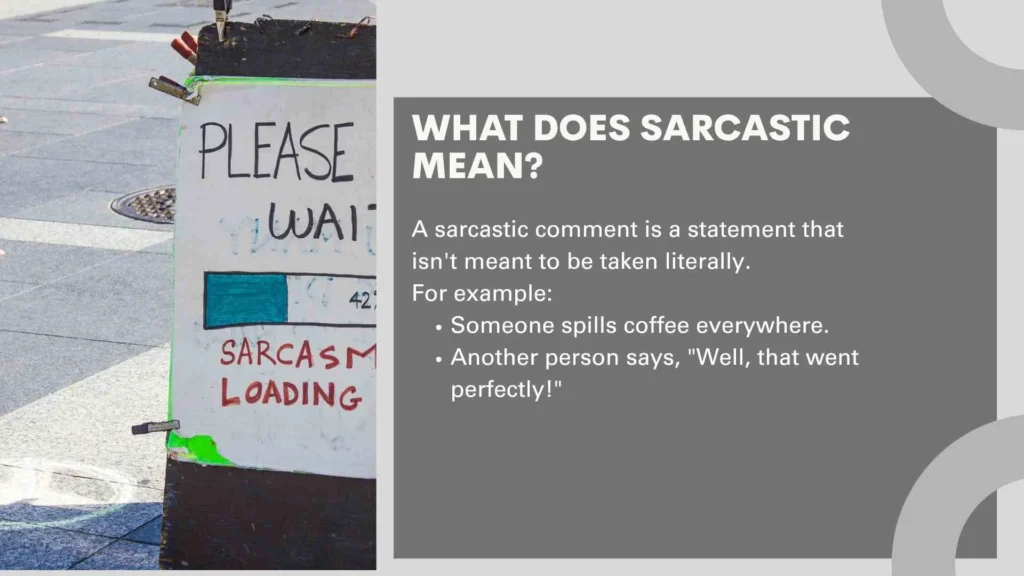
A sarcastic comment is a statement that isn’t meant to be taken literally.
For example:
- Someone spills coffee everywhere.
- Another person says, “Well, that went perfectly!”
They don’t actually think it went perfectly—they’re pointing out the opposite in a humorous or critical way.
Full Meaning in Simple Words
In simple English, sarcastic means:
- Saying one thing but meaning another.
- Using irony to make a joke or criticize something.
- Speaking in a way that shows you don’t really believe what you’re saying.
Sarcasm often depends on:
- Tone of voice
- Facial expressions
- The situation
Without those clues, sarcasm can sometimes be misunderstood.
What Does Sarcastic Mean in Text?
Sarcasm can be harder to recognize in text messages because you can’t hear someone’s tone.
People often use:
- 🙄
- 😏
- 😂
- “/s” (meaning “this is sarcasm”)
WhatsApp Chat Example
Alex: My phone battery died during the meeting.
Chris: Great timing! 🙄
Here, “Great timing!” is sarcastic because the situation was actually bad.
What Does Sarcastic Mean on Social Media (TikTok, Instagram, etc.)?
On social media, sarcasm is common in:
- Funny memes
- TikTok videos
- Instagram captions
- X (Twitter) posts
- Comments
Instagram DM Example
Friend: I forgot my wallet again.
You: You’re really organized today. 😂
TikTok Comment Example
Video: Someone burns dinner.
Comment: MasterChef is calling! 😂
The comment is sarcastic because the cooking clearly didn’t go well.
Real-Life Meaning and Usage
People use sarcasm to:
- Make jokes
- Lighten the mood
- Express frustration
- Point out mistakes
- Tease friends
Some people use sarcasm frequently as part of their personality, while others rarely use it.
Real-Life Situations Where This Word Is Used
You might hear sarcasm:
- Between friends joking around.
- In comedy shows.
- At school.
- At work (carefully).
- In movies and TV shows.
- On social media.
Examples of “Sarcastic” in Sentences
- She made a sarcastic comment about the weather.
- His sarcastic joke made everyone laugh.
- Don’t take her words literally—she’s being sarcastic.
- The teacher didn’t appreciate the student’s sarcastic reply.
- He smiled after making a sarcastic remark.
Different Contexts of Sarcastic
| Context | Meaning |
| Casual conversation | Playful teasing or humor |
| Workplace | Can seem unprofessional if overused |
| School | Often used among classmates |
| Social media | Common in memes and jokes |
| Comedy | A popular style of humor |
Origin and History of the Word
The word sarcastic comes from the Greek word sarkazein, which means “to tear flesh.”
Over time, its meaning changed to describe speech that is sharp, cutting, or mocking rather than physically harmful.
Today, sarcasm usually refers to verbal irony rather than cruelty.
Why Do People Use This Word?
People use sarcasm to:
- Be funny.
- Express disappointment.
- Show frustration.
- Point out something obvious.
- Make criticism sound clever.
Emotional & Psychological Meaning Behind Sarcasm
Sarcasm can express:
- Humor
- Annoyance
- Disappointment
- Intelligence
- Frustration
- Affection (between close friends)
Whether it feels funny or hurtful depends on the relationship and context.
Tone Explanation
Formal
Generally avoided in formal writing and professional communication.
Informal
Very common among friends and family.
Slang
No. “Sarcastic” is a standard English word, not slang.
Offensive
It can be offensive if used to insult or embarrass someone.
Is It Rude to Say This Word?
No. The word sarcastic itself isn’t rude.
However, being sarcastic can sometimes sound rude if the comment mocks or hurts someone.
Is This Word Positive, Negative, or Neutral?
The word itself is neutral.
Its effect depends on how it’s used:
- Positive when it’s playful and funny.
- Negative when it’s mean or disrespectful.
When to Use “Sarcastic”
Use it when describing:
- Ironical jokes.
- Mocking comments.
- Clever humor.
- Verbal irony.
When NOT to Use “Sarcastic”
Avoid sarcasm:
- During serious conversations.
- With people who may misunderstand your tone.
- In professional emails.
- When discussing sensitive topics.
Comparison Table
| Word | Meaning | Usage | Key Difference |
| Sarcastic | Saying the opposite of what you mean | Humor or criticism | Often has a mocking tone |
| Ironic | Something unexpected or opposite | Writing and conversation | Doesn’t always involve humor |
| Witty | Clever and funny | Conversation | Usually positive |
| Mocking | Making fun of someone | Criticism | More openly insulting |
Variations and Related Terms
- Sarcasm – The noun form.
- Sarcastic – The adjective.
- Sarcastically – The adverb.
- Dry humor – Humor delivered seriously.
- Irony – Saying or showing the opposite of expectations.
- Satire – Humor used to criticize society.
- Wit – Clever humor.
- Snarky – Sharply critical or sarcastic.
- Deadpan – Delivering jokes with a serious expression.
- Tongue-in-cheek – Not meant to be taken seriously.
How to Respond to Sarcasm
Casual Replies
- Nice one!
- Very funny.
- I get what you mean.
- Good joke.
Funny Replies
- Tell me how you really feel!
- Thanks for the “support.” 😂
- Ouch—that was sarcastic!
Professional Replies
- I understand your concern.
- Let’s focus on solving the problem.
- Could you explain what you mean directly?
Cultural Usage
USA / Western Usage
Sarcasm is common in American conversations, TV shows, movies, and stand-up comedy. Many people use it with friends as a form of humor.
Global or Internet Usage
Not every culture uses sarcasm the same way. In some countries, sarcastic comments may be taken literally or considered impolite. Online, emojis and “/s” are often used to show that a message is sarcastic.
FAQs
What does sarcastic mean in slang?
“Sarcastic” isn’t slang. It’s a standard English word that describes a style of speaking using irony or mockery.
What does sarcastic mean in text?
It means someone is joking or saying the opposite of what they really mean.
Is sarcasm always rude?
No. It can be playful and funny, but it can also sound rude if it’s intended to criticize or embarrass someone.
Why do people use sarcasm?
People use sarcasm to joke, express frustration, make a point, or add humor to a conversation.
How can I tell if someone is being sarcastic?
Look at the context, tone (if spoken), emojis (if written), and whether the statement seems intentionally opposite to reality.
Is sarcasm the same as irony?
Not exactly. Sarcasm is a type of verbal irony that usually includes humor or criticism.
Conclusion
Understanding what sarcastic means helps you communicate more effectively in everyday conversations, text messages, and social media. Sarcasm involves saying the opposite of what you really mean, often to be humorous, ironic, or critical. While it can make conversations entertaining, it’s important to use it carefully, since not everyone interprets sarcasm the same way.

James Parker is a passionate writer and language enthusiast dedicated to helping readers understand words, meanings, and communication in a simple and effective way. With years of experience in educational writing and vocabulary research, he creates easy-to-understand content that helps students, learners, and readers improve their language skills.
At MeanNings.com, James focuses on providing accurate word meanings, English vocabulary, synonyms, antonyms, and practical language guides. His writing style is clear, informative, and designed for readers of all levels.
James believes that learning language should be simple, engaging, and accessible to everyone. Through his work, he aims to make complex words easier to understand and help readers build confidence in communication.
Books by James Parker
- The Power of Words
- Mastering Everyday Vocabulary
- English Meanings Simplified
 Daniel Brooks