
What Does Amplitude Mean?
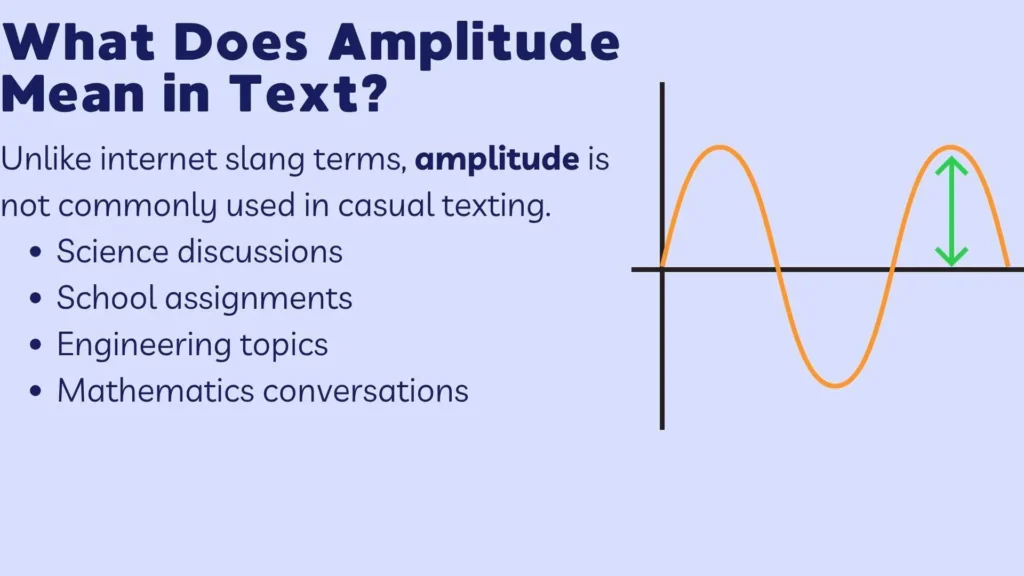
Amplitude means the maximum size, strength, height, or extent of something, especially a wave, signal, movement, or vibration. In science, it refers to how far a wave moves from its normal position. In everyday language, amplitude can also describe the intensity or magnitude of something.
If you’ve been asking what does amplitude mean, the simplest answer is that it measures how big, strong, high, or intense something is.
Quick Meaning
Here are the most common meanings of amplitude:
- In physics: The maximum height or strength of a wave from its center position.
- In sound: The loudness or intensity of a sound wave.
- In electronics: The strength of a signal.
- In general use: The size, extent, or magnitude of something.
Amplitude means the maximum amount by which a wave, signal, or movement differs from its normal position. It is often used to describe the strength, intensity, or size of something.
What Does Amplitude Mean? (Clear and Simple Definition)
The meaning of amplitude depends on the context, but the core idea remains the same.
Amplitude describes how large or powerful something is compared to its normal or resting state.
For example:
- A loud sound has greater amplitude than a quiet sound.
- A large ocean wave has a greater amplitude than a small ripple.
- A strong electrical signal has a higher amplitude than a weak one.
Simply put, amplitude tells us how much movement, energy, or intensity exists.
Full Meaning in Simple Words
In simple words, amplitude is a measurement of size or strength.
Imagine swinging on a playground swing.
- Small swings forward and backward have low amplitude.
- Large swings forward and backward have high amplitude.
The same concept applies to waves, sounds, vibrations, and signals.
The greater the amplitude, the larger or stronger the movement tends to be.
What Does Amplitude Mean in Text?
Unlike internet slang terms, amplitude is not commonly used in casual texting.
When it does appear in text messages, it is usually related to:
- Science discussions
- School assignments
- Engineering topics
- Mathematics conversations
Text Example
Student A: “What’s the amplitude of this graph?”
Student B: “It’s 5 because the wave reaches 5 units above the center line.”
Here, amplitude refers to the height of a wave.
Sometimes people use it figuratively:
“The amplitude of his excitement was obvious.”
This means his excitement was very strong.
What Does Amplitude Mean on Social Media (TikTok, Instagram, etc.)?
On social media, amplitude is relatively uncommon compared to slang words.
However, it may appear in:
- Science content
- Educational videos
- Music production discussions
- Technology posts
Creators sometimes use it metaphorically to describe intensity or energy.
For example:
“The amplitude of the crowd’s reaction was incredible.”
This means the reaction was extremely strong.
WhatsApp Chat Example
Alex: “Why is the speaker so loud?”
Sam: “The audio amplitude is turned up too high.”
Meaning: The sound signal has greater strength.
Instagram DM Example
Friend: “This music hits hard.”
You: “Yeah, the amplitude is much higher than the last version.”
Meaning: The sound is stronger and louder.
TikTok Comment Example
Video: A science experiment showing waves.
Comment: “The amplitude keeps increasing!”
Meaning: The wave height is getting larger.
Real-Life Meaning and Usage
Amplitude is used in many real-world situations.
Sound
Amplitude affects how loud a sound is.
- Low amplitude = quiet sound
- High amplitude = loud sound
Ocean Waves
Scientists measure wave amplitude to study oceans and weather.
Music Production
Audio engineers adjust amplitude to control volume.
Earthquakes
Seismic waves have amplitudes that help indicate earthquake strength.
Electronics
Engineers use amplitude to measure signal strength.
Real-Life Situations Where This Term Is Used
You may hear the word amplitude in:
- Science classrooms
- Physics labs
- Engineering projects
- Music studios
- Audio editing software
- Medical equipment
- Earthquake research
- Telecommunications
Although it’s a technical term, its basic idea of “strength” or “size” applies everywhere.
Examples of Amplitude in Sentences
Here are some examples:
- The wave’s amplitude increased during the storm.
- Higher amplitude usually means louder sound.
- Scientists measured the amplitude of the earthquake waves.
- The graph shows an amplitude of 10 units.
- The signal amplitude became weaker over distance.
- Audio engineers adjusted the amplitude for better sound quality.
- The experiment compared waves with different amplitudes.
Different Contexts of Amplitude
| Context | Meaning |
| Physics | Height of a wave from its center |
| Mathematics | Distance from the midline to a peak |
| Sound | Loudness or signal strength |
| Engineering | Strength of a signal |
| Medicine | Size of electrical activity |
| Everyday Language | Magnitude or intensity |
Origin and History of the Term
The word amplitude comes from the Latin word amplitudo, meaning:
- Size
- Breadth
- Extent
- Magnitude
The term became widely used in science during the development of wave theory and physics.
Over time, it expanded into fields such as:
- Mathematics
- Engineering
- Electronics
- Music technology
Today, amplitude remains an important scientific measurement.
Why Do People Use This Word?
People use amplitude because it provides a precise way to describe size, intensity, or strength.
Instead of saying:
- Very big
- Very strong
- Very loud
Scientists and engineers use amplitude to communicate accurately.
The term helps explain:
- Sound volume
- Wave height
- Signal strength
- Vibrational intensity
Emotional & Psychological Meaning Behind This Word
Although amplitude is primarily a scientific term, people sometimes use it metaphorically.
Examples include:
- Amplitude of emotion
- Amplitude of excitement
- Amplitude of enthusiasm
In these cases, amplitude refers to emotional intensity.
For example:
“The amplitude of the crowd’s excitement was huge.”
This means the excitement was extremely strong.
Psychologically, people often associate higher amplitude with greater energy and impact.
Tone Explanation
The tone of amplitude is generally:
| Tone Type | Applicable? |
| Formal | Yes |
| Academic | Yes |
| Technical | Yes |
| Informal | Sometimes |
| Slang | No |
| Offensive | No |
The word is most commonly used in educational and professional settings.
Is It Rude to Say This Word?
No.
Amplitude is a neutral scientific and mathematical term.
It is not offensive, rude, or inappropriate in any normal context.
Is This Word Positive, Negative, or Neutral?
Neutral
Amplitude itself has no emotional value.
| Type | Rating |
| Positive | Sometimes |
| Neutral | ✓ Mostly |
| Negative | Sometimes |
The context determines whether high amplitude is viewed positively or negatively.
Examples:
- Loud music at a concert = positive.
- Excessive noise at night = negative.
When to Use Amplitude
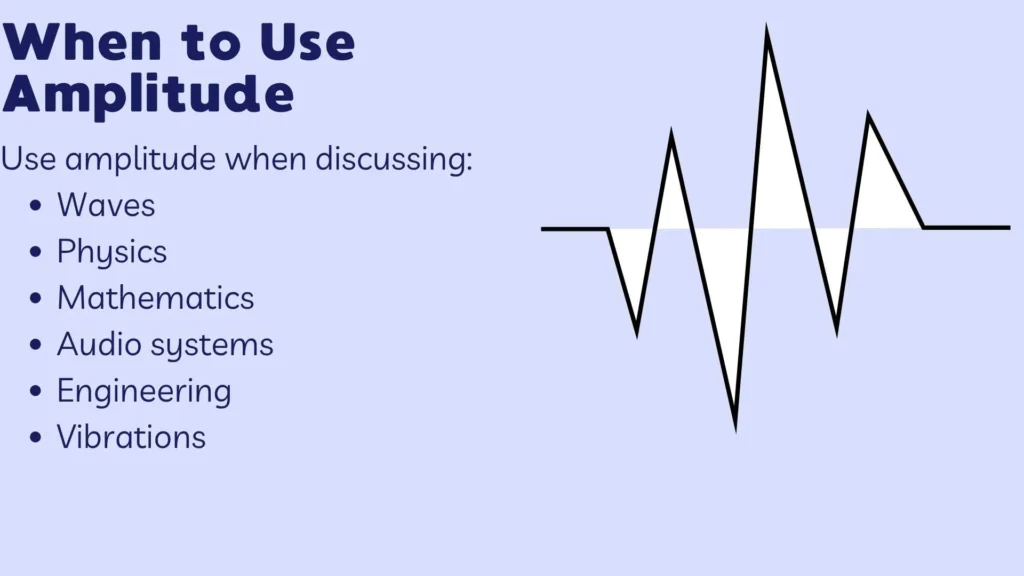
Use amplitude when discussing:
- Waves
- Physics
- Mathematics
- Audio systems
- Engineering
- Vibrations
- Signal processing
- Earthquakes
Examples:
- “The amplitude of the sound increased.”
- “Find the amplitude of the graph.”
- “The signal amplitude is too weak.”
When NOT to Use Amplitude
Avoid using amplitude when:
- Simpler words work better.
- Your audience lacks technical knowledge.
- You mean frequency instead of size.
- You are discussing unrelated topics.
For casual conversations, words like “strength,” “size,” or “intensity” may be easier to understand.
Situations Where You Should Avoid Using This Word
Examples include:
- Informal chats where technical language is unnecessary.
- Conversations with young children unfamiliar with scientific terms.
- Situations where simpler language improves clarity.
Using plain language is often more effective outside technical settings.
Amplitude vs Similar Terms
| Term | Meaning | Usage | Key Difference |
| Amplitude | Maximum size or strength | Waves, sound, signals | Measures height or intensity |
| Frequency | Number of cycles | Physics, sound | Measures repetition rate |
| Magnitude | Overall size | Science, math | Broader measurement |
| Intensity | Strength of effect | Sound, light | Focuses on power |
| Volume | Loudness of sound | Audio | Refers specifically to perceived sound level |
Variations and Related Meanings of Amplitude
Depending on the field, amplitude may have different forms.
1. Wave Amplitude
Height of a wave from its center position.
2. Sound Amplitude
Determines loudness.
3. Signal Amplitude
Strength of an electrical signal.
4. Voltage Amplitude
Maximum voltage level.
5. Seismic Amplitude
Strength of earthquake waves.
6. Mathematical Amplitude
Distance from the graph’s midline to its peak.
7. Vibration Amplitude
Amount of movement in a vibration.
8. Peak Amplitude
Highest point reached.
9. Pulse Amplitude
Strength of a pulse signal.
10. Emotional Amplitude
Figurative use meaning emotional intensity.
How to Respond When Someone Mentions Amplitude
Casual Replies
- “That makes sense.”
- “So it’s basically the strength?”
- “Got it, thanks.”
Funny Replies
- “My math amplitude is currently zero!”
- “The amplitude of my confusion just increased.”
- “Sounds like a very loud problem.”
Professional or Mature Replies
- “Thank you for the explanation.”
- “The amplitude measurement appears accurate.”
- “That helps clarify the data.”
Cultural Usage of Amplitude
USA / Western Usage
In the United States and other Western countries, amplitude is mainly used in:
- Schools
- Universities
- Engineering
- Technology industries
- Audio production
Most people encounter the term in science or math classes.
Global and Internet Usage
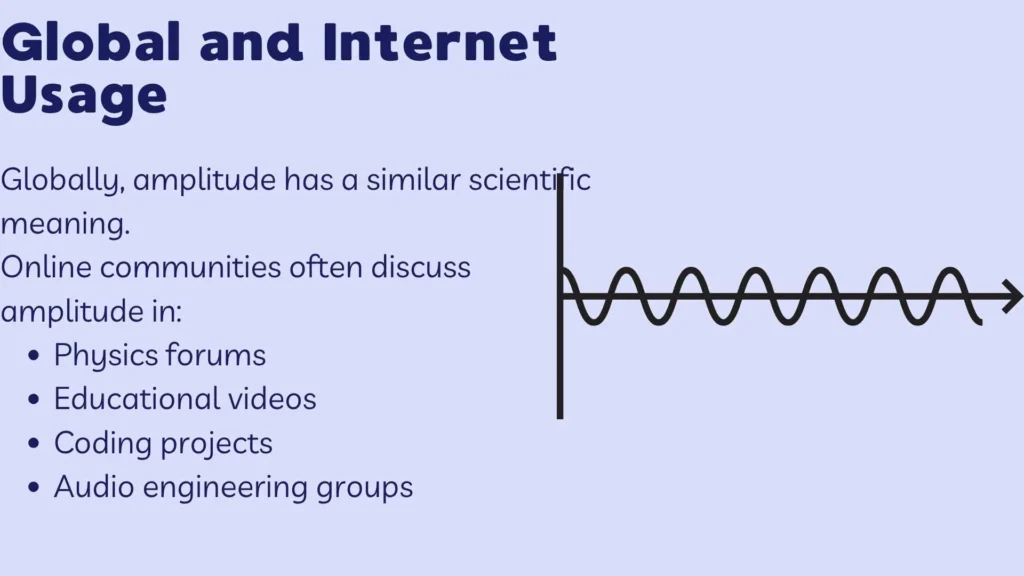
Globally, amplitude has a similar scientific meaning.
Online communities often discuss amplitude in:
- Physics forums
- Educational videos
- Coding projects
- Audio engineering groups
Its meaning remains consistent across countries.
What Does Amplitude Mean in Text?
In text messages, amplitude usually refers to:
- Wave height
- Signal strength
- Sound intensity
- Scientific measurements
Unlike slang terms, it rarely has a hidden meaning.
What Does Amplitude Mean on TikTok / Instagram?
On TikTok and Instagram, amplitude usually appears in:
- Science education content
- Audio production videos
- Technology tutorials
- Engineering discussions
It generally retains its scientific definition.
Is It Rude to Say This?
No.
Amplitude is a completely neutral technical word and is appropriate in academic, professional, and casual educational conversations.
Why Do People Use This Word?
People use amplitude because it accurately describes:
- Strength
- Height
- Magnitude
- Loudness
- Signal power
It provides a precise measurement rather than a vague description.
Frequently Asked Questions (FAQs)
1. What does amplitude mean in simple words?
Amplitude means the size, strength, or height of a wave, signal, vibration, or movement.
2. What does amplitude mean in physics?
In physics, amplitude is the maximum distance a wave moves from its center position.
3. What does amplitude mean in math?
In mathematics, amplitude is the distance from a graph’s midline to its highest or lowest point.
4. Does higher amplitude mean louder sound?
Yes. Higher amplitude generally produces louder sound waves.
5. What is the difference between amplitude and frequency?
Amplitude measures size or strength, while frequency measures how often a wave repeats.
6. Is amplitude positive or negative?
Amplitude is usually expressed as a positive value because it measures distance from a central position.
7. Why is amplitude important?
Amplitude helps scientists, engineers, and mathematicians measure strength, energy, and intensity accurately.
Conclusion
If you’re wondering what does amplitude mean, the simplest answer is that amplitude measures the maximum size, strength, height, or intensity of a wave, signal, vibration, or movement. It is an important concept in physics, mathematics, sound engineering, electronics, and many other fields.
Whether you’re studying waves in science class, analyzing sound in music production, or learning about signals in, understanding amplitude helps you better understand how strong or powerful something is. In everyday terms, amplitude is simply a way of measuring how big, loud, strong, or intense something becomes.

James Parker is a passionate writer and language enthusiast dedicated to helping readers understand words, meanings, and communication in a simple and effective way. With years of experience in educational writing and vocabulary research, he creates easy-to-understand content that helps students, learners, and readers improve their language skills.
At MeanNings.com, James focuses on providing accurate word meanings, English vocabulary, synonyms, antonyms, and practical language guides. His writing style is clear, informative, and designed for readers of all levels.
James believes that learning language should be simple, engaging, and accessible to everyone. Through his work, he aims to make complex words easier to understand and help readers build confidence in communication.
Books by James Parker
- The Power of Words
- Mastering Everyday Vocabulary
- English Meanings Simplified
 Daniel Brooks