Reassurance means giving someone comfort, confidence, or support when they feel worried, uncertain, nervous, or afraid. It helps a person feel calmer and more secure about a situation. Reassurance can come through words, actions, or even a simple gesture that lets someone know everything is okay.
If you have ever told a friend, “Don’t worry, you’ll do great,” you were providing reassurance. Understanding what does reassurance mean can help improve communication, relationships, and emotional well-being.
What Does Reassurance Mean?(Quick Meaning)
Here are the most common meanings of reassurance:
- Comfort given to reduce worry or fear
- Words or actions that increase confidence
- Support that helps someone feel secure
- Confirmation that a situation is under control
These meanings are commonly used in everyday conversations, relationships, workplaces, schools, and online communication.
What Does Reassurance Mean? (Clear and Simple Definition)
In simple terms, reassurance is the act of helping someone feel less anxious or uncertain.
People seek reassurance when they:
- Feel nervous about something
- Need emotional support
- Want confirmation that things will be okay
- Are unsure about a decision
For example:
“Your presentation is well-prepared. You’ll do fine.”
This statement reassures someone who is feeling nervous.
Reassurance in Relationship
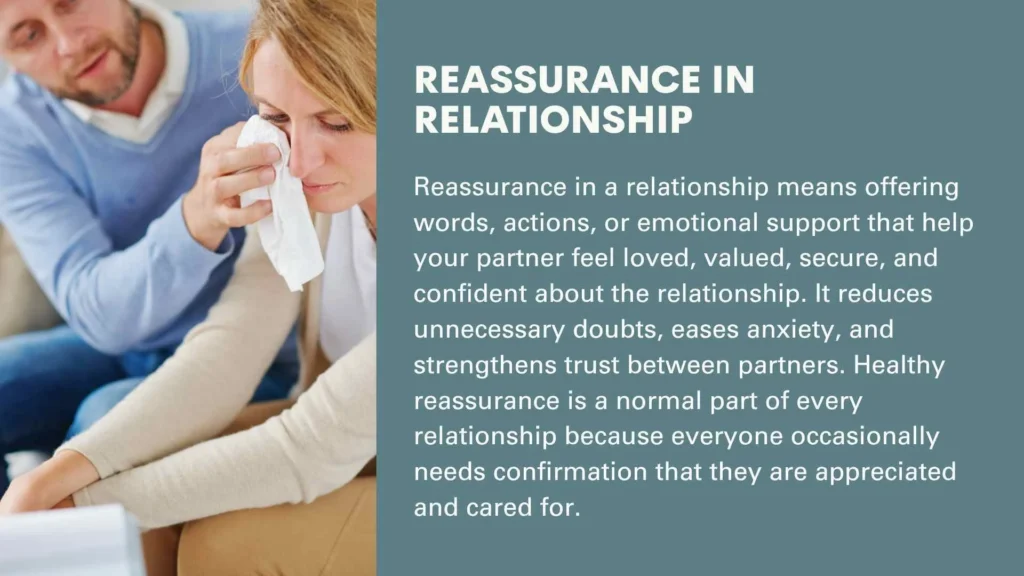
Reassurance in a relationship means offering words, actions, or emotional support that help your partner feel loved, valued, secure, and confident about the relationship. It reduces unnecessary doubts, eases anxiety, and strengthens trust between partners. Healthy reassurance is a normal part of every relationship because everyone occasionally needs confirmation that they are appreciated and cared for.
Reassurance can be verbal, physical, or shown through consistent behavior. Saying “I love you,” expressing appreciation, spending quality time together, or following through on promises are all forms of reassurance. These actions help build emotional security and deepen intimacy.
People may seek reassurance for different reasons, including past relationship experiences, stress, or personal insecurities. While giving reassurance is healthy, relying on it constantly may signal underlying trust or self-esteem issues that should be addressed together.
Examples of reassurance in a relationship include:
- Telling your partner, “I’m here for you no matter what.”
- Sending a thoughtful message before an important event.
- Keeping promises and communicating honestly during disagreements.
- Offering a hug or holding hands when your partner feels anxious.
For example, if your partner worries about an upcoming job interview, reassuring them by saying, “You’ve prepared well, and I believe in you,” can boost their confidence. Similarly, after an argument, reminding your partner that the disagreement does not change your love for them helps restore emotional safety.
Healthy reassurance creates stronger communication, mutual trust, and a lasting emotional connection. It should come naturally from care and respect rather than fear or obligation.
Reassurance Synonym
A reassurance synonym is a word or phrase that expresses the idea of giving comfort, confidence, encouragement, or relief from worry. The best synonym depends on the context in which the word is used.
Common synonyms for reassurance include:
- Comfort
- Encouragement
- Confidence
- Support
- Consolation
- Relief
- Hope
- Confidence-building
- Peace of mind
- Emotional support
- Assurance (in some contexts)
Although these words are similar, they are not always interchangeable. For example, comfort focuses on reducing emotional pain, while encouragement motivates someone to keep going. Support refers to helping someone emotionally or practically, whereas assurance often means giving a firm promise or guarantee.
Here are a few examples:
- Her kind words gave me comfort during a difficult time.
- His encouragement helped me finish the project.
- The doctor’s explanation provided reassurance before the surgery.
- Your support means a lot to me.
Choosing the right synonym depends on what you want to express. If someone is anxious, comfort or peace of mind may be the best choice. If they lack confidence, encouragement or confidence may fit better. In formal writing, assurance and confidence are often appropriate, while comfort and support sound more natural in everyday conversations.
Understanding these subtle differences helps you communicate more clearly and accurately in both personal and professional situations.
Reassurance Medical Meaning
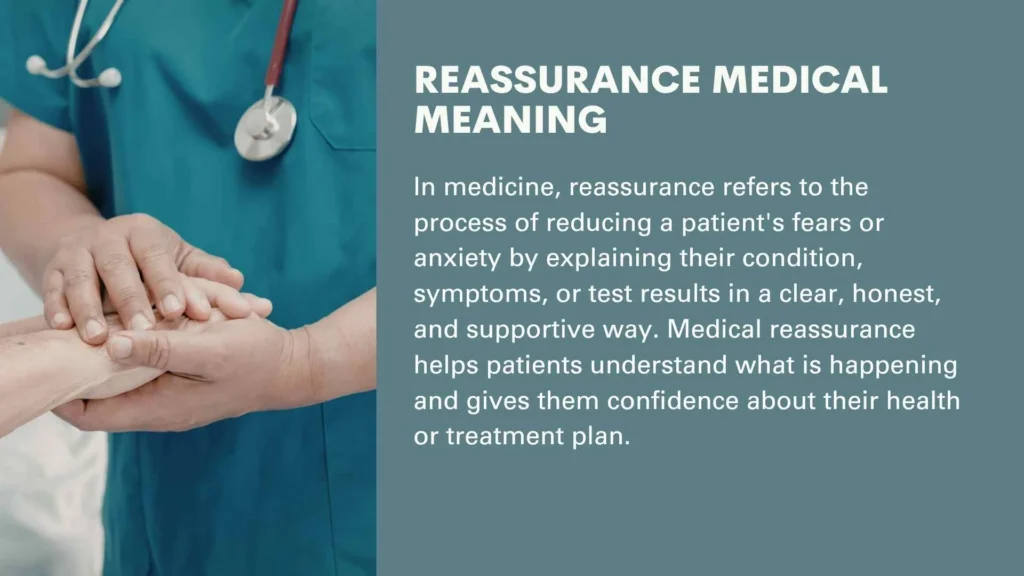
In medicine, reassurance refers to the process of reducing a patient’s fears or anxiety by explaining their condition, symptoms, or test results in a clear, honest, and supportive way. Medical reassurance helps patients understand what is happening and gives them confidence about their health or treatment plan.
Healthcare professionals provide reassurance after evaluating a patient’s symptoms and determining that there is no serious medical problem or that the condition is manageable. Rather than simply saying “everything is fine,” doctors explain why they reached that conclusion and answer any questions the patient may have.
Medical reassurance may include:
- Explaining normal test results.
- Discussing why symptoms are not dangerous.
- Outlining the treatment or recovery plan.
- Answering patient concerns with empathy.
- Providing follow-up instructions if symptoms change.
For example, a patient experiencing chest discomfort may fear a heart attack. After examination and normal test results, the doctor explains the findings and reassures the patient that the symptoms are likely caused by muscle strain or acid reflux.
Another example is reassuring parents that a child’s mild fever is common during a viral infection while explaining when medical attention is necessary.
Effective medical reassurance builds trust between patients and healthcare providers, reduces unnecessary stress, improves treatment adherence, and helps patients make informed decisions about their health. It combines medical knowledge with compassionate communication to support both physical and emotional well-being.
Reassurance and Assurance Meaning
Although reassurance and assurance are closely related, they have different meanings and are used in different situations.
Reassurance means giving comfort or emotional support to someone who is worried, nervous, or uncertain. Its purpose is to reduce fear and help a person feel calmer and more confident.
Assurance, on the other hand, means a promise, guarantee, or confident statement that something is true or will happen. It focuses more on certainty than emotional comfort.
Here is a simple comparison:
| Reassurance | Assurance |
| Provides emotional comfort | Provides confidence or a guarantee |
| Used when someone is anxious | Used to confirm facts or promises |
| Focuses on reducing fear | Focuses on certainty and reliability |
Examples of reassurance:
- A parent comforts a child before the first day of school.
- A friend reminds you that everything will be okay after a stressful day.
Examples of assurance:
- The company gave customers assurance that their personal data is protected.
- The manager offered assurance that the project would be completed on time.
Reassurance Examples
Reassurance examples are statements or actions that help someone feel calmer, safer, or more confident during times of stress, uncertainty, or fear. Reassurance can come through kind words, supportive actions, or simply being present for someone. It plays an important role in relationships, parenting, healthcare, workplaces, and everyday conversations because it reduces anxiety and builds trust.
Here are some common examples of reassurance in different situations:
- In a relationship: “I’m here for you, and we’ll get through this together.”
- At work: “You’ve prepared well. I know you’ll do a great job in the presentation.”
- For a child: “There’s nothing to be afraid of. I’ll stay with you until you feel better.”
- During illness: “The doctor says you’re recovering well, so keep following the treatment.”
- Before an exam: “You’ve studied hard, and you’re ready for this.”
Real-life examples
Example 1: Sarah was nervous before her driving test. Her instructor reassured her by saying, “You’ve practiced enough, so trust yourself.”
Example 2: A parent comforts a frightened child during a thunderstorm by holding their hand and saying, “It’s just thunder. We’re safe inside.”
Example 3: A friend who recently lost a job receives reassurance when another friend says, “You’ll find another opportunity. Your skills are valuable.”
Reassurance is not limited to words. A warm smile, a comforting hug, active listening, or offering practical help can also reassure someone. Effective reassurance is sincere, empathetic, and based on realistic encouragement rather than empty promises. When given thoughtfully, reassurance helps people regain confidence, manage emotions, and feel supported during difficult moments.
Reassurance in a Sentence
Reassurance in a sentence means using the word reassurance correctly to show comfort, confidence, or emotional support. The noun reassurance usually refers to something that reduces worry or fear by providing encouragement or confirmation.
Here are several examples of reassurance used in sentences:
- Her teacher’s reassurance helped her overcome her fear of public speaking.
- The doctor’s reassurance eased the patient’s anxiety before surgery.
- He looked to his parents for reassurance after failing the exam.
- A simple message of reassurance made her feel much better.
- The manager offered reassurance that no employees would lose their jobs.
- Children often seek reassurance from their parents when they are scared.
- His calm voice provided reassurance during the emergency.
- She smiled as a sign of reassurance before the interview began.
Real-life examples
Example 1: Before boarding a plane for the first time, Emma needed reassurance from her family that flying was safe.
Example 2: During a difficult project, the team leader’s reassurance kept everyone motivated.
Example 3: After hearing unexpected news, Mark appreciated his friend’s reassurance that everything would eventually work out.
The word reassurance commonly appears with verbs such as offer, provide, give, seek, receive, and need. It is also frequently used alongside words like comfort, confidence, support, encouragement, peace of mind, and security. Learning these natural sentence patterns helps English learners use the word accurately in both spoken and written communication.
How to Give Reassurance
How to give reassurance involves offering emotional support in a way that helps another person feel understood, safe, and more confident. Good reassurance does not ignore someone’s feelings. Instead, it acknowledges their concerns while providing realistic encouragement and practical support.
Here are effective ways to give reassurance:
- Listen without interrupting.
- Acknowledge the person’s feelings.
- Speak calmly and honestly.
- Offer realistic encouragement instead of false promises.
- Remind them of their strengths and past successes.
- Stay present and available if they need more support.
Real-life examples
Example 1: A friend worries about an upcoming interview. You reassure them by saying, “You’ve prepared well, and your experience makes you a strong candidate.”
Example 2: A child is afraid of sleeping alone. A parent reassures them by reading a bedtime story and explaining that they are safe.
Example 3: Someone feels anxious after making a mistake at work. Their manager says, “Everyone makes mistakes. Let’s learn from it and move forward together.”
When giving reassurance, your tone matters as much as your words. Calm body language, eye contact, and genuine empathy make reassurance more effective. Avoid dismissive phrases like “Don’t worry” without explanation, as they may make the person feel unheard.
Healthy reassurance balances emotional support with honesty. Rather than making unrealistic guarantees, focus on offering confidence, understanding, and practical help. This approach builds trust and strengthens relationships over time.
Reassurance in Spanish Meaning
Reassurance in Spanish meaning depends on the context, but the most common translations are tranquilidad, consuelo, seguridad, apoyo, and tranquilización. Each word expresses reassurance slightly differently, so choosing the right one depends on the situation.
Here are the most common Spanish equivalents:
- Tranquilidad – calmness, peace of mind, or reassurance.
- Consuelo – comfort or consolation during emotional distress.
- Seguridad – confidence, certainty, or a sense of security.
- Apoyo – support or encouragement.
- Tranquilización – the act of reassuring someone or reducing their anxiety.
Examples in English and Spanish
Example 1
- English: Her words gave me reassurance.
- Spanish: Sus palabras me dieron tranquilidad.
Example 2
- English: The doctor’s reassurance calmed the patient.
- Spanish: La tranquilidad del médico calmó al paciente.
Example 3
- English: I need some reassurance before making this decision.
- Spanish: Necesito un poco de tranquilidad antes de tomar esta decisión.
In everyday Spanish conversations, tranquilidad is often the most natural translation when referring to emotional reassurance or peace of mind. Consuelo is more appropriate when comforting someone who is grieving or upset, while seguridad emphasizes confidence or certainty. Understanding these subtle differences helps learners choose the most accurate Spanish word based on context, making communication more natural and precise.
Full Meaning in Simple Words
The meaning of reassurance is closely connected to emotional support and confidence.
Imagine a child scared during a thunderstorm. A parent may hug the child and say:
“Everything is okay. You’re safe.”
That is reassurance.
It doesn’t always solve the problem, but it helps reduce fear and stress.
Reassurance can be:
- Verbal (spoken words)
- Written (texts or messages)
- Physical (a hug or comforting gesture)
- Behavioral (showing support through actions)
What Does Reassurance Mean in Text?
In texting, reassurance usually means sending supportive messages that make someone feel better.
Examples include:
- “You’ve got this!”
- “Don’t stress too much.”
- “Everything will work out.”
- “I’m here for you.”
- “You did your best.”
People often use reassurance texts when a friend is worried about school, work, relationships, or personal challenges.
Text Example
Friend: “I’m scared I might fail the exam.”
You: “You’ve studied hard. I think you’ll do great.”
This message provides reassurance.
What Does Reassurance Mean on Social Media (TikTok, Instagram, etc.)?
On social media, reassurance often appears in comments, posts, captions, and direct messages.
Users offer reassurance to:
- Support friends
- Encourage followers
- Reduce anxiety
- Promote positivity
Many motivational videos on TikTok and Instagram are designed to provide reassurance.
Examples:
- “You’re doing better than you think.”
- “Keep going. You’re stronger than you realize.”
- “Everything happens for a reason.”
These messages help people feel supported and understood.
WhatsApp Chat Example
Sarah: “I’m really nervous about tomorrow’s interview.”
Emma: “Don’t worry. You’ve prepared well and you’re qualified. You’ll do amazing.”
This is reassurance because Emma helps Sarah feel more confident.
Instagram DM Example
User 1: “I don’t think anyone likes my content.”
User 2: “Your content is great. Keep posting and don’t give up.”
The reply offers encouragement and reassurance.
TikTok Comment Example
Creator: “Feeling like I’m not making progress.”
Comment: “Trust the process. Growth takes time. You’re doing great.”
This comment reassures the creator.
Real-Life Meaning and Usage
Reassurance is a normal part of daily life.
People give reassurance in many situations:
- Before exams
- During job interviews
- After mistakes
- During illness
- In relationships
- During stressful events
It helps create trust and emotional connection.
Without reassurance, people may feel isolated, uncertain, or unsupported.
Real-Life Situations Where This Term Is Used
1. Relationships
Partners often reassure each other about feelings, commitment, and trust.
Example:
“I love you and I’m not going anywhere.”
2. Parenting
Parents reassure children when they are scared or upset.
Example:
“I’m right here with you.”
3. Workplace
Managers reassure employees during changes or challenges.
Example:
“Your job is secure.”
4. School
Teachers reassure students before tests.
Example:
“You’ve prepared well.”
5. Healthcare
Doctors reassure patients about treatment plans.
Example:
“We’ll take good care of you.”
Examples of Reassurance in Sentences
Here are some examples of reassurance in everyday language:
- Her words of reassurance helped calm my fears.
- The teacher gave reassurance before the final exam.
- I needed reassurance that I made the right decision.
- His smile provided reassurance during a difficult time.
- The doctor offered reassurance about my recovery.
- Parents often give reassurance to nervous children.
- A simple message can provide reassurance when someone feels stressed.
Different Contexts of Reassurance
Casual Context
Friends comforting each other.
Example:
“Don’t worry, it’ll be okay.”
Academic Context
Teachers helping students feel confident.
Example:
“You understand the material better than you think.”
Professional Context
Managers supporting employees.
Example:
“We appreciate your work and trust your abilities.”
Online Context
Encouraging comments and messages.
Example:
“Keep going—you’ve got this.”
Medical Context
Healthcare professionals reducing patient anxiety.
Example:
“This procedure is very common and safe.”
Origin and History of the Term
The word reassurance comes from the verb reassure.
The term developed from:
- Re- meaning “again”
- Assure meaning “make certain or confident”
Historically, reassurance meant restoring confidence or certainty after fear, doubt, or uncertainty appeared.
Over time, it became a common word in psychology, communication, relationships, and everyday conversation.
Why Do People Use This Word?
People use the word reassurance because humans naturally seek comfort and certainty.
Common reasons include:
- Reducing anxiety
- Building confidence
- Strengthening relationships
- Providing emotional support
- Encouraging others
- Creating trust
Reassurance helps people feel understood and less alone.
Emotional & Psychological Meaning Behind This Word
Psychologically, reassurance is connected to emotional security.
When people receive reassurance, they often experience:
- Lower stress
- Reduced anxiety
- Increased confidence
- Improved emotional stability
- Greater trust in others
Humans are social beings, and reassurance helps satisfy the need for safety and connection.
However, excessive reassurance-seeking can sometimes become unhealthy if a person depends on constant validation from others.
Tone Explanation
The tone of reassurance is usually:
| Tone Type | Description |
| Formal | Professional and respectful |
| Informal | Friendly and conversational |
| Supportive | Encouraging and comforting |
| Emotional | Expresses care and empathy |
| Positive | Focuses on hope and confidence |
Reassurance is generally not considered slang.
Is It Rude to Say This Word?
No, reassurance is not rude.
In fact, it is usually viewed as:
- Kind
- Supportive
- Respectful
- Caring
The only exception is when reassurance sounds dismissive.
For example:
“Stop worrying. It’s nothing.”
This may feel insensitive rather than reassuring.
Is This Word Positive, Negative, or Neutral?
Reassurance is generally a positive word.
Positive Aspects
- Encourages confidence
- Provides comfort
- Builds trust
- Reduces stress
Neutral Usage
Sometimes it simply describes support without strong emotion.
Negative Situations
Rarely negative, except when reassurance becomes excessive or insincere.
When to Use Reassurance
Use reassurance when someone:
- Feels worried
- Is nervous
- Needs encouragement
- Faces uncertainty
- Experiences fear or stress
Examples:
- Before a job interview
- Before an exam
- During difficult life events
- During relationship concerns
When NOT to Use Reassurance
Avoid reassurance when:
- Someone needs practical solutions instead
- Serious concerns are being ignored
- Facts are uncertain
- False promises may be made
For example:
Instead of saying:
“Everything will definitely be fine.”
You might say:
“We’ll handle whatever happens together.”
Situations Where You Should Avoid Using This Word
Avoid reassurance that:
- Minimizes someone’s feelings
- Dismisses real concerns
- Sounds fake
- Ignores important risks
Good reassurance acknowledges feelings while offering support.
Reassurance vs Similar Terms
| Term | Meaning | Usage | Key Difference |
| Reassurance | Comfort and confidence | Emotional support | Focuses on reducing worry |
| Encouragement | Motivation to continue | Goals and challenges | Focuses on action |
| Validation | Recognizing feelings | Emotional conversations | Focuses on understanding emotions |
| Comfort | Relief from distress | Difficult situations | Broader emotional support |
| Assurance | Promise or certainty | Formal and informal settings | Stronger emphasis on certainty |
Variations and Related Meanings
Here are common variations related to reassurance:
- Self-reassurance – Comforting yourself.
- Emotional reassurance – Support for feelings.
- Verbal reassurance – Spoken comforting words.
- Written reassurance – Support through messages.
- Parental reassurance – Comfort from parents.
- Relationship reassurance – Building trust with a partner.
- Professional reassurance – Workplace confidence-building.
- Medical reassurance – Reducing patient anxiety.
- Social reassurance – Support from friends or groups.
- Psychological reassurance – Emotional confidence and stability.
How to Respond to Reassurance
Casual Replies
- “Thanks, I appreciate that.”
- “That makes me feel better.”
- “You’re right, thank you.”
Funny Replies
- “Okay, I’ll try not to panic now!”
- “You deserve a motivational speaker award.”
- “Thanks for talking me off the ledge of overthinking.”
Professional/Mature Replies
- “Thank you for your support.”
- “I appreciate your confidence in me.”
- “Your reassurance means a lot.”
Cultural Usage
USA / Western Usage
In the United States and other Western countries, reassurance is often openly expressed.
Examples include:
- Positive feedback
- Emotional support
- Mental health discussions
- Encouraging communication
People frequently reassure friends, coworkers, partners, and family members.
Global and Internet Usage
Online communities worldwide use reassurance to:
- Support mental well-being
- Encourage creators
- Help people through challenges
- Build positive communities
Although cultures vary, reassurance is generally valued everywhere.
What Does Reassurance Mean in Text?
In text messages, reassurance means sending supportive words that help someone feel calmer or more confident.
Examples:
- “Everything will be okay.”
- “I believe in you.”
- “You’re stronger than you think.”
The purpose is usually emotional support.
What Does Reassurance Mean on TikTok and Instagram?
On TikTok and Instagram, reassurance commonly appears in:
- Motivational videos
- Mental health content
- Relationship discussions
- Supportive comments
- Direct messages
The goal is often to inspire confidence and reduce feelings of anxiety or self-doubt.
Is It Rude to Say This?
No. Reassurance is considered a positive and respectful form of communication.
Most people appreciate sincere reassurance when they are feeling uncertain or stressed.
Why Do People Use This Word?
People use reassurance because it helps:
- Reduce fear
- Build confidence
- Strengthen relationships
- Create emotional safety
- Support mental well-being
It is one of the most common forms of emotional support in everyday life.
Frequently Asked Questions (FAQs)
1. What does reassurance mean in simple words?
Reassurance means helping someone feel less worried, scared, or uncertain by providing comfort, support, or confidence.
2. What does reassurance mean in text messages?
In texts, reassurance means sending encouraging words that help someone feel calmer or more confident.
3. Is reassurance a positive word?
Yes. Reassurance is generally a positive word associated with comfort, trust, and emotional support.
4. Why do people need reassurance?
People need reassurance to reduce anxiety, gain confidence, and feel supported during difficult or uncertain situations.
5. What is an example of reassurance?
A common example is saying:
“Don’t worry. Everything will work out.”
6. Is reassurance the same as encouragement?
Not exactly. Reassurance reduces worry, while encouragement motivates someone to continue or take action.
7. Can too much reassurance be unhealthy?
Yes. Constantly seeking reassurance may sometimes create dependence on others for validation rather than building self-confidence.
Conclusion
So, what does reassurance mean? Reassurance is the act of giving comfort, confidence, and emotional support to someone who feels worried, uncertain, or afraid. Whether it comes through a conversation, text message, social media comment, or simple gesture, reassurance helps people feel safer and more confident.
In everyday life, reassurance plays an important role in relationships, parenting, education, workplaces, and mental well-being. When used sincerely, it strengthens trust, reduces anxiety, and reminds people that they are not facing challenges alone.

James Parker is a passionate writer and language enthusiast dedicated to helping readers understand words, meanings, and communication in a simple and effective way. With years of experience in educational writing and vocabulary research, he creates easy-to-understand content that helps students, learners, and readers improve their language skills.
At MeanNings.com, James focuses on providing accurate word meanings, English vocabulary, synonyms, antonyms, and practical language guides. His writing style is clear, informative, and designed for readers of all levels.
James believes that learning language should be simple, engaging, and accessible to everyone. Through his work, he aims to make complex words easier to understand and help readers build confidence in communication.
Books by James Parker
- The Power of Words
- Mastering Everyday Vocabulary
- English Meanings Simplified
 Daniel Brooks