If you’re wondering what redundant means, the short answer is that redundant means something or someone is no longer needed because it is unnecessary, duplicated, or has been replaced. The word is commonly used in workplaces, writing, technology, engineering, and everyday conversations.
Depending on the situation, the meaning of redundant can refer to repeated information, an employee whose position has been eliminated, or a backup system designed to improve reliability. Understanding the context is key because the word can have both negative and neutral meanings.
What Does Redundant Mean (Quick Meaning)
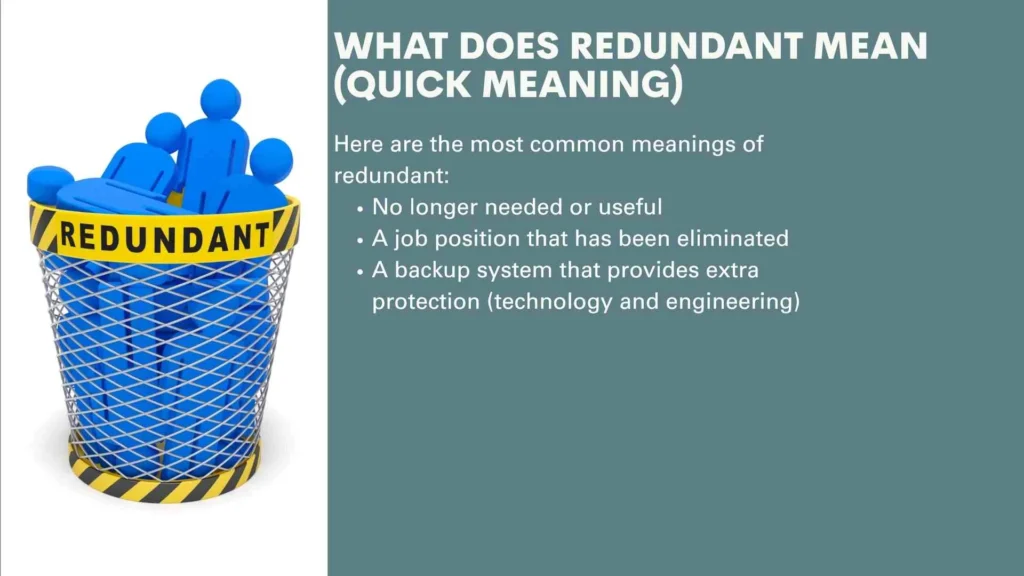
Here are the most common meanings of redundant:
- No longer needed or useful
- Repeated unnecessarily
- A job position that has been eliminated
- A backup system that provides extra protection (technology and engineering)
The definition of redundant depends on the context. Most commonly, it means unnecessary because something is repeated or no longer needed, but in technology it can also mean having a backup system for safety.
What Does Redundant Mean?
The word redundant describes something that has become unnecessary because another person, object, or piece of information already performs the same purpose.
For example:
- A sentence with repeated words may be considered redundant.
- A company may declare a position redundant if it no longer needs that role.
- A computer system may have redundant servers to ensure everything continues working if one fails.
Although the word is the same, the meaning changes depending on where it’s used.
Full Meaning in Simple Words
Imagine buying two identical coffee makers for your kitchen.
If you only need one, the second coffee maker is redundant because it serves no extra purpose.
Now imagine a company that automates part of its work.
If software replaces certain tasks, some jobs may become redundant, meaning the position is no longer required not necessarily because the employee did anything wrong.
In simple words:
Redundant means extra, unnecessary, repeated, or no longer needed.
What Does Redundant Mean in Text?
When people use redundant in text messages, they usually mean that something is unnecessary, repetitive, or no longer useful.
It is not internet slang.
Text Message Example
Emma: Should I explain that again?
Ryan: No, that would be redundant.
Another example:
Chris: Why are there three copies of the same file?
Taylor: They’re redundant. Delete the extras.
What Does Redundant Mean on Social Media?
On TikTok, Instagram, Reddit, Facebook, and X (formerly Twitter), redundant usually keeps its standard English meaning.
People commonly use it to describe:
- Repetitive content
- Duplicate videos
- Unnecessary updates
- Workplace layoffs
- Overused trends
Examples
“This trend is getting redundant.”
“Posting the same video every day feels redundant.”
The word isn’t used as slang but rather as a descriptive adjective.
WhatsApp Chat Example
Alex: Should I include this paragraph again?
Jamie: No, it’s redundant.
Instagram DM Example
Friend: I uploaded the same photo twice.
You: The second one is redundant. I’d delete it.
TikTok Comment Example
Video: “Day 30 of the exact same challenge.”
Comment: This content is starting to feel redundant.
Real-Life Meaning and Usage
The word redundant appears in many parts of daily life.
You might hear it at work, in school, during technical discussions, or while editing documents.
Some of the most common situations include:
- Business meetings
- Writing and editing
- Computer networking
- Engineering
- Everyday conversations
Because the word has multiple meanings, always pay attention to the context.
Real-Life Situations Where This Term Is Used
Workplace
A company reorganizes and removes positions that are no longer needed.
Example:
“My role became redundant after the merger.”
Writing
An editor removes repeated words.
Example:
“The sentence sounded redundant.”
Technology
A business installs backup servers.
Example:
“The company added redundant storage for safety.”
School
A teacher points out repeated ideas in an essay.
Example:
“Your second paragraph is redundant.”
Everyday Conversation
Someone repeats the same story several times.
Example:
“You’re being a little redundant.”
Examples of “What Does Redundant Mean?” in Sentences
- The extra paragraph was redundant and removed from the report.
- My position became redundant after the company restructured.
- The software contains redundant safety features.
- Repeating the same point again is redundant.
- The backup generator provides redundant power during emergencies.
- Several duplicate files were redundant and deleted.
- The editor suggested removing redundant words.
Different Contexts of Redundant
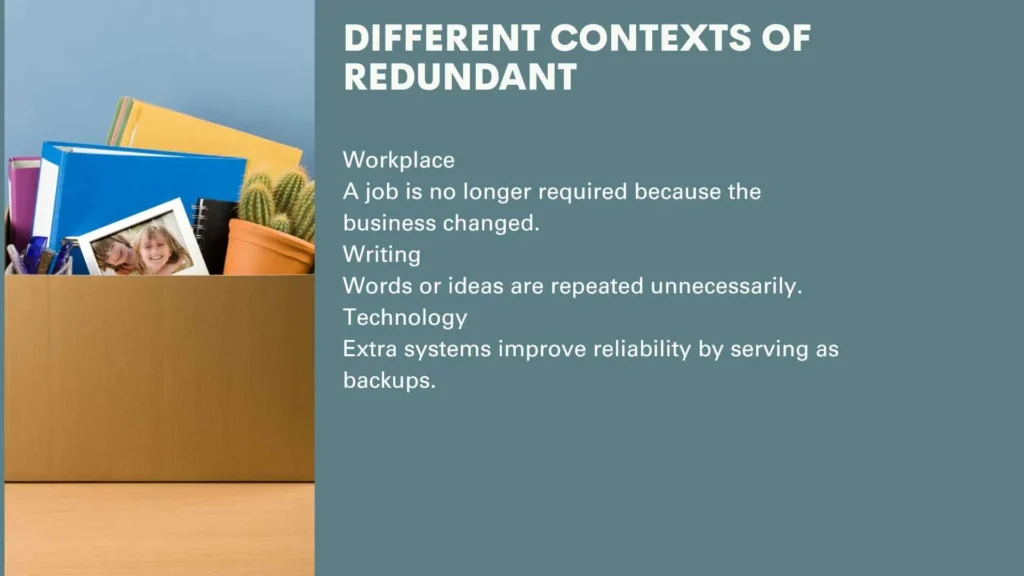
Workplace
A job is no longer required because the business changed.
Writing
Words or ideas are repeated unnecessarily.
Technology
Extra systems improve reliability by serving as backups.
Engineering
Redundant components prevent complete system failure.
Everyday Conversation
People describe repeated actions or unnecessary items as redundant.
Academic Context
Teachers and professors encourage students to avoid redundant language to improve clarity.
Origin and History of the Term
The word redundant comes from the Latin word redundare, meaning “to overflow” or “to overflow in excess.”
It entered English during the 15th century.
Originally, it described something existing in excess or abundance.
Over time, the meaning evolved to describe things that are unnecessary because there is already enough or because they duplicate another function.
Today, the word is widely used in:
- Business
- Law
- Technology
- Education
- Everyday English
Why Do People Use This Word?
People use redundant because it clearly explains that something:
- Isn’t needed
- Is repeated
- Is duplicated
- Has become unnecessary
- Can be removed without affecting the result
It’s a useful word because it applies to many situations.
Emotional & Psychological Meaning Behind This Word
The emotional meaning depends on the context.
In Writing
It usually has no emotional impact.
In Technology
It often creates confidence because backup systems improve reliability.
In Employment
Being told your position is redundant can be emotionally difficult.
Employees may feel:
- Disappointed
- Uncertain
- Frustrated
- Worried
However, redundancy usually refers to the job position, not the person’s value or abilities.
Tone Explanation
The word redundant is generally neutral.
Formal
Yes.
Used in:
- Business
- HR
- Legal documents
- Academic writing
Informal
Yes.
People use it in everyday conversations.
Slang
No.
Offensive
No.
Although it may feel harsh in workplace discussions, the word itself isn’t offensive.
Is It Rude to Say This Word?
No.
However, using it about a person instead of a situation may sound insensitive.
For example:
❌ “You’re redundant.”
Better:
✔ “This step seems redundant.”
When discussing employment, remember that redundancy refers to the position—not the individual’s worth.
Is This Word Positive, Negative, or Neutral?
The meaning changes depending on context.
Neutral
- Writing
- Technology
- Engineering
Negative
- Job loss
- Business restructuring
Positive
In technology, redundant systems improve safety and reliability.
When to Use Redundant
Use the word when discussing:
- Duplicate information
- Repeated words
- Unnecessary tasks
- Eliminated job positions
- Backup systems
- Extra equipment
When NOT to Use Redundant
Avoid using it when:
- Someone simply made a mistake
- Something is unique
- You’re describing temporary delays
- Referring to people personally instead of positions
Situations Where You Should Avoid Using This Word
Avoid calling a person redundant directly.
Instead, explain the situation.
For example:
Instead of:
“You’re redundant.”
Say:
“This role has become redundant.”
This wording is more respectful and accurate.
Redundant vs Similar Words
| Word | Meaning | Common Usage | Key Difference |
| Redundant | No longer needed or repeated | Business, writing, technology | Focuses on unnecessary duplication |
| Duplicate | An exact copy | Documents, files | Means identical copy rather than unnecessary |
| Unnecessary | Not needed | Everyday conversation | Broader meaning than redundant |
| Excessive | More than required | General use | Refers to quantity, not duplication |
| Obsolete | Outdated or replaced | Technology, products | Means old rather than repeated |
Variations and Related Meanings
Here are common variations of redundant:
Redundancy
The condition of being unnecessary or duplicated.
Made Redundant
Common workplace phrase for job elimination.
Redundant Words
Repeated words that don’t add meaning.
Redundant System
A backup system.
Redundant Data
Duplicate information stored in databases.
Redundant Equipment
Extra equipment available if the main equipment fails.
Data Redundancy
Duplicate copies of information for storage or recovery.
Redundant Process
An unnecessary step in a workflow.
How to Respond When Someone Uses “Redundant”
Casual Replies
- That makes sense.
- We probably don’t need it.
- Good point.
Funny Replies
- Guess it’s the backup for the backup!
- That’s extra… and then some!
Professional or Mature Replies
- We should simplify the process.
- Let’s remove any redundant steps.
- Thanks for identifying the duplication.
Cultural Usage
USA / Western Usage
In the United States, redundant is commonly used in:
- Business
- Education
- Technology
- Editing
- Everyday communication
Unlike in the UK, American companies more often say an employee was laid off rather than made redundant, although both expressions may be understood.
Global or Internet Usage Differences
In countries such as the United Kingdom, Australia, and New Zealand, made redundant is the standard phrase for losing a job because the position no longer exists.
Online, people mostly use redundant to describe repeated content, duplicate information, or unnecessary actions.
What Does Redundant Mean in Text?
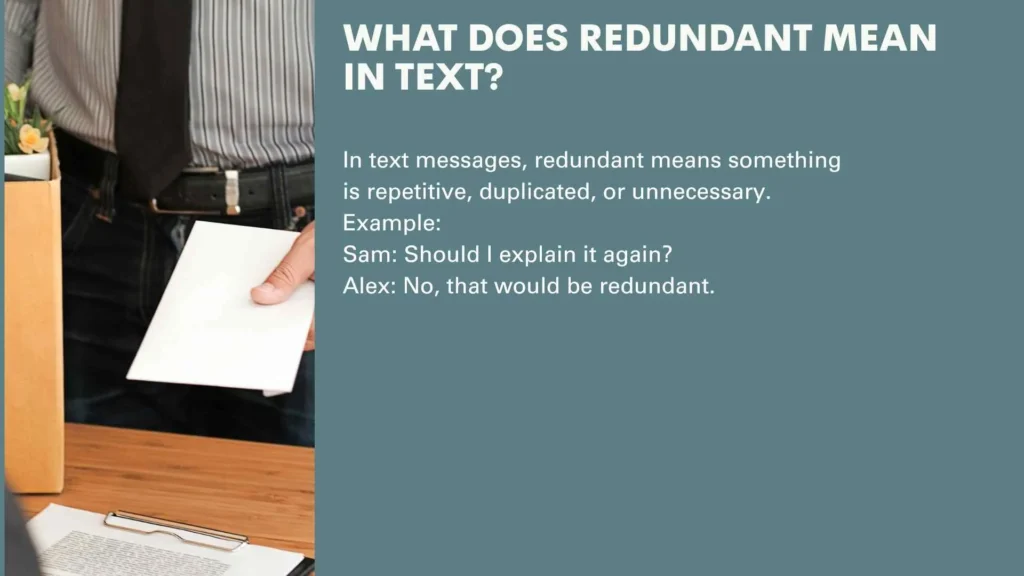
In text messages, redundant means something is repetitive, duplicated, or unnecessary.
Example:
Sam: Should I explain it again?
Alex: No, that would be redundant.
What Does Redundant Mean on TikTok / Instagram?
On TikTok and Instagram, the word often describes:
- Repetitive trends
- Duplicate posts
- Overused jokes
- Recycled content
It does not have a special slang meaning.
Is It Rude to Say This?
No.
The word itself is respectful.
However, use care when discussing someone’s employment or referring directly to people.
It’s better to describe the role as redundant rather than the person.
Why Do People Use This Word?
People use redundant because it’s a precise way to describe something that is unnecessary due to duplication or because it has been replaced. Whether discussing writing, workplace changes, or backup technology, the word helps communicate that an item, process, or role is no longer essential.
Frequently Asked Questions
1. What does redundant mean in simple words?
It means something is unnecessary because it is repeated, duplicated, or no longer needed.
2. What does being redundant mean at work?
It means a job position has been eliminated because the employer no longer needs that role. It does not necessarily reflect the employee’s performance.
3. Is redundant the same as fired?
No. Being made redundant usually happens because the position is removed, while being fired is typically related to an employee’s conduct or performance.
4. What does redundant mean in writing?
It means using extra words or repeating ideas that don’t add new meaning.
5. What does redundant mean in technology?
It refers to backup systems or duplicate components that keep services running if one part fails.
6. Is redundant a negative word?
Not always. It can be negative in employment contexts but neutral or even positive in writing, engineering, and technology.
7. What is another word for redundant?
Depending on the context, alternatives include unnecessary, repetitive, duplicate, excessive, or surplus.
Conclusion
Understanding what does redundant mean helps you use the word correctly in different situations. In general, redundant means something that is unnecessary because it is repeated, duplicated, or no longer needed. In the workplace, it often refers to a position that has been eliminated. In writing, it describes repeated words or ideas, while in technology it can refer to valuable backup systems that improve reliability.
By recognizing the context, you’ll better understand the meaning of redundant, communicate more clearly, and avoid common misunderstandings.

James Parker is a passionate writer and language enthusiast dedicated to helping readers understand words, meanings, and communication in a simple and effective way. With years of experience in educational writing and vocabulary research, he creates easy-to-understand content that helps students, learners, and readers improve their language skills.
At MeanNings.com, James focuses on providing accurate word meanings, English vocabulary, synonyms, antonyms, and practical language guides. His writing style is clear, informative, and designed for readers of all levels.
James believes that learning language should be simple, engaging, and accessible to everyone. Through his work, he aims to make complex words easier to understand and help readers build confidence in communication.
Books by James Parker
- The Power of Words
- Mastering Everyday Vocabulary
- English Meanings Simplified
 Daniel Brooks