If you’ve ever wondered what sync means, the simple answer is that sync means to make two or more things work together, match, or stay updated with each other. The word is most commonly used in technology, messaging apps, cloud storage, smartphones, and everyday conversations.
Today, the meaning of sync goes beyond computers. People use it to describe everything from syncing phones and calendars to being “in sync” with someone emotionally or working together as a team.
What Does Sync Mean (Quick Meaning)
Here are the most common meanings of sync:
- To keep two or more devices or accounts updated with the same information
- To make things happen at the same time or in harmony
- To match or coordinate actions, data, or schedules
- To connect information across different platforms automatically
The definition of sync is to synchronize, meaning to make things work together, stay updated, or happen at the same time.
What Does Sync Mean?
The word sync is short for synchronize.
When two things are in sync, they match, work together, or stay connected.
For example:
- Your phone syncs with your laptop so photos appear on both devices.
- Your smartwatch syncs with your fitness app.
- Two dancers perform in sync.
- Coworkers stay in sync on a project.
In every case, sync means working together smoothly and consistently.
Full Meaning in Simple Words
Imagine you take a picture on your phone.
A few seconds later, the same picture automatically appears on your tablet and laptop.
Your devices are syncing.
Now imagine two musicians playing perfectly together.
They are also in sync.
Simply put:
Sync means keeping things connected, matched, or working together.
It can refer to:
- Data
- Devices
- People
- Music
- Schedules
- Teams
- Conversations
What Does Sync Mean in Text?
In text messages, sync usually means getting on the same page or making sure information matches.
It can also mean updating devices or coordinating plans.
Text Message Example
Emma: Did your calendar update?
Ryan: Yes, it synced this morning.
Another example:
Alex: Let’s sync before tomorrow’s meeting.
Jordan: Sounds good. I’ll call you this afternoon.
Here, “sync” means discussing plans to ensure everyone agrees.
What Does Sync Mean on Social Media?
On TikTok, Instagram, Facebook, Reddit, and X (formerly Twitter), sync has several common meanings.
People use it to describe:
- Devices updating automatically
- Being emotionally connected
- Matching dance moves
- Lip-sync videos
- Team coordination
Examples:
“My phone finally synced with my cloud account.”
“We’re completely in sync.”
“That lip sync was amazing.”
Unlike many online words, sync isn’t internet slang—it keeps its standard meaning.
WhatsApp Chat Example
Chris: My contacts aren’t showing up.
Taylor: Try syncing your Google account.
Instagram DM Example
Friend: Are we still meeting at 6?
You: Yep! Let’s sync our schedules first.
TikTok Comment Example
Video: Two dancers perform perfectly together.
Comment: They’re so in sync! 🔥
Real-Life Meaning and Usage
The word sync is part of everyday language, especially in today’s digital world.
You’ll hear it when talking about:
- Smartphones
- Computers
- Smartwatches
- Calendars
- Cloud storage
- Team projects
- Music
- Relationships
Whether you’re updating files or coordinating with coworkers, sync is all about keeping things connected.
Real-Life Situations Where This Term Is Used
Smartphones
Your contacts sync between your phone and email account.
Cloud Storage
Photos automatically sync to Google Photos or iCloud.
Workplace
Managers ask employees to “sync up” before meetings.
School
Students sync assignments across multiple devices.
Music
Singers and dancers perform in sync.
Relationships
Couples often say they feel “in sync” when they understand each other well.
Examples of “What Does Sync Mean?” in Sentences
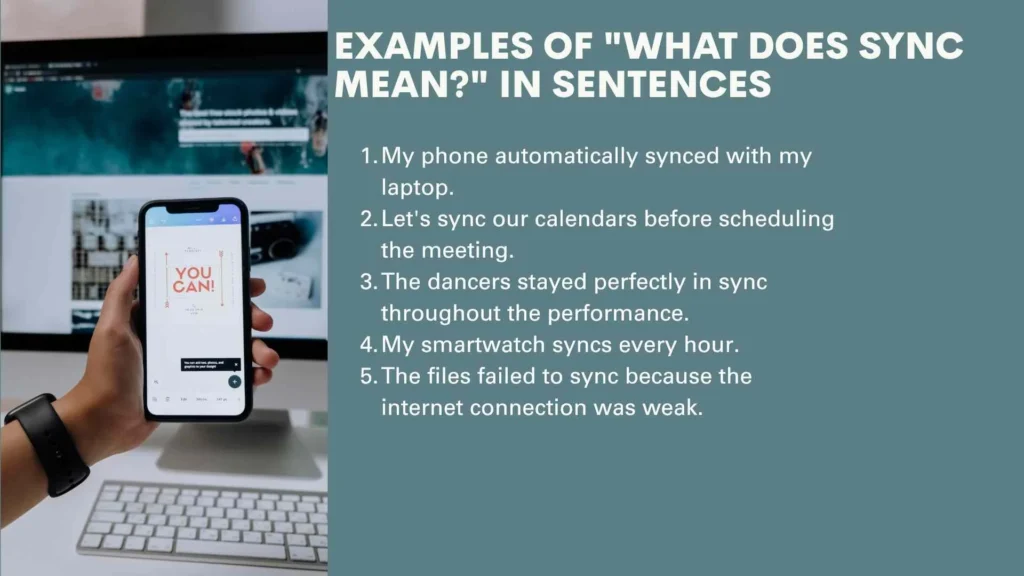
- My phone automatically synced with my laptop.
- Let’s sync our calendars before scheduling the meeting.
- The dancers stayed perfectly in sync throughout the performance.
- My smartwatch syncs every hour.
- The files failed to sync because the internet connection was weak.
- We need to sync our project updates before presenting.
- The app syncs data across all your devices.
Different Contexts of Sync
Technology
Keeping devices or data updated.
Example:
“My notes sync across all devices.”
Business
Coordinating work.
Example:
“Let’s sync after lunch.”
Music
Playing or singing together.
Example:
“The band stayed perfectly in sync.”
Relationships
Being emotionally connected.
Example:
“We’ve been in sync since day one.”
Sports
Players move together smoothly.
Example:
“The team’s defense stayed in sync.”
Academic Context
Teachers may ask students to sync assignments with online learning platforms.
Origin and History of the Term
The word sync comes from the longer word synchronize, which comes from the Greek roots:
- syn = together
- chronos = time
Originally, synchronize meant making events happen at the same time.
As technology evolved, sync became a common abbreviation used in computers, smartphones, cloud services, and software.
Today, it also describes people working together or sharing the same understanding.
Why Do People Use This Word?
People use sync because it’s a quick and easy way to describe coordination.
It can mean:
- Updating data
- Connecting devices
- Matching schedules
- Working together
- Sharing information
- Being emotionally aligned
The word saves time because it applies to many situations.
Emotional & Psychological Meaning Behind This Word
Although sync is often technical, it also has emotional meaning.
People associate being “in sync” with:
- Good communication
- Trust
- Harmony
- Teamwork
- Understanding
- Connection
In relationships, saying you’re “in sync” usually means both people understand each other naturally.
Tone Explanation
The word sync has a neutral and friendly tone.
Formal
Yes.
Used in:
- Business
- Technology
- Education
Informal
Yes.
Friends use it daily.
Slang
Not exactly.
Although it’s shortened from “synchronize,” it’s considered standard English rather than slang.
Offensive
No.
The word is respectful and appropriate in every setting.
Is It Rude to Say This Word?
No.
Sync is completely polite.
You can safely use it:
- At work
- At school
- In emails
- In text messages
- On social media
Is This Word Positive, Negative, or Neutral?
The word is generally neutral.
However, phrases like:
- “We’re finally in sync.”
often carry a positive feeling because they suggest cooperation and understanding.
When to Use Sync
Use sync when talking about:
- Updating devices
- Cloud storage
- Phone contacts
- Calendars
- Team meetings
- Shared documents
- Relationships
- Music
- Dance
- Scheduling
When NOT to Use Sync
Avoid using the word when:
- Talking about unrelated objects
- Describing random events with no connection
- Referring to situations where nothing is coordinated
Situations Where You Should Avoid Using This Word
Don’t use sync if you’re simply describing:
- Copying a file once (without ongoing updates)
- Sending a single email
- Random coincidences
- Independent actions
Sync implies an ongoing connection or coordinated action.
Sync vs Similar Words
| Word | Meaning | Common Usage | Key Difference |
| Sync | Keep things updated or coordinated | Technology, business, relationships | Focuses on matching or working together |
| Connect | Link two things | Devices, networking | Doesn’t always keep information updated |
| Backup | Create a copy of data | Technology | Saves information but doesn’t automatically update it |
| Upload | Send data to the internet or cloud | Technology | One-way transfer rather than continuous synchronization |
| Share | Give access to information | Online collaboration | Doesn’t automatically stay updated |
Variations and Related Meanings
Here are common variations of sync:
Synchronize
The full form of sync.
Syncing
The ongoing process of synchronization.
In Sync
Working together perfectly.
Auto Sync
Automatic updating between devices.
Cloud Sync
Keeping cloud storage updated.
Calendar Sync
Matching schedules across devices.
Data Sync
Keeping information consistent across systems.
Contact Sync
Updating phone contacts automatically.
File Sync
Matching files on different devices.
Lip Sync
Matching mouth movements with recorded audio.
How to Respond When Someone Says “Sync”
Casual Replies
- Sounds good!
- Let’s do it.
- I’m ready.
- Everything’s synced now.
Funny Replies
- Finally, my brain and calendar are in sync!
- Hopefully my Wi-Fi gets the memo too!
Professional or Mature Replies
- I’ll sync the latest updates before our meeting.
- Let’s schedule a quick sync this afternoon.
- I’ll make sure all files are synchronized before sharing them.
Cultural Usage
USA / Western Usage
In the United States, sync is widely used in technology, business, education, and everyday conversations.
Common phrases include:
- Sync your phone.
- Let’s sync up.
- Stay in sync.
- Calendar sync.
- Data sync.
It’s one of the most frequently used technology-related words.
Global or Internet Usage Differences
Around the world, sync has nearly the same meaning.
On social media, it’s also associated with:
- Lip-sync videos
- Dance challenges
- Team coordination
- Device updates
- Shared cloud storage
Unlike many internet expressions, sync has a consistent meaning across cultures.
What Does Sync Mean in Text?
In text messages, sync usually means coordinating with someone or updating information across devices.
Example:
Mia: Did your notes update?
Jake: Yep, everything synced automatically.
It can also mean getting on the same page:
Boss: Let’s sync tomorrow morning.
What Does Sync Mean on TikTok / Instagram?
On TikTok and Instagram, sync commonly refers to:
- Lip-sync videos
- Matching dance routines
- Devices updating automatically
- Friends or couples being emotionally connected
It is not considered internet slang with a hidden meaning.
Is It Rude to Say This?
No.
The word sync is neutral, professional, and suitable for every audience.
Why Do People Use This Word?
People use sync because it clearly describes coordination, connection, and automatic updating. Whether discussing technology, teamwork, schedules, or relationships, it’s a simple word that communicates the idea of things working together smoothly and staying aligned.
Frequently Asked Questions
1. What does sync mean in simple words?
It means keeping two or more things connected, matched, or updated so they work together.
2. What does sync mean on a phone?
It means your phone automatically updates and shares information—such as contacts, photos, emails, or calendars with other devices or cloud services.
3. What does “in sync” mean?
It means two or more people or things are working together smoothly, in harmony, or with the same understanding.
4. Is sync the same as backup?
No. Sync keeps information updated across devices, while a backup creates a separate copy for recovery if data is lost.
5. What does sync mean in text?
In text messages, it usually means coordinating plans or ensuring information is updated and consistent.
6. What is lip sync?
Lip sync is moving your lips to match pre-recorded audio, often used in music videos and TikTok content.
7. Is sync a slang word?
No. Sync is a standard English abbreviation of synchronize and is widely used in technology and everyday conversation.
Conclusion
Understanding what does sync mean is useful because the word appears everywhere—from smartphones and cloud storage to business meetings and social media. In its simplest form, sync means to make two or more things work together, stay updated, or happen in harmony. Whether you’re syncing your devices, coordinating with coworkers, or describing a relationship where you’re “in sync,” the idea is the same: connection, consistency, and smooth coordination.