If you’re wondering what conscientious means, the simple answer is that conscientious describes someone who is careful, responsible, hardworking, and pays close attention to doing things correctly. A conscientious person takes their duties seriously, thinks about the impact of their actions, and tries to do their best in every situation.
Whether you hear this word in school, the workplace, job interviews, or everyday conversations, understanding the meaning of conscientious can help you recognize one of the most respected personality traits in English.
Quick Meaning
Here are the most common meanings of conscientious:
- Careful and responsible when completing tasks.
- Hardworking and dependable, always trying to do the right thing.
- Thoughtful about others and aware of responsibilities.
- Paying close attention to details to avoid mistakes.
What Does Conscientious Mean?
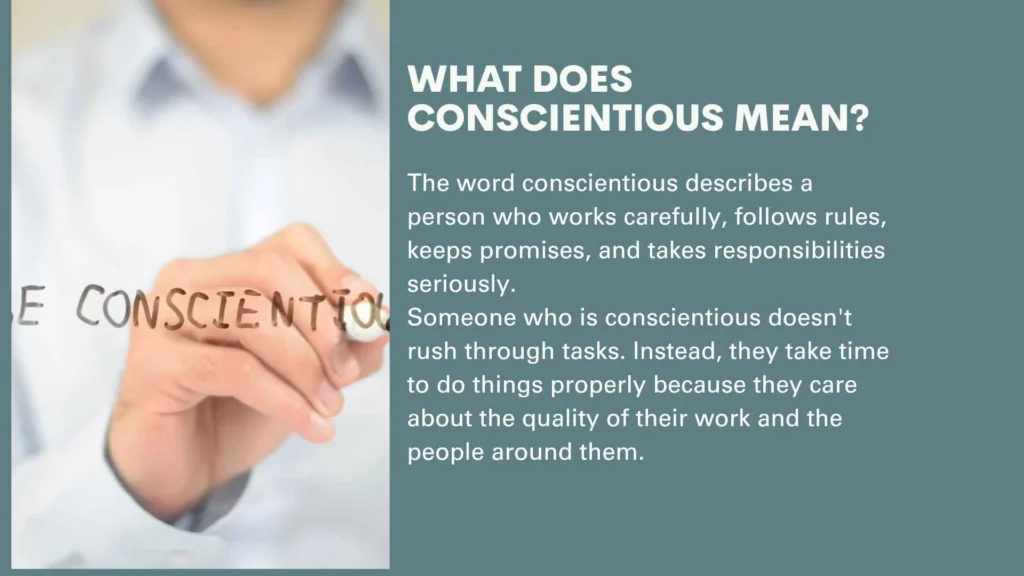
The word conscientious describes a person who works carefully, follows rules, keeps promises, and takes responsibilities seriously.
Someone who is conscientious doesn’t rush through tasks. Instead, they take time to do things properly because they care about the quality of their work and the people around them.
In everyday English, conscientious means being responsible, careful, and committed to doing your best.
For example:
- She is a conscientious student who always finishes her homework.
- He is conscientious about keeping appointments.
- Our manager is conscientious and checks every report carefully.
Conscientious pronunciation
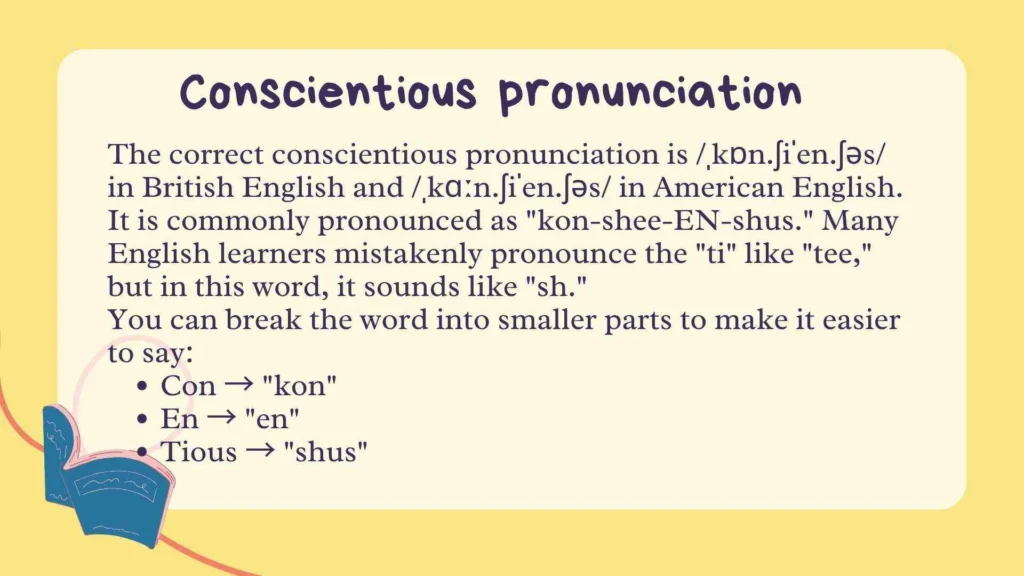
The correct conscientious pronunciation is /ˌkɒn.ʃiˈen.ʃəs/ in British English and /ˌkɑːn.ʃiˈen.ʃəs/ in American English. It is commonly pronounced as “kon-shee-EN-shus.” Many English learners mistakenly pronounce the “ti” like “tee,” but in this word, it sounds like “sh.”
You can break the word into smaller parts to make it easier to say:
- Con → “kon”
- Sci → “shee”
- En → “en”
- Tious → “shus”
When spoken naturally, the stress falls on the third syllable (EN).
Here are a few examples of the word in everyday speech:
- “She is a conscientious employee who always meets deadlines.”
- “A conscientious student prepares for exams well in advance.”
- “Doctors must be conscientious when caring for patients.”
Learning the pronunciation also helps you understand related words, such as conscientiously (adverb) and conscientiousness (noun), which are commonly used in professional, educational, and psychological contexts.
If you’re practicing English vocabulary, say the word slowly several times before using it in complete sentences. Listening to native speakers and repeating after them can also improve your pronunciation and confidence.
What does conscientious mean in a sentence
Conscientious means being careful, responsible, hardworking, and paying close attention to doing things correctly. In a sentence, it describes someone who takes their duties seriously and always tries to produce high-quality work.
The word is often used to describe people who are dependable and committed, whether at school, work, or in personal responsibilities. A conscientious person usually plans ahead, follows instructions, and avoids careless mistakes.
Here are some sentence examples:
- Sarah is a conscientious nurse who carefully checks every patient’s medication.
- Because he is conscientious, Jake always finishes his assignments before the deadline.
- The manager praised the conscientious employee for maintaining accurate records.
- A conscientious driver follows traffic laws and drives safely.
- Our teacher appreciates conscientious students who participate in class and complete homework on time.
The word fits many situations, including:
- Academic writing
- Workplace communication
- Performance reviews
- Character descriptions
- Professional recommendations
For example, a teacher might write, “Emma is a conscientious learner who consistently demonstrates responsibility.” Likewise, an employer may describe a worker as conscientious because they complete tasks accurately and reliably.
Using conscientious in sentences adds a positive description of someone’s character and work ethic. It emphasizes responsibility, dedication, honesty, and attention to detail rather than simply saying someone is “hardworking.”
Conscientiously meaning
Conscientiously is the adverb form of conscientious. It means doing something carefully, responsibly, honestly, and with great attention to detail. A person who works conscientiously makes an effort to complete tasks correctly rather than rushing or taking shortcuts.
This word is commonly used in schools, workplaces, healthcare, customer service, and legal settings to describe responsible behavior.
Examples include:
- The accountant conscientiously reviewed every financial report before submitting it.
- She conscientiously followed the doctor’s instructions during her recovery.
- The volunteers conscientiously cleaned the park after the community event.
Someone who acts conscientiously often demonstrates:
- Strong work ethic
- Reliability
- Carefulness
- Integrity
- Professional responsibility
Imagine a construction worker checking every safety measure before beginning work. That person is acting conscientiously because they understand that accuracy protects everyone involved.
Similarly, a student who carefully researches sources, proofreads assignments, and submits work on time is completing tasks conscientiously.
Related words include carefully, diligently, faithfully, thoroughly, and responsibly. While these words have similar meanings, conscientiously especially emphasizes acting according to one’s sense of duty and moral responsibility.
What does conscientious mean in law
In legal contexts, conscientiousness refers to acting with honesty, diligence, good faith, and careful attention to legal duties or professional responsibilities. Although the word itself is not a technical legal term, it frequently appears when describing the expected conduct of lawyers, judges, trustees, employers, and public officials.
A conscientious legal professional carefully follows laws, ethical rules, and procedures while protecting the rights of others.
Examples include:
- A conscientious lawyer thoroughly reviews evidence before representing a client.
- A conscientious judge considers all relevant facts before making a decision.
- A conscientious employer complies with labor laws and workplace safety regulations.
The term may also appear in discussions about conscientious objection, where an individual refuses military service or certain legal obligations because of sincerely held religious or moral beliefs. In many countries, laws provide limited protections for conscientious objectors under specific conditions.
Being conscientious in law generally involves:
- Following legal procedures
- Acting ethically
- Exercising reasonable care
- Meeting professional standards
- Protecting clients’ or the public’s interests
For example, a trustee managing someone else’s assets must act conscientiously by keeping accurate records and making decisions that benefit the beneficiaries rather than themselves.
Overall, in legal settings, conscientious behavior reflects professionalism, integrity, accountability, and respect for the rule of law.
What does conscientious Mean in psychology
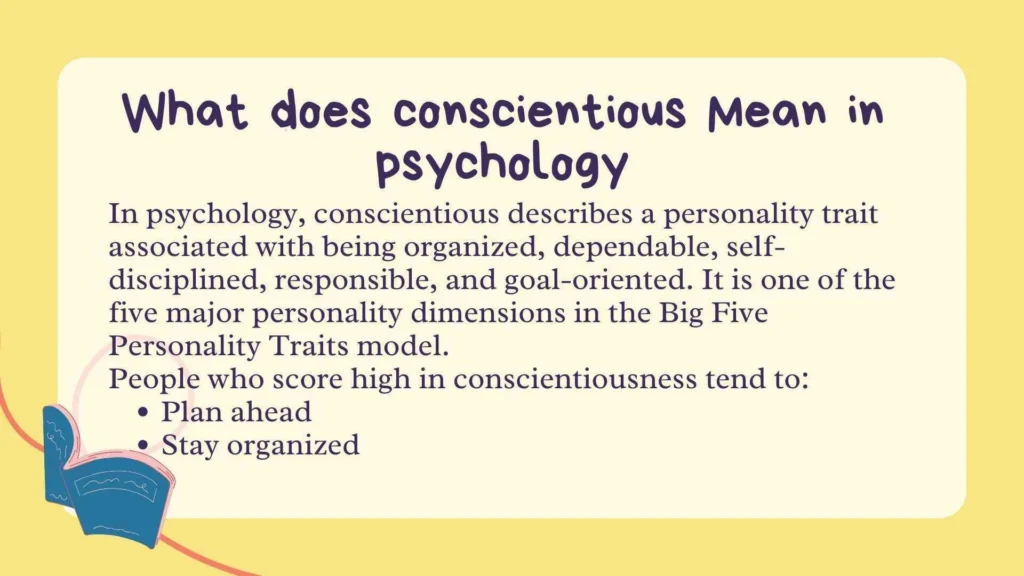
In psychology, conscientious describes a personality trait associated with being organized, dependable, self-disciplined, responsible, and goal-oriented. It is one of the five major personality dimensions in the Big Five Personality Traits model.
People who score high in conscientiousness tend to:
- Plan ahead
- Stay organized
- Complete tasks on time
- Control impulses
- Set and achieve long-term goals
For example:
- A student studies every day instead of cramming the night before an exam.
- An employee consistently meets deadlines and produces accurate work.
- A parent carefully plans household responsibilities and follows through on commitments.
Research in psychology has linked high conscientiousness with positive life outcomes, including better academic performance, career success, healthier habits, and greater reliability in relationships.
However, extremely high conscientiousness can sometimes lead to perfectionism, excessive self-criticism, or difficulty relaxing. Balance is important because flexibility also plays a role in emotional well-being.
Psychologists often measure conscientiousness through personality assessments to better understand how individuals approach work, relationships, and personal goals. This trait influences motivation, decision-making, time management, and self-control.
In everyday life, being conscientious means consistently making thoughtful choices, fulfilling responsibilities, and striving to do things well.
Conscientious synonym
Several words can be used as a conscientious synonym, depending on the situation. While they all suggest responsibility and care, each has a slightly different meaning.
Common synonyms include:
- Responsible
- Diligent
- Careful
- Thorough
- Reliable
- Meticulous
- Industrious
- Dedicated
- Attentive
- Dependable
- Hardworking
- Honest
Here is how they compare:
- Responsible emphasizes accountability.
- Diligent highlights persistent effort.
- Meticulous focuses on extreme attention to detail.
- Reliable stresses consistency and trustworthiness.
- Thorough means completing every part of a task carefully.
Example sentences:
- She is a conscientious employee.
- She is a diligent employee.
- She is a reliable employee.
Each sentence has a slightly different emphasis, even though they share similar meanings.
When choosing a synonym, consider the context. In professional writing, diligent, responsible, and reliable are often the best alternatives. In academic settings, thorough and careful may fit better. For personality descriptions, dependable and dedicated are common choices.
Understanding these related words helps expand your vocabulary and allows you to express different shades of meaning more accurately.
Conscientious student meaning
A conscientious student is someone who studies responsibly, stays organized, works hard, and consistently puts effort into learning. Instead of doing only the minimum required, they aim to understand concepts thoroughly and complete their work to the best of their ability.
A conscientious student often demonstrates these qualities:
- Completes homework on time
- Pays attention during lessons
- Prepares for tests in advance
- Participates respectfully in class
- Accepts feedback and improves
Real-life examples include:
- A student who creates a weekly study schedule and follows it consistently.
- Someone who carefully checks assignments before submitting them.
- A learner who asks thoughtful questions to better understand difficult topics.
Teachers often describe conscientious students as dependable because they rarely miss deadlines and take responsibility for their learning. These students are also more likely to develop strong study habits, effective time management, and lifelong learning skills.
Being conscientious does not necessarily mean earning perfect grades. A student can struggle with a subject while still being conscientious by showing dedication, persistence, and a willingness to improve.
Schools value conscientious students because they contribute positively to the classroom, respect classmates and teachers, and maintain a strong commitment to their educational goals.
Conscientious decision meaning
A conscientious decision is a choice made carefully, responsibly, ethically, and after thoughtful consideration of the possible consequences. Instead of acting impulsively, a conscientious person weighs the facts, considers how others may be affected, and chooses the most responsible course of action.
Characteristics of a conscientious decision include:
- Careful evaluation of available information
- Consideration of ethical principles
- Awareness of short-term and long-term consequences
- Responsibility toward others
- Honest and fair judgment
Examples from everyday life include:
- A manager reviews all employee concerns before making a promotion decision.
- A doctor explains every treatment option before recommending the best choice.
- Parents carefully compare schools before deciding where to enroll their child.
In business, conscientious decision-making builds trust because leaders act transparently and prioritize fairness. In personal life, it helps people make choices that align with their values and responsibilities.
A conscientious decision is not simply the easiest or fastest option. Instead, it reflects careful thinking, integrity, empathy, and accountability. Whether in education, healthcare, finance, or family life, making conscientious decisions often leads to better outcomes because important factors have been thoughtfully considered before taking action.
Full Meaning in Simple Words
Imagine someone who:
- Double-checks their work.
- Arrives on time.
- Keeps promises.
- Thinks before acting.
- Tries not to disappoint others.
That person is conscientious.
It’s more than simply being hardworking. A conscientious person also cares about doing things correctly, honestly, and responsibly.
What Does Conscientious Mean in Text?
In text messages, emails, or online chats, conscientious has the same meaning it does in everyday English.
Someone may text:
“She’s very conscientious about her work.”
This means she is reliable, organized, and careful.
Unlike internet abbreviations, conscientious is not a slang term or acronym.
What Does Conscientious Mean on Social Media (TikTok, Instagram, etc.)?
On TikTok, Instagram, LinkedIn, Facebook, and X (formerly Twitter), conscientious often appears in posts about:
- Productivity
- Career advice
- Personal development
- Psychology
- Education
- Personality traits
Examples include:
- “Being conscientious can help you achieve your goals.”
- “Employers value conscientious workers.”
- “Conscientious people usually plan ahead.”
The word keeps its original meaning on social media and is commonly used in motivational or educational content.
WhatsApp Chat Example
Emma: Did you finish the project already?
Ryan: Yes. I wanted to review everything first.
Emma: You’re so conscientious!
Instagram DM Example
Friend: My coworker always helps everyone and never misses deadlines.
You: Sounds like they’re really conscientious.
TikTok Comment Example
Video: “Habits of successful people.”
Comment:
Being conscientious is one of the biggest reasons successful people stay consistent.
Real-Life Meaning and Usage
The word conscientious is commonly used to describe people who take pride in their work and responsibilities.
You’ll often hear it used for:
- Students
- Employees
- Teachers
- Nurses
- Doctors
- Parents
- Volunteers
- Leaders
For example:
“Our new employee is extremely conscientious and always delivers high-quality work.”
Real-Life Situations Where This Term Is Used
At Work
Managers often describe dependable employees as conscientious because they complete tasks carefully and on time.
At School
Teachers may praise students who study consistently and pay attention to instructions.
During Job Interviews
Applicants often describe themselves as conscientious to show they are responsible and trustworthy.
In Relationships
A conscientious partner listens carefully, respects commitments, and considers the feelings of others.
In Healthcare
Doctors and nurses are expected to be conscientious because accuracy and responsibility affect patient safety.
Examples of Conscientious in Sentences
Here are several examples:
- She is a conscientious employee who never misses a deadline.
- My brother is conscientious about saving money every month.
- The teacher appreciated his conscientious attitude toward learning.
- Being conscientious helped her earn a promotion.
- He completed the assignment carefully because he is conscientious.
- Conscientious drivers always follow traffic laws.
- Parents appreciate conscientious babysitters who pay attention to every detail.
Different Contexts of Conscientious
Academic Context
Students who study regularly and complete assignments carefully are often described as conscientious.
Example:
“Conscientious students usually earn higher grades.”
Workplace Context
Employers value conscientious workers because they are dependable.
Example:
“We’re looking for conscientious team members.”
Psychology Context
In psychology, conscientiousness is one of the Big Five personality traits. It refers to being organized, disciplined, dependable, and goal-oriented.
Everyday Conversation
Friends may compliment someone by saying:
“She’s really conscientious.”
This simply means she is thoughtful and responsible.
Online Context
Personal development creators often encourage followers to become more conscientious by building better habits and staying organized.
Origin and History of the Term
The word conscientious comes from the Latin word conscientia, meaning knowledge within oneself or conscience.
Over time, the word evolved into English to describe someone who acts according to their conscience by being honest, responsible, and careful.
Today, it is commonly used in education, psychology, business, and everyday conversation.
Why Do People Use This Word?
People use conscientious because it expresses more than simply being hardworking.
It also suggests qualities like:
- Responsibility
- Honesty
- Reliability
- Self-discipline
- Carefulness
- Integrity
For example:
Instead of saying:
“She’s hardworking.”
Someone may say:
“She’s conscientious.”
This tells listeners that she not only works hard but also pays attention to quality and ethics.
Emotional & Psychological Meaning Behind This Word
Emotionally, conscientious is linked with positive personal qualities.
People who are conscientious often:
- Feel responsible for their actions.
- Want to meet expectations.
- Care about doing things correctly.
- Think ahead before making decisions.
- Value honesty and trust.
Psychologists consider conscientiousness one of the strongest predictors of long-term success because it is connected to self-control, organization, and persistence.
Tone Explanation
Formal
Very common.
You’ll often see conscientious used in:
- Job applications
- Recommendation letters
- Performance reviews
- Academic writing
Informal
It is also used naturally in conversations.
Example:
“He’s really conscientious about recycling.”
Slang
No.
Conscientious is not slang.
Offensive
No.
The word is considered respectful and complimentary.
Is It Rude to Say This Word?
No.
Calling someone conscientious is usually a compliment.
It tells them you see them as:
- Responsible
- Dependable
- Careful
- Trustworthy
Only in rare situations could it sound sarcastic if spoken with an ironic tone.
Is This Word Positive, Negative, or Neutral?
The word is generally positive.
| Situation | Tone |
| Job interview | Positive |
| Performance review | Positive |
| School report | Positive |
| Daily conversation | Positive |
Most people appreciate being described as conscientious.
When to Use Conscientious
Use this word when describing someone who:
- Pays attention to details.
- Is reliable.
- Works carefully.
- Takes responsibility seriously.
- Keeps promises.
- Produces high-quality work.
When NOT to Use Conscientious
Avoid using the word when:
- Someone acts carelessly.
- Someone ignores responsibilities.
- You want a very casual tone with young children.
- A simpler word like “careful” works better.
Situations Where You Should Avoid Using This Word
You may not need to use conscientious in:
- Casual text messages between close friends.
- Informal jokes.
- Conversations with young learners unfamiliar with advanced vocabulary.
- Situations where “careful” or “responsible” sounds more natural.
Comparison Table: Conscientious vs Similar Terms
| Term | Meaning | Usage | Key Difference |
| Conscientious | Careful, responsible, dependable | School, work, personality | Focuses on responsibility and attention to detail |
| Responsible | Reliable and accountable | Everyday conversation | Broader and more common |
| Diligent | Hardworking and persistent | Academic and professional settings | Emphasizes consistent effort |
| Careful | Avoids mistakes | Daily speech | Focuses mainly on caution |
| Reliable | Can be trusted | Work and relationships | Emphasizes dependability rather than attention to detail |
Variations and Related Meanings of Conscientious
Depending on the context, you may encounter these related forms:
- Conscientious worker – Someone who performs duties carefully.
- Conscientious student – A learner who studies responsibly.
- Conscientious employee – A dependable professional.
- Conscientious parent – A parent who thoughtfully cares for children.
- Conscientiously – The adverb form, meaning carefully or responsibly.
- Conscientiousness – The noun referring to the personality trait.
- Highly conscientious – Extremely responsible and organized.
- Socially conscientious – Concerned about society and community.
- Environmentally conscientious – Caring about environmental responsibility.
- Financially conscientious – Careful with money and budgeting.
How to Respond When Someone Uses “Conscientious”
Casual Replies
- Thanks! I appreciate that.
- I try my best.
- That’s nice of you to say.
- Thank you!
Funny Replies
- Guess my to-do list is paying off!
- My calendar deserves the credit.
- Years of color-coded notes finally worked!
Professional Replies
- Thank you for your kind feedback.
- I appreciate your recognition.
- I’m committed to doing quality work.
- That means a lot to me.
USA / Western Usage
In the United States, Canada, the United Kingdom, and Australia, conscientious is widely used in:
- Performance reviews
- College recommendations
- Job interviews
- Workplace evaluations
- Professional communication
Employers often seek conscientious employees because they are dependable and trustworthy.
Global or Internet Usage Differences

Around the world, conscientious generally carries the same meaning.
The main differences are:
- Native English speakers use it more frequently in professional settings.
- English learners may first encounter it in textbooks or language classes.
- On social media, it’s commonly used in discussions about personality, productivity, and self-improvement.
The word is not considered internet slang and retains its standard meaning across platforms.
Frequently Asked Questions
What does conscientious mean in simple words?
It means being careful, responsible, hardworking, and committed to doing things correctly.
What does conscientious mean in text?
In text messages, conscientious simply means someone is dependable, thoughtful, and responsible. It is not an abbreviation or slang.
What does conscientious mean on TikTok or Instagram?
On social media, it usually describes a responsible or disciplined person. It’s often used in motivational, educational, or career-related posts.
Is conscientious a compliment?
Yes. Calling someone conscientious is generally considered a positive compliment because it highlights their reliability and strong work ethic.
Is conscientious the same as hardworking?
Not exactly. A hardworking person puts in effort, while a conscientious person also focuses on responsibility, accuracy, and doing things the right way.
Is conscientious a personality trait?
Yes. In psychology, conscientiousness is one of the Big Five personality traits and is associated with organization, self-discipline, and dependability.
Can you use conscientious in everyday conversation?
Absolutely. While it’s more common in professional and academic settings, it’s perfectly natural to use when describing responsible or reliable people.
Conclusion
Understanding what does conscientious mean helps you recognize a valuable quality that is respected in school, work, relationships, and everyday life. A conscientious person is someone who is careful, dependable, organized, and committed to doing the right thing, even when no one is watching.
Whether you’re writing a resume, preparing for a job interview, studying English, or simply expanding your vocabulary, knowing the meaning of conscientious allows you to describe people more accurately and communicate with greater confidence. It’s a positive word that reflects responsibility, integrity, and attention to detail qualities that are appreciated in every stage of life.
You Should Also Check These Posts: