
If you’re wondering what does mortality mean, the simple answer is that mortality refers to death or the state of being mortal, meaning that all living things eventually die. The word is often used in healthcare, science, insurance, statistics, and everyday conversations when discussing life expectancy, death rates, or human existence.
Understanding the meaning of mortality can help you better understand news reports, medical information, academic discussions, and even philosophical conversations about life.
What Does Mortality Mean?(Quick Meaning)
What does mortality mean?
- The condition of being subject to death
- The occurrence of death within a population
- A measurement of death rates in a specific group
- Human awareness that life is temporary
This quick definition is often enough for people searching for the meaning of mortality in everyday language.
What Does Mortality Mean?
The phrase what does mortality mean asks for the definition of the word “mortality.”
In simple terms, mortality means:
- The fact that living beings eventually die
- Death as a natural part of life
- Statistics related to deaths in a population
For example:
- “Human mortality reminds us that life is precious.”
- “The mortality rate decreased due to better healthcare.”
Mortality is commonly used in medical, scientific, and social discussions.
Morbidity Meaning
Morbidity meaning refers to the presence of illness, disease, injury, or poor health within an individual or a population. In medicine and public health, morbidity does not mean death. Instead, it describes how often people become sick or live with a particular medical condition. Healthcare professionals use morbidity data to understand disease patterns, plan treatments, and improve public health programs.
Morbidity can refer to both short-term illnesses, such as seasonal influenza, and long-term chronic conditions, such as diabetes, asthma, or heart disease. A person with multiple health conditions is said to have high morbidity because they are affected by more than one disease.
Common types of morbidity include:
- Acute morbidity: Temporary illnesses like food poisoning or pneumonia.
- Chronic morbidity: Long-lasting diseases such as arthritis or hypertension.
- Comorbidity: When a person has two or more medical conditions at the same time.
Real-life examples
- During flu season, hospitals report higher morbidity because more people become sick.
- A person living with diabetes and high blood pressure has multiple morbidities.
- Researchers study childhood obesity morbidity to understand its impact on long-term health.
Morbidity statistics help governments and healthcare organizations identify health risks, allocate medical resources, and develop prevention programs. Unlike mortality, which measures deaths, morbidity focuses on the burden of disease, quality of life, disability, and healthcare needs. Understanding morbidity helps doctors and policymakers improve patient outcomes and reduce the spread of illness.
What Does Mortality Mean in Medical Terms
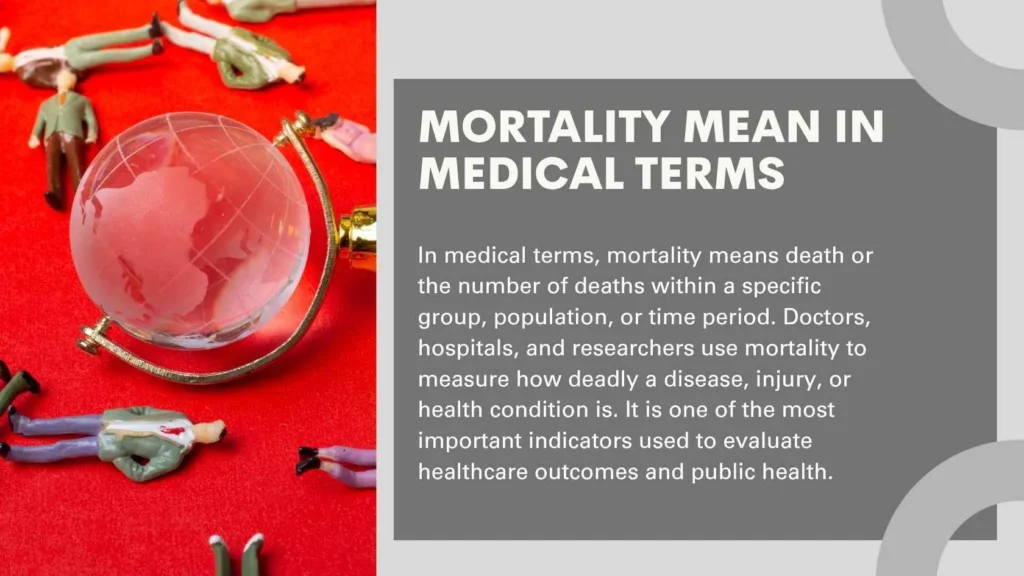
In medical terms, mortality means death or the number of deaths within a specific group, population, or time period. Doctors, hospitals, and researchers use mortality to measure how deadly a disease, injury, or health condition is. It is one of the most important indicators used to evaluate healthcare outcomes and public health.
Mortality can describe an individual death or be expressed as a mortality rate, which shows how many people die out of a certain population over a given period. Medical professionals also use mortality data to compare diseases, evaluate treatments, and identify health risks.
Common medical terms related to mortality include:
- Mortality rate: The number of deaths in a population.
- Infant mortality: Deaths of babies before their first birthday.
- Maternal mortality: Deaths related to pregnancy or childbirth.
- Hospital mortality: Deaths that occur during hospitalization.
Real-life examples
- Doctors may report a low mortality rate for a common surgery because most patients recover successfully.
- Researchers compare cancer mortality rates to evaluate new treatments.
- During a disease outbreak, public health officials monitor mortality to understand its severity.
Mortality is different from morbidity. Mortality measures death, while morbidity measures illness or disease. Together, these statistics help healthcare professionals assess public health, improve medical care, and develop strategies to prevent unnecessary deaths.
What Does Mortality Mean in Science
In science, mortality refers to the occurrence or frequency of death among living organisms. Scientists use the term to study humans, animals, plants, and even microorganisms. Mortality helps researchers understand survival, population changes, disease outbreaks, environmental impacts, and life expectancy.
Different scientific fields use mortality in different ways:
- Biology: Studies the natural death of organisms.
- Ecology: Measures how deaths affect animal and plant populations.
- Epidemiology: Tracks deaths caused by diseases.
- Environmental science: Examines mortality linked to pollution, climate change, or habitat destruction.
Scientists often calculate mortality rates to compare populations or determine how dangerous a disease or environmental condition may be.
Real-life examples
- Marine biologists study fish mortality after an oil spill.
- Wildlife researchers monitor bird mortality during migration seasons.
- Epidemiologists analyze mortality during infectious disease outbreaks.
Mortality data helps scientists answer important questions such as why populations decline, which diseases are most dangerous, and how environmental factors influence survival. By studying mortality alongside birth rates and disease prevalence, researchers gain a clearer understanding of population health and ecosystem balance.
What Does Mortality Mean Simple
Simply put, mortality means death or the fact that all living things eventually die. It can also refer to the number of deaths in a group of people or animals during a certain period.
In everyday language, mortality reminds us that human life is not permanent. In healthcare and science, however, the word usually refers to statistics that measure deaths caused by diseases, accidents, or other factors.
Easy examples
- Everyone experiences mortality because every living person eventually dies.
- A disease with high mortality causes many deaths.
- Hospitals monitor mortality to see how effective treatments are.
Think of it this way:
- Mortality = Death
- Morbidity = Illness
Although the word may sound complicated, its meaning is straightforward. Doctors, researchers, insurance companies, and governments use mortality information to improve healthcare, reduce preventable deaths, and understand public health trends.
Knowing the simple meaning of mortality also makes it easier to understand related terms like mortality rate, life expectancy, and survival rate, which are commonly used in medical reports and scientific studies.
What is the meaning of mortality rate
A mortality rate is the number of deaths that occur within a specific population during a certain period of time. It helps measure how common death is in a community, country, or group and is usually expressed per 1,000, 10,000, or 100,000 people each year.
Healthcare professionals and governments use mortality rates to monitor public health, evaluate diseases, and identify health risks.
Common types include:
- Crude mortality rate: Overall deaths in a population.
- Age-specific mortality rate: Deaths within a certain age group.
- Cause-specific mortality rate: Deaths caused by a particular disease or condition.
- Infant mortality rate: Deaths of infants before age one.
Real-life examples
- A country may report a declining mortality rate because healthcare has improved.
- Researchers compare heart disease mortality rates between different regions.
- Public health agencies monitor mortality rates during pandemics to assess disease severity.
Mortality rate is different from the fatality rate. A mortality rate considers the entire population, while a fatality rate looks only at people who have a specific disease.
Understanding mortality rates helps policymakers improve healthcare systems, identify vulnerable populations, and develop effective disease prevention strategies.
What does mortality mean in the Bible
In the Bible, mortality refers to the temporary and earthly nature of human life. It reminds believers that every person is subject to physical death because humans are mortal, unlike God, who is eternal. The Bible often contrasts mortality with eternal life, emphasizing that physical death is not the end for those who have faith.
Biblical teachings present mortality as part of the human condition. While the body is mortal and eventually dies, many passages teach that the soul can receive eternal life through God’s promise.
Common biblical themes related to mortality include:
- Human life is temporary.
- Death entered the world because of sin.
- Eternal life is offered through faith.
- God alone possesses immortality.
Real-life examples
- A pastor may speak about human mortality during a funeral service.
- Christians often reflect on mortality during times of grief or illness.
- Bible studies may discuss mortality when exploring the hope of resurrection.
Rather than focusing only on death, the Bible uses mortality to encourage people to live wisely, trust God, and value eternal life over temporary earthly concerns.
Mortality vs Morbidity
Mortality and morbidity are related medical terms, but they describe different concepts. Mortality refers to death, while morbidity refers to illness, disease, or poor health. Understanding the difference is essential when reading medical articles, research studies, or health reports.
| Mortality | Morbidity |
| Means death | Means illness or disease |
| Measures the number of deaths | Measures the number of people who become sick |
| Used to calculate mortality rates | Used to calculate disease prevalence and incidence |
| Focuses on survival | Focuses on health conditions |
Real-life examples
- A disease may have high morbidity but low mortality, meaning many people get sick but few die.
- The common cold has high morbidity because millions become ill each year, but mortality is very low.
- Certain aggressive cancers may have both high morbidity and high mortality.
Doctors and researchers often examine both mortality and morbidity together. Morbidity helps measure the overall burden of disease, while mortality shows its impact on survival. Together, they provide a complete picture of population health and help guide healthcare decisions.
Does mortality mean death
Yes, mortality means death. The word refers either to the state of being mortal (able to die) or to the occurrence and measurement of deaths within a population. In medicine, science, and public health, mortality almost always relates to deaths rather than illnesses.
For example, when experts discuss a disease’s mortality, they are talking about how many people die because of that disease, not how many people become sick.
Real-life examples
- COVID-19 mortality refers to deaths caused by the virus.
- A hospital’s mortality statistics show the number of patients who died during treatment.
- Researchers compare mortality between different age groups to identify health risks.
People sometimes confuse mortality with morbidity because the words sound similar. However, the distinction is simple:
- Mortality = Death
- Morbidity = Disease or illness
Understanding this difference makes medical reports, scientific research, and public health statistics much easier to interpret. When you see the word mortality, you can generally assume it is referring to death, death rates, or the likelihood of dying rather than becoming ill.
Full Meaning in Simple Words
Think of mortality as the opposite of immortality.
If someone is mortal, they can die. Mortality is the reality that every living creature has a limited lifespan.
For example:
- Humans have mortality.
- Animals have mortality.
- Plants also experience mortality.
The word can describe both an individual’s ability to die and the overall number of deaths in a population.
What Does Mortality Mean in Text?
When used in text messages, emails, or online discussions, mortality usually keeps its standard meaning.
Someone might write:
“The documentary made me think about mortality.”
This means the documentary made them think about life, death, and the fact that people do not live forever.
Unlike many internet abbreviations, mortality is not commonly used as slang.
Text Example
Friend 1: That movie was deep.
Friend 2: Yeah, it really made me think about mortality.
Meaning: The movie caused them to reflect on life and death.
What Does Mortality Mean on Social Media (TikTok, Instagram, etc.)?
On social media platforms like TikTok, Instagram, X, and Facebook, mortality is often used in discussions about:
- Life lessons
- Aging
- Mental health
- Philosophy
- Personal growth
- Historical events
- Health topics
People may use the term when discussing how short life can be or when reflecting on meaningful experiences.
TikTok Comment Example
User: This video reminded me of my mortality.
Meaning: The video made the user think about the fact that life is temporary.
Instagram DM Example
Person A: That birthday post was emotional.
Person B: It definitely made me think about mortality and how fast time passes.
WhatsApp Chat Example
Ali: Did you watch that documentary?
Sara: Yes. It really made me think about mortality and making the most of life.
Real-Life Meaning and Usage
In everyday life, mortality can refer to several different concepts.
Medical Usage
Doctors and researchers often discuss mortality rates.
Example:
“The mortality rate for the disease has decreased.”
Insurance Usage
Insurance companies use mortality data to calculate risks and premiums.
Example:
“Mortality tables help determine life insurance costs.”
Personal Reflection
People may think about mortality during major life events.
Example:
“Becoming a parent changed his view of mortality.”
Philosophical Usage
Philosophers often discuss mortality when exploring the meaning of life.
Example:
“Mortality gives life a sense of urgency and purpose.”
Real-Life Situations Where This Term Is Used
You may hear the word mortality in situations such as:
- Hospital reports
- Health news articles
- Insurance policies
- Academic research
- Philosophy classes
- Religious discussions
- Conversations about aging
- Historical studies
- Public health reports
The term is widely used across many fields.
Examples of Mortality in Sentences
Here are some examples of mortality used naturally:
- Human mortality is a fact of life.
- The study examined infant mortality rates across different regions.
- The accident made him think about his own mortality.
- Advances in medicine have helped reduce mortality.
- Mortality statistics are important for public health planning.
- The book explores themes of mortality and human existence.
- Growing older often increases awareness of mortality.
Different Contexts of Mortality
Casual Context
People discuss mortality when talking about life and death.
Example:
“That experience reminded me of my mortality.”
Academic Context
Researchers analyze mortality data.
Example:
“The report focuses on mortality trends.”
Medical Context
Doctors track mortality rates to evaluate treatments.
Example:
“The treatment significantly lowered mortality.”
Online Context
Users may discuss mortality after watching emotional or thought-provoking content.
Example:
“This video gave me a weird sense of mortality.”
Philosophical Context
Mortality often appears in discussions about life’s purpose.
Example:
“Mortality makes every moment valuable.”
Origin and History of the Term
The word mortality comes from the Latin word mortalis, meaning “subject to death.”
Over centuries, the term entered English and became widely used in medicine, philosophy, religion, and public policy.
Historically, mortality statistics became important as governments began tracking population health and life expectancy.
Today, mortality remains one of the most important concepts in healthcare and demographic research.
Why Do People Use This Word?
People use the word mortality because it communicates ideas about:
- Death
- Human limitations
- Health outcomes
- Population studies
- Life expectancy
- Personal reflection
It is a precise term that helps people discuss serious topics clearly.
Emotional & Psychological Meaning Behind This Word
Mortality often carries strong emotional significance.
Thinking about mortality can lead people to:
- Appreciate life more
- Value relationships
- Set meaningful goals
- Reflect on personal priorities
- Seek purpose and fulfillment
Psychologists have found that awareness of mortality can influence behavior, decision-making, and personal growth.
For many people, mortality serves as a reminder to make the most of their time.
Tone Explanation
The tone of the word mortality is generally:
| Tone Type | Is Mortality Used This Way? |
| Formal | Yes |
| Informal | Sometimes |
| Academic | Very common |
| Medical | Very common |
| Slang | Rarely |
| Offensive | No |
| Professional | Yes |
Mortality is considered a serious and respectful term.
Is It Rude to Say This Word?
No.
Mortality is not a rude word.
It is a standard English term used in healthcare, science, education, and everyday conversation.
However, because it relates to death, it may feel sensitive in certain situations.
Using the word respectfully is important when discussing personal loss or grief.
Is This Word Positive, Negative, or Neutral?
Mortality is generally considered neutral.
Although it relates to death, the word itself is not negative or offensive.
Its emotional impact depends on the context.
| Context | Tone |
| Medical report | Neutral |
| Research paper | Neutral |
| Personal reflection | Emotional |
| Discussion of loss | Sensitive |
| Philosophy | Reflective |
When to Use Mortality
Use mortality when discussing:
- Death rates
- Life expectancy
- Health studies
- Aging
- Human existence
- Philosophical topics
- Medical research
Examples:
- “Mortality rates are improving.”
- “The experience changed his view of mortality.”
When NOT to Use Mortality
Avoid using mortality when:
- Talking casually about someone who recently passed away
- Speaking with someone who is grieving unless the context requires it
- Trying to sound informal or humorous
In emotional situations, simpler words like “loss” or “passing” may be more appropriate.
Situations Where You Should Avoid Using This Word
You may want to avoid the word when:
- Comforting grieving family members
- Writing casual social media captions
- Speaking with young children about death
- Discussing sensitive tragedies without proper context
Sensitivity matters when talking about topics related to death.
Mortality Compared With Similar Terms
| Term | Meaning | Usage | Key Difference |
| Mortality | Death or death rate | Medical, academic, personal | Broad concept of death |
| Fatality | A death caused by a specific event | News, accidents | Usually one death event |
| Mortality Rate | Number of deaths in a population | Statistics | Measurement, not concept |
| Life Expectancy | Expected lifespan | Healthcare, demographics | Focuses on living length |
| Immortality | Living forever | Religion, fiction, philosophy | Opposite of mortality |
Variations and Related Meanings of Mortality
Here are common variations related to mortality:
- Human Mortality – The fact that humans eventually die.
- Mortality Rate – Number of deaths in a population.
- Infant Mortality – Deaths among infants.
- Maternal Mortality – Deaths related to pregnancy or childbirth.
- Child Mortality – Deaths among children.
- Disease Mortality – Deaths caused by a disease.
- Age-Specific Mortality – Death rates within an age group.
- Excess Mortality – Deaths above expected levels.
- Mortality Risk – Probability of death.
- Mortality Statistics – Data about deaths.
How to Respond When Someone Mentions Mortality
Casual Replies
- “Life really is short.”
- “That’s something many people think about.”
- “It definitely puts things in perspective.”
Funny Replies
- “Well, that’s an unexpectedly deep conversation!”
- “Thanks for the existential crisis today!”
- “That escalated quickly.”
Professional or Mature Replies
- “It’s an important part of understanding life.”
- “Mortality often encourages people to focus on what matters.”
- “That’s a thoughtful perspective.”
Cultural Usage
USA and Western Usage
In the United States and many Western countries, mortality is commonly discussed in:
- Healthcare
- Insurance
- Public health
- Psychology
- Philosophy
The word is generally viewed as professional and educational.
Global and Internet Usage
Globally, mortality carries a similar meaning.
Online communities often use it in discussions about:
- Personal growth
- Mental health
- Aging
- Life experiences
- Existential topics
The internet has also made discussions about mortality more open and accessible.
What Does Mortality Mean in Text?
In text messages, mortality usually refers to:
- Awareness of death
- Thoughts about life’s limited duration
- Discussions about health or aging
It does not normally have a hidden slang meaning.
What Does Mortality Mean on TikTok or Instagram?
On TikTok and Instagram, mortality is often used when:
- Reacting to emotional videos
- Discussing aging
- Sharing life advice
- Reflecting on important moments
Users generally use the term in its traditional sense.
Is It Rude to Say This?
No, mortality is not rude.
It is a neutral and widely accepted word.
The key is using it with sensitivity when discussing personal loss or grief.
Why Do People Use This Word?
People use mortality because it helps describe:
- The reality of death
- Population health trends
- Human life spans
- Personal reflections on life
- Serious medical and academic topics
It is a clear and precise word with broad applications.
Frequently Asked Questions
What does mortality mean in simple words?
Mortality means the fact that living things eventually die or the measurement of deaths in a population.
Is mortality the same as death?
Not exactly. Death is a single event, while mortality refers to the concept, condition, or rate of death.
What does mortality mean in healthcare?
In healthcare, mortality often refers to death rates and the number of deaths caused by diseases or conditions.
Is mortality a negative word?
No. It is generally a neutral term, though it may feel emotional because it relates to death.
What is a mortality rate?
A mortality rate is a statistical measure showing how many people die within a specific population and time period.
What is the opposite of mortality?
The opposite of mortality is immortality, which means living forever or being incapable of dying.
Why do people think about mortality?
People often think about mortality when reflecting on life’s meaning, aging, personal goals, and major life experiences.
Conclusion
So, what does mortality mean? Simply put, mortality refers to the fact that living beings eventually die and can also describe death rates within a population. The term is commonly used in healthcare, research, insurance, philosophy, and everyday conversations about life and death. While mortality is a serious topic, understanding it helps people better appreciate life, make informed decisions, and gain perspective on what truly matters.

James Parker is a passionate writer and language enthusiast dedicated to helping readers understand words, meanings, and communication in a simple and effective way. With years of experience in educational writing and vocabulary research, he creates easy-to-understand content that helps students, learners, and readers improve their language skills.
At MeanNings.com, James focuses on providing accurate word meanings, English vocabulary, synonyms, antonyms, and practical language guides. His writing style is clear, informative, and designed for readers of all levels.
James believes that learning language should be simple, engaging, and accessible to everyone. Through his work, he aims to make complex words easier to understand and help readers build confidence in communication.
Books by James Parker
- The Power of Words
- Mastering Everyday Vocabulary
- English Meanings Simplified
 Daniel Brooks