A tornado warning means a tornado has been spotted or detected on radar in your area. Issued by the National Weather Service (NWS), it signals an immediate threat to life and property. You should take shelter right away. This is not a drill.
A tornado warning is one of the most urgent alerts the U.S. weather system can issue. Unlike a tornado watch, which means conditions are right for a tornado to form, a tornado warning means a tornado is already happening or is about to happen. Knowing the difference could save your life.
This guide breaks down everything you need to know from the official definition of a tornado warning to how the phrase is used in texts, on social media, and in everyday conversation. You’ll also find a comparison table, real-life examples, and answers to the most-searched questions about this topic.
What Is the Full Meaning of a Tornado Warning?
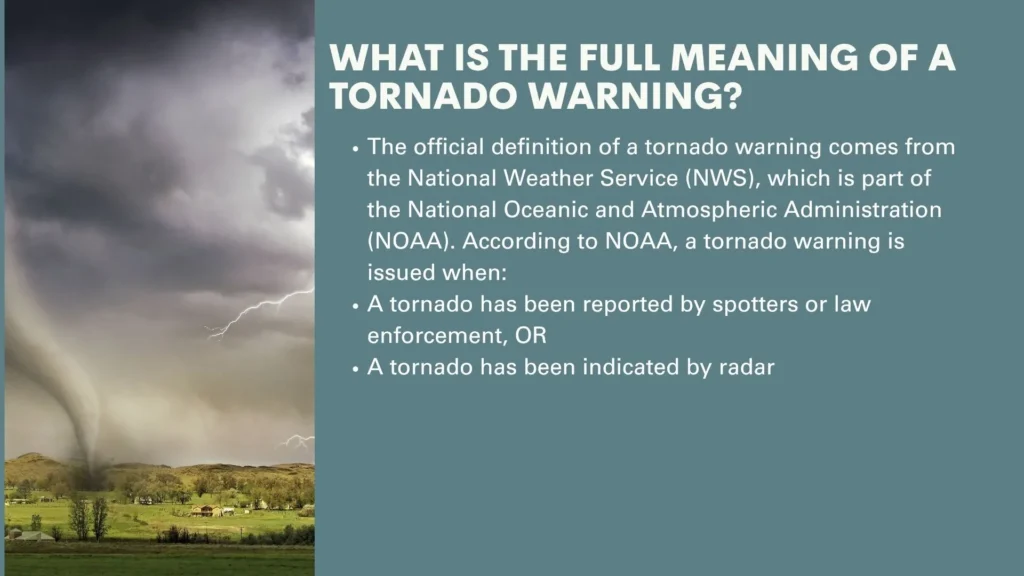
The official definition of a tornado warning comes from the National Weather Service (NWS), which is part of the National Oceanic and Atmospheric Administration (NOAA). According to NOAA, a tornado warning is issued when:
- A tornado has been reported by spotters or law enforcement, OR
- A tornado has been indicated by radar
In simple words: something dangerous is already happening near you. A tornado warning covers a specific area, usually a county or part of a county, and typically lasts 30 to 60 minutes.
Here are the core meanings at a glance:
- Official weather meaning: A tornado has been confirmed or detected take shelter immediately
- General meaning: A serious, urgent alert about tornado activity in your specific area
- Slang/informal meaning: A warning that something intense, chaotic, or overwhelming is coming (used metaphorically)
- Text/social media meaning: Often used to describe a dramatic situation, someone with unpredictable behavior, or a warning about something chaotic
What Does a Tornado Warning Mean in Text?
When someone sends a “tornado warning” in a text message, they’re usually not talking about the weather. In casual texting, the phrase is used as a metaphor. Here’s how it typically shows up:
- “She’s giving me tornado warning vibes” → meaning someone seems unpredictable or intense
- “Bro, tornado warning at home rn” → meaning things are chaotic or there’s a big argument happening
- “That meeting was a tornado warning” → meaning it was stressful and fast-moving
In text conversations, the meaning of tornado warning shifts from a literal weather alert to a way of describing high-stress or chaotic situations. Context is everything.
What Does a Tornado Warning Mean on Social Media?
Social media has added a whole new layer to how people use weather language. Tornado warning is no exception.
WhatsApp Chat Example
Alex: bro why aren’t you answering??
Jordan: sorry fam, tornado warning at my house rn 😭
Alex: omg what happened
Jordan: mom and dad going at it again lol it’s chaos
Here, “tornado warning” means the home environment is tense and chaotic, nothing to do with actual weather.
Instagram DM Example
@user1: did you see her story??
@user2: yeah that’s a whole tornado warning 🌪️ stay away from that drama
@user1: RIGHT lmaooo
On Instagram, the phrase is used to warn someone away from drama or a toxic person almost like a red flag alert.
TikTok Comment Example
@tornadogirl99: POV: your ex texts you 💀
@commentuser: this is a tornado warning era for sure 🌀😭
On TikTok, “tornado warning” is often used humorously to describe a chaotic personal situation, usually tied to relationships or big life events.
Real-Life Meaning and Usage
The definition of tornado warning in a real-life, official context is serious. When the NWS issues one, every second counts. Emergency alerts go out through:
- Wireless Emergency Alerts (WEA) the loud alarm on your phone
- NOAA Weather Radio
- Local TV and radio broadcasts
- Weather apps like Weather.com or the NWS app
If you’re in the warning zone, you’re expected to act immediately. No waiting, no watching from the window.
Real-Life Situations Where a Tornado Warning Is Used
Here are common scenarios where you’ll hear or see this term:
- A storm chaser spots a funnel cloud and reports it to the NWS → a tornado warning is issued for that county
- Doppler radar detects a rotating thunderstorm (called a mesocyclone) → NWS issues a tornado warning even before a tornado touches down
- During a school tornado drill, teachers explain what a tornado warning means vs. a watch
- News reporters break into programming to announce a tornado warning with a map of affected areas
- Friends texting during a storm use the phrase casually to describe the scary weather outside
Examples of “Tornado Warning” in Sentences
Here are at least five example sentences showing how the term is used across different contexts:
- Official: “The National Weather Service has issued a tornado warning for Harris County until 7:45 PM residents should seek shelter immediately.”
- News: “A tornado warning was confirmed after a funnel cloud was spotted near downtown Oklahoma City.”
- Casual text: “Heads up tornado warning at my place, my roommates are losing it 😭”
- Social media: “That party last night was giving full tornado warning energy 🌪️”
- School setting: “Our teacher explained that a tornado warning is more serious than a watch because the tornado is already there.”
- Metaphorical: “Dating him was like living under a constant tornado warning always bracing for impact.”
Tornado Warning in Different Contexts
Formal / Academic Context
In formal settings like a geography class, weather report, or emergency management briefing “tornado warning” always refers to its official NWS definition. The tone is serious, specific, and urgent.
Casual / Everyday Context
Among friends or in everyday life, the phrase is used loosely to mean anything chaotic or intense. It’s a shorthand for “brace yourself, things are about to get wild.”
Online / Slang Context
Online, especially on TikTok and Twitter (X), tornado warning has become a pop culture phrase used to describe dramatic people, situations, or decisions. It’s often paired with the 🌪️ emoji.
Origin and History of the Term
The first official tornado warning in the United States was issued on March 25, 1948, by U.S. Air Force meteorologists Major Ernest Fawbush and Captain Robert Miller at Tinker Air Force Base in Oklahoma. A tornado had struck the base just five days earlier, and when conditions looked similar, they issued a warning and another tornado did hit.
Before this, weather officials actually avoided using the word “tornado” in public communications out of fear of causing panic. That policy changed after 1948, and the NWS eventually built the modern warning system we use today.
The metaphorical use of “tornado warning” in casual speech is much more recent, growing alongside social media culture in the 2010s and 2020s.
Why Do People Use This Term?
People use “tornado warning” for two main reasons:
- Practical safety: The official warning system saves lives by giving people minutes to find shelter before a tornado hits.
- Expressive communication: The phrase is vivid and powerful. It instantly communicates intensity, chaos, and urgency which is why it works so well as a metaphor.
The meaning of tornado warning lands hard whether it’s literal or figurative. That’s the power of using weather as a language tool.
Emotional and Psychological Meaning Behind the Term
A tornado warning triggers a very specific emotional response: immediate fear and urgency. Psychologically, it activates what’s known as the fight-or-flight response. Your brain registers it as a life-threatening signal.
That’s exactly why people borrow the term for non-weather situations. Saying someone gives you “tornado warning vibes” taps into that same emotional intensity. It tells the listener: this is serious, this is fast-moving, and you should pay attention.
Tone Explanation
| Context | Tone |
| Official NWS alert | Urgent, formal, life-saving |
| News broadcast | Serious, informative |
| Texting a friend | Casual, dramatic, sometimes funny |
| TikTok/Instagram | Playful, exaggerated, relatable |
| Academic writing | Neutral, factual |
Is It Rude to Say “Tornado Warning”?
No, “tornado warning” is not a rude phrase. It has no offensive meaning in either its official or informal use. However, using it sarcastically during an actual weather emergency could be seen as dismissive or irresponsible.
Metaphorically, calling a person a “tornado warning” might be seen as rude if said directly to them, since it implies they’re chaotic or destructive. Context and delivery matter.
Is a Tornado Warning Positive, Negative, or Neutral?
Negative in nearly every context.
- Officially, it signals danger and potential destruction
- Metaphorically, it signals chaos, stress, or a problematic person/situation
There are rare humorous uses where it’s used playfully (e.g., “tornado warning energy at this party 🌪️😂”), but even then, it leans toward something overwhelming rather than something good.
When to Use “Tornado Warning”
Use this term when:
- ✅ You’re in an area under an official NWS tornado warning and need to take shelter
- ✅ You’re explaining the definition of tornado warning to someone who doesn’t know the difference between a watch and a warning
- ✅ You’re describing a chaotic situation informally (in texts, captions, or comments)
- ✅ You’re writing about weather safety or emergency preparedness
When NOT to Use “Tornado Warning”
Avoid this term when:
- ❌ You want to describe a tornado watch these are two very different things
- ❌ You’re in a formal setting and trying to use it metaphorically it could confuse people
- ❌ You want to downplay an actual tornado warning as if it’s not serious
Situations Where You Should Avoid This Term
- During an actual emergency, don’t use it as a joke it can cause confusion
- In professional or academic writing, avoid the metaphorical use unless you’re writing about language or culture
- When talking to children about weather safety keep the focus on the official meaning so they know what to do
Decision Guide| What Should You Do During a Tornado Warning?
Use this quick guide to decide your next step:
Are you currently under a tornado warning?
→ Yes: Go to the lowest floor of a sturdy building. Get to an interior room away from windows. Cover your head.
→ No, it’s a tornado watch: Stay alert. Monitor local weather. Prepare your shelter spot just in case.
→ Not sure? Check the NWS website (weather.gov) or your phone’s weather app for your exact location’s status.
Are you in a mobile home or vehicle?
→ Yes: Leave immediately and go to a nearby sturdy building or shelter. Mobile homes and vehicles are extremely dangerous during tornadoes.
→ No: Shelter in place on the lowest floor, away from windows.
Comparison Table| Tornado Warning vs. Similar Terms
| Term | Meaning | Who Issues It | Urgency Level | Key Difference |
| Tornado Warning | Tornado has been spotted or detected on radar | NWS | 🔴 Extreme act NOW | Tornado is confirmed or imminent |
| Tornado Watch | Conditions are favorable for tornadoes to form | NWS Storm Prediction Center | 🟡 High stay alert | No tornado confirmed yet |
| Severe Thunderstorm Warning | Severe thunderstorm with 58+ mph winds or 1″ hail is occurring | NWS | 🟠 Serious take precautions | No tornado confirmed, but dangerous weather |
| Tornado Emergency | Catastrophic tornado confirmed, extreme threat to life | NWS (rare) | 🔴🔴 Critical life-threatening | Stronger language than a standard tornado warning; used for violent, confirmed tornadoes |
Variations and Related Meanings
Here are 5–10 variations and related uses of “tornado warning”:
- Tornado watch conditions are right, but no tornado confirmed yet
- Tornado emergency a rare, extreme-level upgrade from a standard tornado warning
- Funnel cloud warning a rotating column of air is visible but hasn’t touched ground
- Severe weather warning broader term covering multiple types of dangerous weather
- “Tornado warning vibes” slang for someone or something that feels chaotic and unpredictable
- “Red flag warning” a wildfire equivalent; sometimes used interchangeably in casual speech to mean “danger ahead”
- Storm warning general term for any severe weather event
- Flash flood warning same urgent structure as a tornado warning, but for flooding
- Blizzard warning same NWS format, applied to extreme snow and wind
- “Walking tornado warning” slang for a person who causes chaos wherever they go
How to Respond to a Tornado Warning
Casual Reply (Text/Social Media)
- “Oh no, stay safe! 🙏”
- “Bro get to shelter NOW”
- “That’s wild, is everyone okay?”
Funny/Playful Reply (When Used Metaphorically)
- “Already grabbing my metaphorical helmet 😂”
- “And yet you still showed up to the party 🌪️”
- “Noted. Keeping my distance 👀”
Professional/Mature Reply (Official Context)
- “Please follow NWS guidelines and seek shelter immediately.”
- “Our team is monitoring the situation and will provide updates as the warning progresses.”
- “Thank you for the alert. All staff have been notified and are taking shelter.”
Cultural Usage| USA vs Global Context
USA Usage
In the United States, “tornado warning” is a highly specific, well-understood term. Americans, especially those in Tornado Alley (Texas, Oklahoma, Kansas, Nebraska, and surrounding states) grow up doing tornado drills. The phrase carries real weight. Most Americans know exactly what to do when they hear it.
Global / Internet Usage
Outside the U.S., tornadoes are less common, so the official meaning of tornado warning is less widely understood. However, the metaphorical, internet slang usage has spread globally through TikTok, Twitter, and Instagram. Users in the UK, Australia, and other countries use the phrase the same way American Gen Z does to describe chaos, drama, or intense situations.
The 🌪️ emoji has become a universal symbol for this kind of informal use, bridging cultural gaps online.
Frequently Asked Questions
What is the difference between a tornado warning and a tornado watch?
A tornado watch means atmospheric conditions are favorable for tornadoes to develop. No tornado has formed yet. A tornado warning means a tornado has already been confirmed by spotters or detected on radar. A warning requires immediate action; a watch requires heightened alertness.
What does a tornado warning mean for my specific location?
A tornado warning applies to a specific geographic area, usually a county or portion of a county. If your location falls within the warned area, you should seek shelter immediately. Check weather.gov or your local NWS office to confirm whether your address is included.
How long does a tornado warning typically last?
Most tornado warnings are in effect for 30 to 60 minutes, according to NOAA. However, the duration depends on the storm’s speed and movement. Always wait for an official “all clear” from the NWS before leaving shelter.
What should I do the moment a tornado warning is issued?
Go to the lowest level of a sturdy building, such as a basement or an interior room on the ground floor. Stay away from windows. Cover your head and neck. If no building is available, lie flat in a low-lying area and cover your head. Do not shelter under a highway overpass.
What does “tornado warning” mean in slang or text?
In slang and casual texting, “what does a tornado warning mean in slang” is a growing search because younger generations use it to describe chaotic people, intense situations, or anything that signals incoming drama or stress. It’s not an official definition, just a cultural way of expressing urgency and unpredictability.
Is a tornado warning the same as a tornado emergency?
No. A tornado emergency is a rare, upgraded alert issued by the NWS when a large, violent tornado is confirmed and poses an extreme threat to a densely populated area. It’s more severe than a standard tornado warning and uses stronger, more direct language to urge immediate action.
Can a tornado warning be issued without a tornado touching the ground?
Yes. The NWS can issue a tornado warning based solely on radar evidence of rotation, even if no tornado has been visually confirmed. This is called a “radar-indicated” tornado warning, and it’s taken just as seriously as a confirmed one.
Conclusion
A tornado warning is one of the most time-sensitive alerts in the American weather system. When the NWS issues one, the clock starts immediately. The difference between a watch and a warning, between staying calm and taking action, can be the difference between safety and serious harm.
Outside of weather, “tornado warning” has taken on a life of its own in everyday speech, a way to describe intensity, chaos, and the kind of situations you want to be prepared for. Whether you’re sheltering from an actual storm or just navigating a dramatic group chat, understanding what the phrase means in every context keeps you one step ahead.