Have you ever wondered what discreet means? In simple words, discreet describes someone or something that is careful, private, and tactful. A discreet person knows how to keep information confidential, avoid drawing unnecessary attention, and act wisely in sensitive situations.
Whether you see the word in a text message, a business email, or on social media, understanding the meaning of discreet helps you communicate more accurately and avoid confusing it with the similar-looking word discrete, which has a completely different meaning.
What Does Discreet Mean (Quick Meaning)
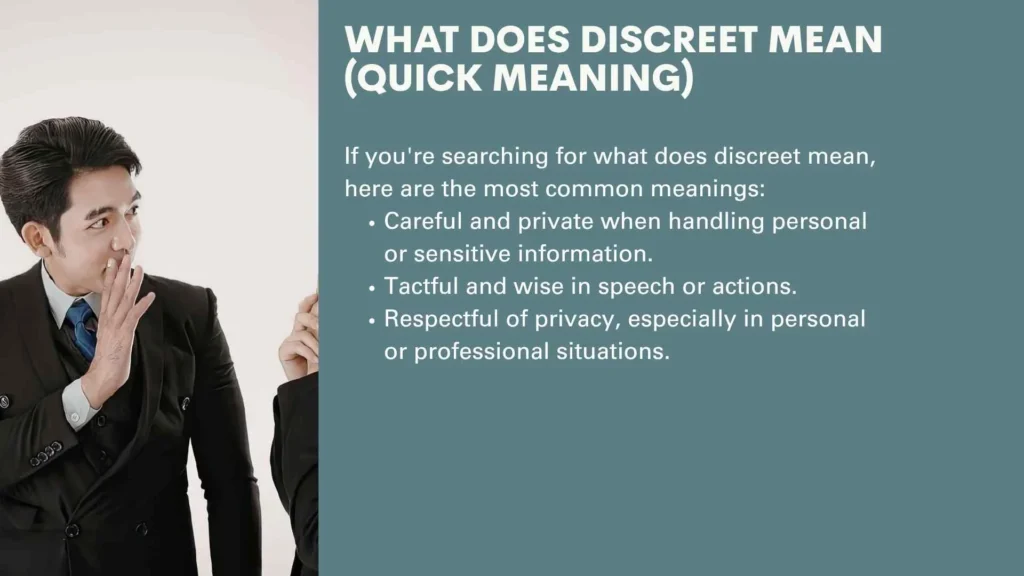
If you’re searching for what does discreet mean, here are the most common meanings:
- Careful and private when handling personal or sensitive information.
- Tactful and wise in speech or actions.
- Designed to avoid attention, such as discreet packaging or services.
- Respectful of privacy, especially in personal or professional situations.
The definition of discreet is being careful, respectful of privacy, and avoiding unnecessary attention while handling information, conversations, or actions.
What Does Discreet Mean?
The word discreet refers to behaving in a thoughtful, careful, and private way. Someone who is discreet understands when information should remain confidential and knows how to handle situations without embarrassing others or attracting attention.
Being discreet doesn’t mean being secretive in a dishonest way. Instead, it usually means showing good judgment and respecting people’s privacy.
For example:
- A doctor is discreet about patient information.
- A friend is discreet when you share a personal secret.
- A company offers discreet shipping for private purchases.
Full Meaning in Simple Words
Think of discreet as another way of saying:
- Careful
- Private
- Respectful
- Trustworthy
- Tactful
- Quiet about sensitive matters
Imagine telling your best friend something personal. If they never tell anyone else, they are being discreet.
Another example is receiving a package without any labels showing what’s inside. That’s called discreet packaging because it protects your privacy.
What Does Discreet Mean in Text?
In text messages, discreet usually means someone wants privacy or wants information handled carefully.
Example
Person A: “Can you keep this between us?”
Person B: “Of course. I’ll be discreet.”
Meaning: I’ll keep your information private.
Sometimes people text:
- “Please be discreet.”
- “Let’s keep this discreet.”
- “Thanks for being discreet.”
These messages all emphasize confidentiality and respect.
What Does Discreet Mean on Social Media (TikTok, Instagram, etc.)?
On social media, discreet often relates to privacy and avoiding public attention.
People may use it when discussing:
- Private relationships
- Anonymous accounts
- Confidential purchases
- Sensitive topics
- Personal matters
Unlike slang words, discreet keeps its standard English meaning online.
WhatsApp Chat Example
Alex: “I need to tell you something personal.”
Jamie: “Don’t worry. I’ll be discreet.”
Instagram DM Example
“I’d rather keep this discreet until everything is official.”
Meaning: They don’t want others to know yet.
TikTok Comment Example
“She handled the situation very discreetly. Respect.”
Meaning: She acted privately and maturely without creating drama.
Real-Life Meaning and Usage
You will hear discreet in many everyday situations.
Some common examples include:
- Healthcare
- Legal services
- Business meetings
- Customer service
- Friendships
- Relationships
- Online shopping
Businesses often advertise:
- Discreet delivery
- Discreet customer support
- Discreet consultation
All of these promise privacy and confidentiality.
Real-Life Situations Where This Term Is Used
At Work
Managers may ask employees to be discreet about company information.
In Healthcare
Doctors remain discreet about patient records.
In Relationships
Partners appreciate discreet conversations regarding personal matters.
During Job Interviews
Candidates may ask recruiters to be discreet if their current employer doesn’t know they’re job hunting.
Shopping Online
Many companies offer discreet packaging for personal products.
Examples of Discreet in Sentences
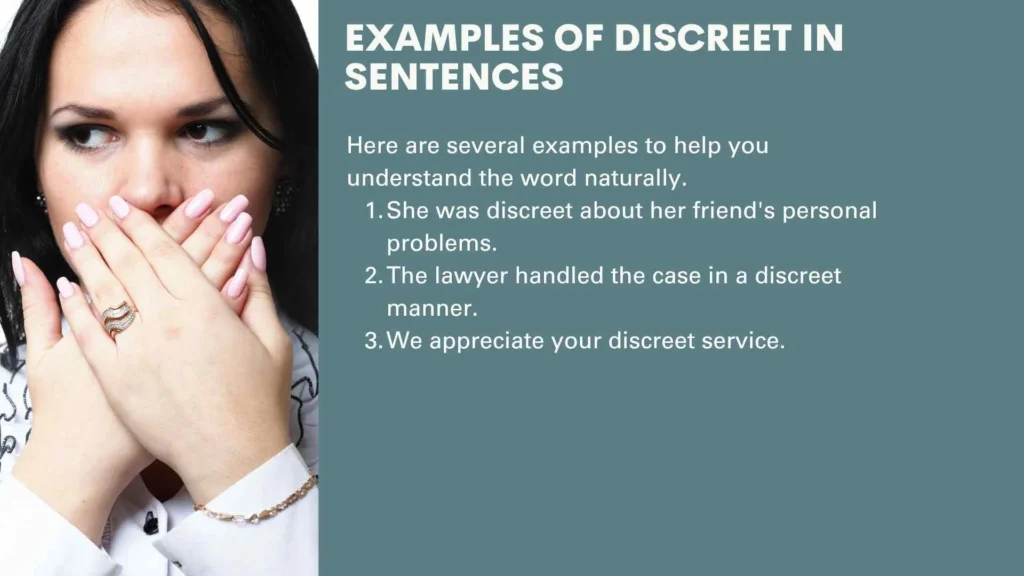
Here are several examples to help you understand the word naturally.
- She was discreet about her friend’s personal problems.
- The lawyer handled the case in a discreet manner.
- We appreciate your discreet service.
- Please be discreet when discussing confidential information.
- He quietly left through the side entrance to remain discreet.
- The company offers discreet packaging for every order.
- A discreet conversation prevented unnecessary gossip.
- Teachers should be discreet when discussing student records.
Different Contexts of Discreet
Casual Conversations
Friends use it when asking someone to keep a secret.
Example:
“Please be discreet about what I told you.”
Professional Setting
Employers value employees who can protect confidential information.
Example:
“Our HR department handles complaints discreetly.”
Academic Context
Teachers may discuss students’ grades discreetly to protect privacy.
Medical Setting
Healthcare workers must remain discreet with patient information.
Online Communication
People may request discreet conversations in private messages rather than public comments.
Origin and History of the Term
The word discreet comes from the Latin word meaning to separate or distinguish wisely.
Over time, English speakers began using it to describe people who show sound judgment, especially when handling private matters.
Today, it mainly refers to being careful, tactful, and respectful of confidentiality.
Why Do People Use This Word?
People use discreet because it quickly communicates trust and professionalism.
Common reasons include:
- Protecting privacy
- Showing respect
- Avoiding embarrassment
- Preventing gossip
- Maintaining confidentiality
- Demonstrating maturity
It is commonly used in customer service, healthcare, legal work, education, and personal relationships.
Emotional & Psychological Meaning Behind This Word
Calling someone discreet is generally a compliment.
It suggests they are:
- Trustworthy
- Responsible
- Mature
- Respectful
- Emotionally intelligent
People naturally trust someone who can keep sensitive information private.
Tone Explanation
Formal
Very common.
Example:
“Our services are completely discreet.”
Informal
Also common.
Example:
“Be discreet, okay?”
Slang
No.
Discreet is not slang.
Offensive
No.
It is considered polite and respectful.
Is It Rude to Say This Word?
No.
In fact, discreet is usually viewed as positive.
However, context matters.
Instead of saying:
“You should be discreet.”
You could politely say:
“It may be best to keep this private.”
This sounds less like criticism.
Is This Word Positive, Negative, or Neutral?
Mostly positive.
Positive
- Respectful
- Professional
- Trustworthy
Neutral
Sometimes simply describes private behavior.
Negative
Rarely negative unless used sarcastically.
Example:
“Oh sure, you were really discreet.”
When to Use Discreet
Use this word when discussing:
- Confidential information
- Personal conversations
- Business matters
- Medical records
- Legal advice
- Sensitive purchases
- Professional communication
- Respect for privacy
When NOT to Use Discreet
Avoid using it when talking about:
- Physical separation of objects
- Individual parts of something
In these cases, the correct word is discrete, not discreet.
Example:
❌ “The graph has discreet sections.”
✅ “The graph has discrete sections.”
Situations Where You Should Avoid Using This Word
Don’t use discreet when:
- You actually mean “separate.”
- Discussing mathematical concepts.
- Referring to individual categories.
- Talking about distinct objects.
Remember:
- Discreet = careful
- Discrete = separate
Discreet vs Similar Words
| Word | Meaning | Common Usage | Key Difference |
| Discreet | Careful and private | Confidential situations | Focuses on privacy and tact |
| Private | Not open to everyone | Personal information | Broader than discreet |
| Confidential | Officially secret | Business, legal, medical | More formal and legal |
| Secretive | Hides information | Personal behavior | Often has a negative tone |
| Discrete | Separate or distinct | Math, science, technology | Means separate—not private |
Possible Meanings and Variations
Depending on context, discreet can imply:
- Careful with information
- Respectful of privacy
- Quiet and low-profile
- Professional confidentiality
- Tactful communication
- Discreet packaging
- Discreet customer service
- Discreet investigation
- Discreet relationship
- Discreet behavior
How to Respond When Someone Says “Be Discreet”
Casual Replies
- “Don’t worry.”
- “I’ve got you.”
- “Your secret is safe.”
- “I won’t tell anyone.”
Funny Replies
- “My lips are officially sealed.”
- “I’m taking this secret to the grave.”
- “Even my phone doesn’t know.”
Professional Replies
- “Absolutely. I’ll keep this confidential.”
- “You can trust me.”
- “I’ll handle it professionally.”
- “Your privacy will be respected.”
USA / Western Usage
In the United States, discreet commonly appears in:
- Healthcare
- Banking
- Legal services
- Online shopping
- Customer service
- Human resources
Businesses frequently advertise:
- Discreet billing
- Discreet packaging
- Discreet consultation
Americans generally associate the word with professionalism and privacy.
Global or Internet Usage Differences
Worldwide, discreet carries nearly the same meaning.
Online, people use it when discussing:
- Private messaging
- Anonymous accounts
- Sensitive purchases
- Personal relationships
- Confidential discussions
Its meaning remains consistent across English-speaking countries.
What Does Discreet Mean in Slang?
Many people search for what does discreet mean in slang, but the truth is that discreet isn’t slang.
It keeps its standard English meaning:
- Private
- Careful
- Respectful
- Confidential
Some dating profiles use “discreet” to indicate someone prefers privacy, but this is still the regular meaning rather than slang.
Frequently Asked Questions
What does discreet mean in simple words?
It means being careful, private, and respectful when handling sensitive information or situations.
What does discreet mean in text messages?
It means keeping something confidential or avoiding unnecessary attention.
Is discreet a compliment?
Yes. Calling someone discreet usually means they are trustworthy and respectful.
Is discreet the same as secretive?
No. Discreet has a positive meaning, while secretive often suggests hiding information in a suspicious way.
What is the difference between discreet and discrete?
Discreet means careful and private.
Discrete means separate or distinct.
Is discreet a formal word?
Yes, but it is also commonly used in everyday conversations.
Why do businesses advertise discreet packaging?
It reassures customers that their purchases will arrive without revealing what’s inside.
Conclusion
Understanding what does discreet mean can improve both your communication and your vocabulary. The word describes someone or something that handles information with care, respects privacy, and avoids unnecessary attention. Whether you’re reading a business email, chatting with friends, shopping online, or browsing social media, you’ll often encounter this positive and professional term.
Remember the simple rule: discreet means private and careful, while discrete means separate or distinct. Knowing the difference will help you use both words confidently in everyday English.

James Parker is a passionate writer and language enthusiast dedicated to helping readers understand words, meanings, and communication in a simple and effective way. With years of experience in educational writing and vocabulary research, he creates easy-to-understand content that helps students, learners, and readers improve their language skills.
At MeanNings.com, James focuses on providing accurate word meanings, English vocabulary, synonyms, antonyms, and practical language guides. His writing style is clear, informative, and designed for readers of all levels.
James believes that learning language should be simple, engaging, and accessible to everyone. Through his work, he aims to make complex words easier to understand and help readers build confidence in communication.
Books by James Parker
- The Power of Words
- Mastering Everyday Vocabulary
- English Meanings Simplified
 Daniel Brooks