If you’re wondering what does disdain mean, it refers to a strong feeling of disrespect, scorn, or disapproval toward someone or something that a person considers unworthy of respect. Unlike simple dislike, disdain often includes a sense of looking down on someone or believing they are beneath you.
Understanding the meaning of disdain can help you better recognize emotions in conversations, literature, social media posts, and everyday interactions. It is a powerful word that describes more than annoyance—it describes contempt mixed with judgment.
What Does Disdain Mean?
- A strong feeling of disrespect or scorn
- Looking down on someone or something as unworthy
- Showing contempt, rejection, or superiority
- Expressing intense disapproval or lack of respect
What Does Disdain Mean?
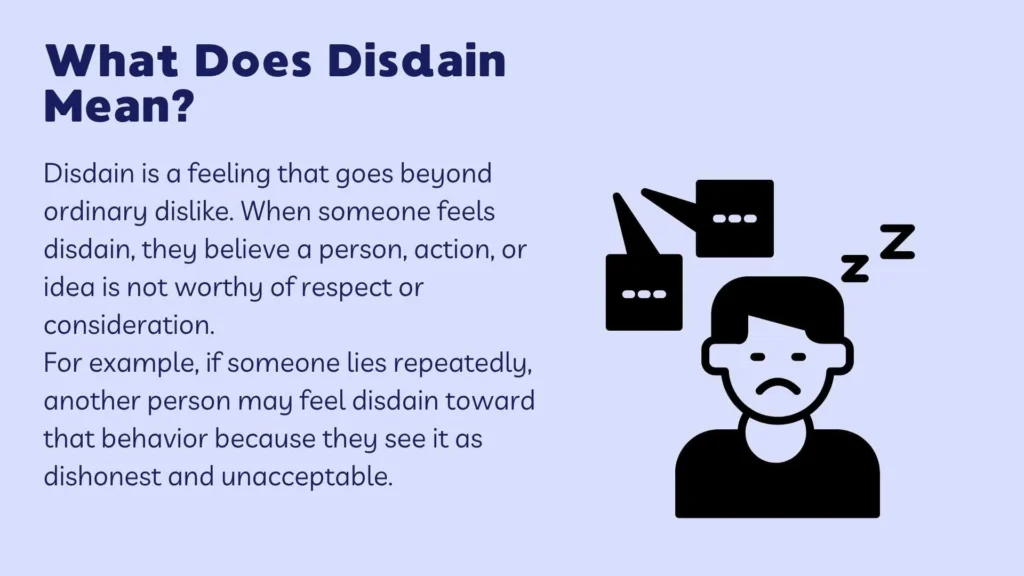
Disdain is a feeling that goes beyond ordinary dislike. When someone feels disdain, they believe a person, action, or idea is not worthy of respect or consideration.
For example, if someone lies repeatedly, another person may feel disdain toward that behavior because they see it as dishonest and unacceptable.
Disdain can be shown through:
- Words
- Facial expressions
- Tone of voice
- Body language
- Actions
Unlike anger, which is often emotional and immediate, disdain can feel colder and more judgmental.
Full Meaning in Simple Words
In everyday language, disdain means:
“I don’t respect this person, idea, or behavior because I think it is beneath my standards.”
For example:
- A student may feel disdain for cheating.
- A customer may show disdain toward poor service.
- A person may feel disdain for dishonesty or cruelty.
The definition of disdain combines three main ideas:
- Strong dislike
- Lack of respect
- A feeling of superiority
That’s what makes disdain different from simply not liking something.
What Does Disdain Mean in Text?
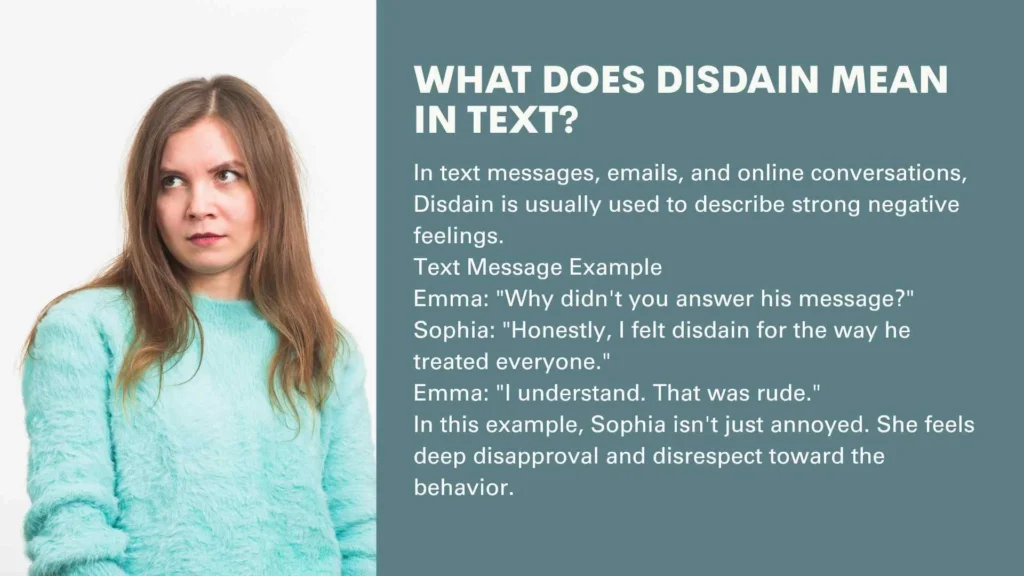
In text messages, emails, and online conversations,
Disdain is usually used to describe strong negative feelings.
Text Message Example
Emma: “Why didn’t you answer his message?”
Sophia: “Honestly, I felt disdain for the way he treated everyone.”
Emma: “I understand. That was rude.”
In this example, Sophia isn’t just annoyed. She feels deep disapproval and disrespect toward the behavior.
Common Text Meanings
When used in text, disdain often means:
- Strong disapproval
- Lack of respect
- Looking down on someone’s actions
- Feeling contempt
Disdain Synonym
The best synonym for disdain depends on the context, but it generally refers to a feeling of deep disrespect, contempt, or scorn toward someone or something. It describes looking down on a person, idea, or behavior because you believe it is unworthy of respect.
Common synonyms for disdain include:
- Contempt – strong dislike mixed with a sense of superiority.
- Scorn – open expression of disrespect or mockery.
- Disrespect – lack of respect for someone or something.
- Derision – ridicule or mocking criticism.
- Disgust – strong revulsion, often with contempt.
- Loathing – intense hatred or dislike.
- Disapproval – a negative opinion without necessarily feeling superior.
- Snobbery – treating others as inferior because of social status.
- Arrogance – behaving as though you are better than others.
- Disrespectfulness – showing little regard for another person.
While these words are related, they are not always interchangeable. For example, contempt is usually the closest synonym because it combines dislike with a feeling of superiority. Scorn often emphasizes outward actions, such as mocking or rejecting someone. Disapproval, on the other hand, is milder and may simply mean you do not agree with something.
Real-life examples
- The manager showed disdain for employees who arrived late every day.
- She looked at the fake designer bag with obvious contempt.
- Many people expressed scorn toward the unfair decision.
Choosing the right synonym depends on the tone you want. If you are describing a powerful feeling of disrespect, contempt or scorn usually works best. For everyday writing, disrespect or disapproval may be more appropriate.
What Does Disdain Mean in Law
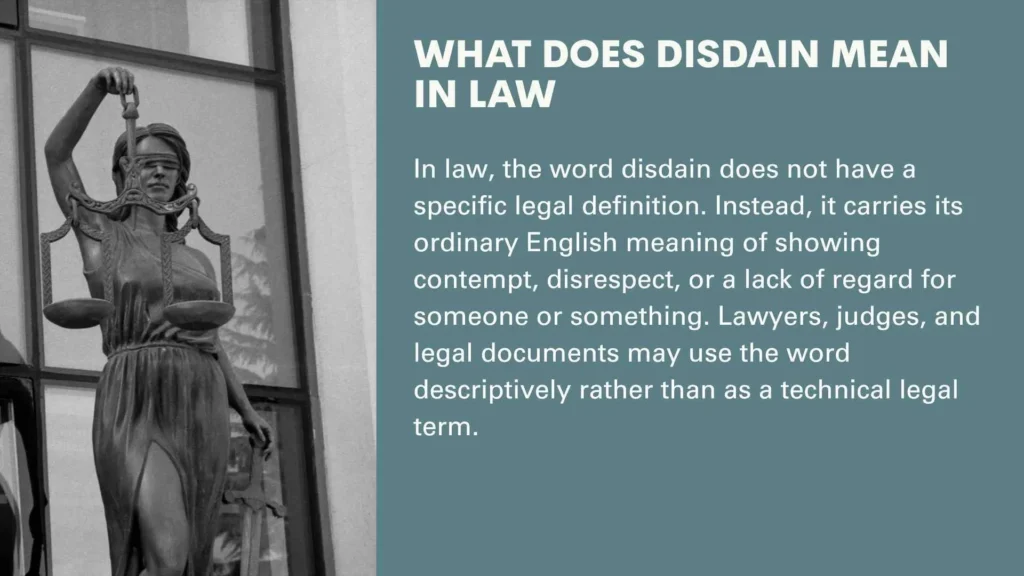
In law, the word disdain does not have a specific legal definition. Instead, it carries its ordinary English meaning of showing contempt, disrespect, or a lack of regard for someone or something. Lawyers, judges, and legal documents may use the word descriptively rather than as a technical legal term.
For example, a court might describe someone’s behavior as showing disdain for the law, meaning that the person ignored legal rules or treated them with disrespect. Similarly, a judge may say a party displayed disdain for the court’s authority if they repeatedly violated court orders or refused to cooperate.
Although disdain itself is not a legal offense, actions that demonstrate disdain can sometimes lead to legal consequences. Examples include:
- Ignoring a court order.
- Refusing to follow judicial instructions.
- Showing disrespectful conduct during court proceedings.
- Repeatedly violating legal obligations.
In these situations, the legal issue is not the emotion of disdain but the conduct that accompanies it. For example, someone who openly ignores a judge’s order may face penalties because they failed to comply with the law, not simply because they felt contempt.
Real-life examples
- The judge stated that the defendant’s actions showed disdain for the justice system.
- A company demonstrated disdain for safety regulations by repeatedly ignoring inspection requirements.
- An individual who continually violated court orders was described as acting with disdain toward the court’s authority.
In legal writing, disdain is mainly used as descriptive language to emphasize disrespect or contempt rather than to identify a specific legal concept or crime.
What Does Disdain Mean in English
In English, disdain means a feeling of strong disrespect, contempt, or scorn toward someone or something that you believe is unworthy of respect. It can be used as both a noun and a verb.
As a noun, disdain refers to the feeling itself.
- He spoke with disdain about dishonest behavior.
As a verb, it means to reject or look down on someone or something.
- She disdained taking shortcuts because she valued honesty.
The word often suggests that the person feels superior to the object of their disdain. It is stronger than simple dislike because it combines negative feelings with a belief that the other person or thing deserves little respect.
Some closely related words include:
- Contempt
- Scorn
- Disrespect
- Derision
- Disapproval
The opposite of disdain includes words such as respect, admiration, esteem, and appreciation.
Real-life examples
- The athlete showed disdain for unfair competition.
- Many readers expressed disdain toward misleading advertisements.
- She did not hide her disdain for rude behavior during the meeting.
In everyday English, disdain is commonly used in conversations, literature, news articles, and formal writing to describe an attitude of looking down on others. It often appears when discussing social behavior, relationships, politics, workplace situations, and personal opinions.
Disdain in a Sentence
The word disdain is commonly used in sentences to describe strong disrespect, contempt, or scorn toward a person, idea, action, or object. It can function as either a noun or a verb, depending on how it is used.
Disdain as a noun
- She looked at the broken toy with disdain.
- His voice was filled with disdain when discussing dishonesty.
- The audience reacted with disdain to the offensive remarks.
- Many people expressed disdain for the unfair policy.
- Her disdain for gossip was obvious.
Disdain as a verb
- He disdained cheating to win the competition.
- She disdained anyone who lied to gain an advantage.
- They disdain unnecessary luxury and prefer a simple lifestyle.
- The scientist disdained unsupported claims without evidence.
- We should not disdain people simply because they have different opinions.
Real-life examples
- A customer showed disdain by refusing to listen respectfully to the store employee.
- The coach disdained excuses and expected every player to work hard.
- Many citizens expressed disdain for corruption and demanded greater accountability.
Does Disdain Mean Hate
Yes, disdain and hate are related emotions, but they do not mean the same thing. Disdain means feeling that someone or something is beneath your respect or unworthy of your attention. Hate, on the other hand, is a much stronger emotion involving intense dislike, anger, or hostility.
When you feel disdain, you often look down on a person or idea with contempt or scorn. You may not feel angry—you simply believe it deserves little respect. Hate usually involves powerful negative feelings and may lead to resentment or conflict.
Here are the key differences:
- Disdain: Looking down on someone with contempt or disrespect.
- Hate: Feeling deep anger, dislike, or hostility toward someone or something.
- Disdain often comes from a sense of superiority.
- Hate is usually driven by strong emotional pain, fear, or resentment.
Real-life examples
- A teacher may disdain cheating because it goes against honesty, but that does not mean the teacher hates the students who cheat.
- Someone might hate spicy food because it makes them uncomfortable, but they would not feel disdain toward it.
- A wealthy character in a novel may look at poor people with disdain, believing they are inferior.
Many dictionaries list words such as contempt, scorn, disrespect, derision, disapproval, and arrogance alongside disdain. Meanwhile, hatred, loathing, animosity, hostility, and resentment are more closely associated with hate.
Understanding this difference helps you choose the right word. Use disdain when describing a feeling of contempt or looking down on someone, and use hate when referring to deep emotional dislike.
What Does Disdain Mean in the Bible
In the Bible, disdain refers to treating someone or something with contempt, scorn, or a lack of respect. Although some Bible translations may not frequently use the exact word disdain, the idea appears throughout Scripture whenever people reject God’s wisdom, mock others, or show pride and arrogance.
Biblically, disdain is often connected with sinful attitudes such as:
- Pride
- Arrogance
- Contempt
- Mockery
- Disrespect
- Hard-heartedness
The Bible teaches believers to avoid looking down on others because every person is created with value and dignity. Instead of showing disdain, Christians are encouraged to practice humility, kindness, forgiveness, compassion, and love.
For example, the religious leaders during Jesus’ ministry sometimes treated tax collectors and sinners with disdain because they considered them morally inferior. Jesus challenged this attitude by showing mercy and compassion to those who were rejected by society.
Another example is when people mocked or rejected God’s prophets. Their disdain reflected not only disrespect for the messengers but also rejection of God’s message.
Everyday examples
- A person who laughs at someone’s faith may show disdain for religious beliefs.
- Someone who refuses to listen because they think others are beneath them displays a spirit of disdain.
- Choosing kindness instead of contempt reflects the biblical teaching of loving your neighbor.
In biblical understanding, disdain is generally viewed as a negative attitude because it grows out of pride rather than humility. Scripture consistently encourages respect, mercy, and love instead of contempt for others.
Disdain Look Meaning
A disdain look is a facial expression that shows contempt, scorn, disgust, or a feeling that someone or something is not worthy of respect. It communicates negative judgment without needing words.
People often recognize a disdainful look through subtle facial cues rather than obvious actions. Common signs include:
- Raising one eyebrow.
- Rolling the eyes.
- Looking down at someone dismissively.
- Curling one side of the mouth into a slight sneer.
- A cold, uninterested stare.
A disdainful look usually suggests that the person feels superior or unimpressed. It is different from an angry expression because it focuses more on disrespect than rage.
Real-life examples
- During a meeting, a manager gives a disdainful look after hearing an unrealistic suggestion.
- A movie villain glances at the hero with a look of disdain before walking away.
- A teenager gives a disdainful look when asked to do chores, silently expressing contempt.
Similar expressions include scornful look, contemptuous glance, sneer, disapproving expression, dismissive look, and condescending stare. These phrases all describe facial expressions that communicate disrespect or disapproval.
Writers often use the phrase “a look of disdain” to show a character’s attitude without directly stating their feelings. This helps readers understand emotions through body language instead of dialogue.
Overall, a disdain look is a powerful nonverbal signal that expresses contempt, superiority, or lack of respect toward a person, object, or idea.
Disdain Expression Meaning
The expression of disdain refers to any facial expression, gesture, tone of voice, or body language that shows contempt, scorn, or disrespect. It reveals that a person thinks someone or something is beneath consideration or respect.
Unlike simple disappointment or annoyance, an expression of disdain suggests a feeling of superiority. It often communicates, “I don’t think this deserves my respect.”
Common expressions of disdain include:
- A sneer or curled lip.
- Rolling the eyes.
- Looking away dismissively.
- Folding the arms while smirking.
- Speaking with a sarcastic or contemptuous tone.
These expressions may be subtle, but they clearly communicate negative feelings.
Real-life examples
- An employee responds to criticism with an expression of disdain, silently showing contempt for the manager’s opinion.
- A politician reacts with visible disdain during a debate after hearing an opponent’s statement.
- A shopper gives a disdainful expression when offered a product they consider poor quality.
Related words include contempt, scorn, disrespect, derision, arrogance, sneer, dismissiveness, and condescension. These terms are often used in discussions of emotions, communication, literature, and psychology.
What Does Disdain Mean on Social Media (TikTok, Instagram, etc.)?
On social media platforms, the word “disdain” is often used when discussing:
- Drama
- Celebrity reactions
- Relationship conflicts
- Political debates
- Viral videos
People use the term to describe expressions, attitudes, and behaviors that communicate disrespect.
What Does Disdain Mean on TikTok?
TikTok users frequently use the word when analyzing facial expressions or reactions.
Example TikTok Caption:
“That look of pure disdain says everything.”
Meaning: The person clearly looks disgusted or disapproving.
What Does Disdain Mean on Instagram?
Instagram users often use the word in captions and comments.
Example Comment:
“You can see the disdain in her eyes.”
Meaning: Her expression shows clear disrespect or contempt.
WhatsApp Chat Example
Jake: “Did you enjoy the meeting?”
Ryan: “No, I felt complete disdain for how they handled it.”
Jake: “Sounds like it was frustrating.”
Instagram DM Example
Friend: “What did you think of that influencer?”
You: “Honestly, I felt some disdain after hearing those comments.”
Friend: “Yeah, they were pretty disrespectful.”
TikTok Comment Example
Video: Someone acting arrogantly.
Comment: “The disdain in that expression is impossible to miss.”
Meaning: The viewer noticed obvious disrespect.
Real-Life Meaning and Usage
Disdain appears in many real-world situations.
People may experience disdain toward:
- Dishonesty
- Arrogance
- Cruel behavior
- Corruption
- Unfair treatment
It is often connected to moral judgments and personal values.
For example, a person may feel angry about dishonesty, but disdain adds another layer: they also lose respect for the dishonest person.
Real-Life Situations Where This Term Is Used
Workplace Conflicts
Employees may feel disdain toward unethical behavior.
School and Education
Teachers may express disdain toward plagiarism or cheating.
Relationships
Someone may develop disdain after repeated disrespect.
Politics
Citizens may feel disdain toward corruption.
Sports Rivalries
Fans sometimes express disdain toward rival teams.
Customer Experiences
Consumers may show disdain toward poor customer service.
Examples of Disdain in Sentences
Here are several examples of disdain in everyday use:
- She looked at the dishonest politician with disdain.
- His voice carried obvious disdain for the proposal.
- Many people feel disdain toward scammers.
- The teacher showed disdain for plagiarism.
- He spoke about the decision with clear disdain.
- Her facial expression revealed her disdain.
- They treated the idea with complete disdain.
- The audience reacted with disdain to the offensive remarks.
Different Contexts of Disdain
Casual Context
In everyday conversations, disdain describes strong dislike.
Example: “I have disdain for rude behavior.”
Academic Context
Students often encounter the word in literature and psychology.
Example: “The character’s disdain reflects class differences.”
Professional Context
Disdain may be discussed in leadership, ethics, and workplace communication.
Online Context
The word frequently appears in social media commentary.
Literary Context
Authors use disdain to reveal character emotions and conflicts.
Origin and History of the Term
The word “disdain” comes from Old French and entered English hundreds of years ago.
Historically, it referred to rejecting or looking down on something considered unworthy.
Writers throughout history have used disdain in novels, poetry, and speeches to describe pride, contempt, and social judgment.
Today, the meaning remains largely the same, although it is now commonly used in everyday conversations and online discussions.
Why Do People Use This Word?
People use the word disdain because it communicates a very specific emotion.
It is stronger than:
- Dislike
- Annoyance
- Frustration
The word helps explain situations where someone not only dislikes something but also loses respect for it.
Using the word allows people to express deeper emotional reactions with greater precision.
Emotional & Psychological Meaning Behind This Word
Psychologically, disdain is linked to:
- Contempt
- Moral judgment
- Feelings of superiority
- Social distancing
When someone feels disdain, they often see themselves as morally, intellectually, or socially above the person or behavior they are criticizing.
Researchers often consider disdain and contempt important emotions because they can affect relationships and communication.
Common emotions associated with disdain include:
- Disapproval
- Disgust
- Frustration
- Disappointment
- Superiority
Tone Explanation
| Tone Type | Description |
| Formal | Common |
| Informal | Sometimes |
| Academic | Frequently used |
| Emotional | Strong |
| Slang | No |
| Offensive | Depends on context |
| Professional | Acceptable |
Disdain is generally considered a formal or semi-formal word.
Is It Rude to Say This Word?
The word itself is not rude.
However, because disdain describes disrespect, using it can sometimes sound harsh.
For example:
- “I disagree with you” sounds neutral.
- “I feel disdain for your opinion” sounds much stronger.
So while the word isn’t offensive, it can create tension depending on how it is used.
Is This Word Positive, Negative, or Neutral?
Negative
Most uses of disdain are negative because they involve disrespect or disapproval.
Neutral
In academic writing, the word can be neutral and descriptive.
Positive
Rarely positive. Sometimes people use it when rejecting harmful actions or unethical behavior.
Overall, disdain is generally viewed as a negative emotion.
When to Use Disdain
Use the word when:
- Describing strong disapproval
- Writing essays or reports
- Discussing emotions
- Analyzing literature
- Explaining attitudes and behavior
It works best when ordinary words like “dislike” are not strong enough.
When NOT to Use Disdain
Avoid using disdain when:
- Trying to sound diplomatic
- Resolving conflicts
- Speaking to sensitive audiences
- Giving constructive feedback
The word can sound judgmental and harsh.
Situations Where You Should Avoid Using This Word
You may want to avoid the word in:
- Job interviews
- Customer service interactions
- Professional disagreements
- Family disputes
- Mediation discussions
In these situations, softer language may be more effective.
Disdain vs Similar Words
Comparison Table
| Word | Meaning | Usage | Key Difference |
| Disdain | Strong disrespect and scorn | Formal and emotional contexts | Includes judgment and superiority |
| Dislike | Not enjoying something | Everyday conversations | Much weaker emotion |
| Contempt | Deep disrespect | Serious situations | Usually stronger than disdain |
| Scorn | Openly mocking disrespect | Emotional or literary use | More openly mocking |
| Annoyance | Mild irritation | Casual situations | Much less intense |
Variations and Related Meanings
Contempt
A stronger form of disrespect.
Scorn
Mocking or ridiculing someone.
Disapproval
Believing something is wrong.
Aversion
Strong dislike or avoidance.
Condescension
Talking down to others.
Rejection
Refusing to accept something.
Disrespect
Lack of regard for someone.
Hostility
Open negativity toward others.
Disgust
Strong revulsion or dislike.
Superiority
Feeling above others socially or morally.
How to Respond to Disdain
Casual Replies
- “I see where you’re coming from.”
- “That’s your opinion.”
- “Fair enough.”
Funny Replies
- “Tell us how you really feel!”
- “That’s one way to put it!”
- “No sugarcoating there!”
Professional or Mature Replies
- “I understand your concerns.”
- “Let’s discuss this respectfully.”
- “I appreciate your perspective.”
Cultural Usage
USA / Western Usage
In the United States and other Western countries, disdain is commonly used in:
- Literature
- News analysis
- Political discussions
- Relationship advice
- Professional communication
It is generally understood as a sophisticated word describing strong disapproval.
Global or Internet Usage Differences
Online communities worldwide use the word similarly.
However, internet users often apply it to:
- Viral reactions
- Celebrity controversies
- Meme culture
- Social commentary
The core meaning remains consistent across cultures.
What Does Disdain Mean in Text?
In text messages, disdain means strong disapproval, disrespect, or contempt toward a person, behavior, or idea.
People use it when “dislike” doesn’t fully capture the intensity of their feelings.
What Does Disdain Mean on TikTok / Instagram?
On TikTok and Instagram, disdain usually describes:
- Facial expressions
- Negative reactions
- Disrespectful attitudes
- Social criticism
The word often appears in captions, comments, and reaction videos.
Is It Rude to Say This?
Not necessarily.
The word itself is acceptable and professional. However, because it describes strong disrespect, it can sound harsh depending on the situation.
Why Do People Use This Word?
People use disdain because it clearly communicates:
- Strong emotions
- Moral judgment
- Lack of respect
- Social rejection
It helps describe feelings that are stronger than simple annoyance or dislike.
Frequently Asked Questions
What does disdain mean in simple words?
Disdain means strong dislike and disrespect toward someone or something considered unworthy.
Is disdain stronger than dislike?
Yes. Disdain includes disrespect and judgment, making it stronger than ordinary dislike.
What is an example of disdain?
“She looked at the dishonest behavior with disdain.”
Is disdain a negative word?
Most of the time, yes. It usually describes negative emotions and attitudes.
What is the difference between disdain and contempt?
Contempt is often considered more intense, while disdain focuses more on looking down on someone.
Can disdain be used in everyday conversation?
Yes, although it is more common in formal discussions and writing.
What does disdainful mean?
Disdainful describes someone showing or expressing disdain.
Conclusion
Understanding what does disdain mean helps you recognize one of the strongest forms of disapproval in the English language. Disdain is more than simple dislike—it combines disrespect, scorn, and a sense of superiority toward a person, behavior, or idea.
Whether you encounter the word in books, social media posts, text messages, workplace discussions, or everyday conversations, the meaning of disdain remains consistent: a powerful feeling that something is unworthy of respect. Learning how and when to use the word can improve your vocabulary, communication skills, and understanding of emotional language.