Moving into a college dorm, accepting a new job, or signing a housing agreement can bring up one common question: What Does Room and Board Mean? In simple terms, room and board refers to the cost of a place to live (room) and the meals provided (board). You’ll often see this term in college tuition, employee benefits, rental agreements, and boarding arrangements.
While the basic meaning stays the same, the details can vary depending on the school, employer, or industry. For example, one college may include a meal plan with room and board, while another offers different housing and dining options at separate prices. Understanding what’s included can help you avoid unexpected costs and make smarter financial decisions.
What Does Room and Board Mean (Quick Meaning)
Here are the most common meanings of room and board:
- Housing and meals provided together (most common meaning)
- A living arrangement where accommodation and food are included
- A common expense in college tuition and financial aid discussions
- A benefit offered by some employers, camps, or boarding schools
Room and board means a package that includes a place to live (room) and meals (board). It is commonly used for college housing, boarding schools, work benefits, and temporary living arrangements.
What Does Room and Board Mean?
The meaning of room and board is simple:
- Room = A place to stay or sleep.
- Board = Meals or food provided regularly.
When combined, room and board refers to receiving both housing and meals as part of the same arrangement.
For example, many colleges list tuition separately from room and board because students often pay additional fees for living in campus housing and eating in the dining hall.
What does room and board mean include in general
Room and board generally includes two essential living expenses: housing (room) and meals (board). When an employer, college, boarding school, or care facility says it provides room and board, it usually means you receive a place to live along with daily meals as part of the agreement. However, what is included can vary depending on the organisation or contract.
In most cases, room refers to:
- A private or shared bedroom
- Basic furniture such as a bed, desk, and wardrobe
- Utilities like electricity, water, and heating
- Internet access in some locations
Board refers to:
- Breakfast, lunch, and dinner
- Meal plans or cafeteria access
- Sometimes snacks or beverages
Keep in mind that room and board does not always include personal expenses such as transportation, laundry, toiletries, entertainment, textbooks, or health insurance. Always review the agreement to understand what is covered.
Real-life examples
- A university charges students £8,000 per year for room and board, covering a dormitory room and three meals daily.
- A summer camp offers free room and board to counselors in exchange for their work.
- An employee at a remote resort receives accommodation and meals as part of their compensation package.
The exact benefits differ by institution or employer, so asking for a detailed list of included services helps avoid unexpected costs.
Room and board in hospital meaning
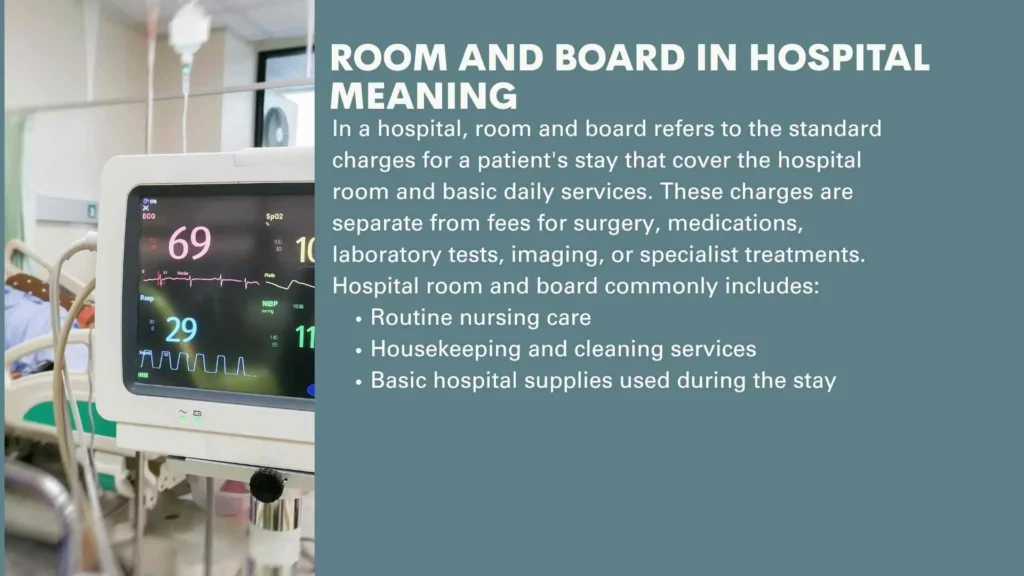
In a hospital, room and board refers to the standard charges for a patient’s stay that cover the hospital room and basic daily services. These charges are separate from fees for surgery, medications, laboratory tests, imaging, or specialist treatments.
Hospital room and board commonly includes:
- A private, semi-private, or shared hospital room
- Regular meals designed for the patient’s medical needs
- Routine nursing care
- Housekeeping and cleaning services
- Basic hospital supplies used during the stay
Many health insurance policies mention room and board because they often pay only up to a certain room category. If a patient chooses a more expensive private room than their insurance allows, they may have to pay the difference.
Examples
- A patient recovering after surgery stays in a semi-private room, and the room and board charge covers accommodation, meals, and routine nursing care.
- An insurance company pays for standard room and board but does not cover a luxury hospital suite.
- A maternity patient receives room and board charges for each day spent in the hospital after childbirth.
Understanding hospital room and board helps patients read medical bills more accurately and estimate out-of-pocket healthcare expenses before admission.
Room and board origin
The phrase room and board dates back several centuries and combines two everyday words that describe the basic necessities of living. While room clearly means a place to stay, board originally referred to the table where meals were served.
Historically, people would gather around a large wooden board used as a dining table. Over time, the word board became closely associated with meals rather than the furniture itself. By the 16th and 17th centuries, the expression board commonly meant food or meal service.
As inns, boarding houses, and schools became more common, the combined phrase room and board developed to describe accommodation together with meals under one payment or agreement.
Today, the expression remains widely used in:
- Colleges and universities
- Boarding schools
- Hotels with long-term accommodation
- Employee housing
- Military and care facilities
Historical examples
- Boarding houses charged guests one fee for room and board.
- Students attending residential schools paid tuition plus room and board.
- Farm workers often received room and board instead of higher wages during seasonal employment.
Although lifestyles have changed, the phrase continues to describe the combined cost of lodging and meals in many parts of the world.
What does the board mean in room and board
In the phrase room and board, the word board means meals or food provided as part of your accommodation. It does not refer to a committee, board of directors, whiteboard, or wooden plank in this context.
The meaning comes from an old tradition where families and guests ate together around a wooden dining board. Eventually, the word board became another way of saying meals or meal service.
When someone says they receive board, it usually means:
- Daily meals are provided.
- Food is included in the overall cost.
- The person does not need to purchase separate meal plans.
Examples
- A boarding school provides students with board through its dining hall.
- A hotel advertises room and board, meaning guests receive accommodation and meals.
- A live-in caregiver receives free room and board from the family they work for.
Understanding the meaning of board helps explain related terms like boarding house, boarding school, and full board, all of which involve providing meals along with accommodation.
Room and board synonym
There is no single perfect synonym for room and board, but several similar expressions describe accommodation with meals included. The best choice depends on the situation.
Common synonyms and related terms include:
- Accommodation and meals
- Lodging and meals
- Housing and meals
- Board and lodging
- Living accommodations
- Residential accommodation
- Full board (meals included)
- Bed and board (older expression)
Each phrase has slightly different usage. For example, board and lodging is common in British English, while room and board is more widely used in American English.
Examples
- The internship provides accommodation and meals throughout the programme.
- Staff members receive board and lodging while working at the countryside hotel.
- International students pay separately for tuition and room and board.
When writing formally, choose the expression that matches your audience. For American readers, room and board remains the clearest and most recognised term, while British readers may be more familiar with board and lodging.
Food and board meaning
Food and board generally refers to meals together with accommodation, although the phrase is less common than room and board or board and lodging. In everyday English, people usually say room and board when both housing and meals are included.
The word food simply means meals, while board historically refers to meal service. Because both words relate to eating, the expression food and board can sound repetitive. This is why official documents, employers, schools, and universities rarely use it.
If you encounter the phrase, it generally means:
- Meals are provided.
- Accommodation is included.
- Living expenses are partially or fully covered.
Examples
- A volunteer programme offers food and board during the project.
- Seasonal workers receive food and board as part of their employment package.
- A charitable organisation provides food and board for residents in temporary housing.
In modern English, room and board is the preferred and more accurate expression when referring to both accommodation and meals. Using the standard phrase also helps avoid confusion in contracts, educational policies, and employment agreements.
Full Meaning in Simple Words
Imagine you’re attending college away from home.
Instead of renting an apartment and buying groceries separately, you live in a dormitory and eat at the campus cafeteria. The combined cost for your dorm room and meal plan is called room and board.
The phrase is also used in many other situations, including:
- Boarding schools
- Summer camps
- Hotels with meal packages
- Seasonal jobs
- Live-in caregiver positions
- Employee housing
In simple words:
Room and board = a place to live + food to eat.
What Does Room and Board Mean in Text?
In text messages, emails, or online conversations, room and board keeps the same meaning as it does in everyday English.
People usually use it when discussing:
- College expenses
- Housing
- Employment benefits
- Rent agreements
Example Text Message
Alex: Does your scholarship cover room and board?
Emma: Yes, it pays for my dorm and meal plan.
What Does Room and Board Mean on Social Media (TikTok, Instagram, etc.)?
On social media, room and board usually appears in discussions about:
- College life
- Student budgeting
- Financial aid
- Dorm tours
- Study abroad experiences
- Jobs with free accommodation
Unlike many internet phrases, room and board is not slang. It keeps its original meaning across platforms.
WhatsApp Chat Example
Friend: Are you staying on campus?
You: Yes, my parents already paid for room and board this semester.
Instagram DM Example
Friend: Is housing included?
You: Yes! The internship provides room and board for all participants.
TikTok Comment Example
Video: “College costs explained.”
Comment:
“Don’t forget room and board. That can cost thousands each year!”
Real-Life Meaning and Usage
The definition of room and board appears in many everyday situations.
College and University
This is the most common place you’ll hear the term.
Students often pay separately for:
- Tuition
- Books
- Room and board
- Transportation
For example:
Tuition may cost $12,000, while room and board adds another $10,000 per year.
Jobs
Some employers provide room and board as an employee benefit.
Examples include:
- Summer camp counselors
- Cruise ship employees
- Farm workers
- Resort staff
- Live-in nannies
- Caregivers
Boarding Schools
Students attending boarding schools usually receive:
- Dormitory accommodation
- Three daily meals
This complete package is known as room and board.
Military and Training Programs
Some military training centers and government programs also provide room and board during training.
Real-Life Situations Where This Term Is Used
You may hear this phrase in situations like:
- Applying for college
- Comparing universities
- Reading scholarship information
- Signing employment contracts
- Looking for seasonal jobs
- Applying for internships
- Living at boarding schools
- Volunteer programs abroad
Examples of Room and Board in Sentences
Here are several examples that show how the phrase is used naturally.
- My scholarship pays for tuition and room and board.
- The summer camp provides free room and board for counselors.
- Room and board are included in the boarding school fees.
- The internship offers room and board during the program.
- We calculated tuition separately from room and board.
- Some jobs overseas include room and board as part of the salary.
- My parents helped pay for my first year’s room and board.
Different Contexts of Room and Board
Academic Context
Universities list room and board as one of the largest educational expenses.
Example:
“The financial aid package covers room and board.”
Employment Context
Companies may offer housing and meals for employees.
Example:
“The resort provides room and board for seasonal workers.”
Casual Conversation
Friends often discuss room and board while talking about college costs.
Example:
“My dorm fees include room and board.”
Online Context
You’ll frequently see the phrase in:
- College websites
- Financial aid forums
- Reddit discussions
- Student blogs
- Internship listings
Origin and History of the Term
The phrase room and board has existed for centuries.
The word room has always referred to living space or accommodation.
The word board originally referred to the dining table. Since meals were served “at the board” (table), the word gradually became associated with food and meal service.
Over time, the phrase room and board came to mean both lodging and meals provided together.
Today, it remains widely used throughout the United States and many English-speaking countries.
Why Do People Use This Word?
People use room and board because it clearly describes two major living expenses in one simple phrase.
Instead of saying:
Housing, accommodation, and meals
people simply say:
Room and board.
It saves time and is widely understood.
Emotional & Psychological Meaning Behind This Word
Although room and board is mostly a practical term, it can carry emotional meaning.
For students, it often represents:
- Independence
- Moving away from home
- Beginning college life
- New experiences
For workers, it may symbolize:
- Financial security
- Reduced living expenses
- Temporary relocation
- Career opportunities
Tone Explanation
The phrase room and board has a neutral and professional tone.
It is commonly used in:
- Schools
- Universities
- Employment contracts
- Government documents
- Financial discussions
It is not slang and is suitable in both formal and informal conversations.
Is It Rude to Say This Word?
No.
Room and board is a completely polite and respectful phrase.
It is appropriate in:
- Academic writing
- Professional emails
- Casual conversations
- Business contracts
There is nothing offensive about the term.
Is This Word Positive, Negative, or Neutral?
The phrase is generally neutral.
Depending on context, people may view it positively because it often means:
- Free housing
- Included meals
- Financial savings
However, the phrase itself carries no positive or negative emotion.
When to Use Room and Board
Use this phrase when talking about:
- College costs
- Housing packages
- Meal plans
- Boarding schools
- Seasonal employment
- Scholarships
- Live-in jobs
- Training programs
When NOT to Use Room and Board
Avoid using the phrase when discussing:
- Hotel room rates without meals
- Apartment rent only
- Grocery shopping
- Home ownership
- Restaurant dining alone
In those situations, more specific terms work better.
Situations Where You Should Avoid Using This Word
Don’t use room and board if:
- Only housing is provided.
- Only meals are included.
- The arrangement doesn’t involve accommodation.
For example:
If an employer offers free lunch but no housing, “room and board” would be inaccurate.
Room and Board vs. Similar Terms
| Term | Meaning | Common Usage | Key Difference |
| Room and Board | Housing plus meals | Colleges, jobs, boarding schools | Includes both lodging and food |
| Tuition | Cost of education | Schools and colleges | Does not include housing or meals |
| Rent | Payment for housing | Apartments and houses | Covers accommodation only |
| Meal Plan | Prepaid food service | Colleges and campuses | Covers meals only |
| Lodging | Place to stay | Hotels and travel | Refers only to accommodation |
Variations and Related Meanings
Here are several related terms and variations.
1. Room Only
Housing without meals.
2. Board Only
Meals provided without accommodation.
3. Full Board
Accommodation plus three meals daily.
4. Half Board
Accommodation plus breakfast and one additional meal.
5. Bed and Breakfast
Accommodation with breakfast included.
6. All-Inclusive
Housing, meals, drinks, and activities included.
7. Campus Housing
Student accommodation that may include room and board.
8. Boarding
Living somewhere while receiving meals.
How to Respond When Someone Mentions Room and Board
Casual Replies
- That’s a great deal!
- Nice! That saves a lot of money.
- Is food included too?
- Which dorm are you staying in?
Funny Replies
- Free food? Sign me up!
- Sounds like adulting made easier.
- At least you won’t have to cook every day!
Professional Replies
- Does the package include both housing and meals?
- Is room and board fully covered by the employer?
- Are meal plans included in the accommodation fees?
USA / Western Usage
In the United States, room and board is one of the most common financial terms used in higher education.
Universities often separate costs into:
- Tuition
- Room and board
- Books
- Personal expenses
Employers may also advertise jobs that include room and board, especially in tourism, agriculture, and hospitality.
Global or Internet Usage Differences
Outside the U.S., people may use different expressions such as:
- Accommodation and meals
- Lodging and meals
- Housing and food
- Full board
- Boarding accommodation
Even so, many English speakers around the world understand the American term room and board.
What Does Room and Board Mean in Text?
In text conversations, room and board almost always refers to accommodation and meals included together.
Example:
“The internship covers room and board, so I won’t need to pay rent.”
What Does Room and Board Mean on TikTok / Instagram?
On TikTok and Instagram, creators often use the phrase when discussing:
- College budgeting
- Scholarships
- Dorm life
- Student loans
- Travel jobs
- Seasonal employment
The meaning remains the same as in everyday English.
Is It Rude to Say This?
No.
It is a standard English phrase that is widely accepted in professional, educational, and casual settings.
Why Do People Use This Word?
People use room and board because it is a simple way to describe a package that includes both living accommodations and meals. It’s especially helpful in contracts, financial aid information, and discussions about housing costs.
Frequently Asked Questions
What does room and board mean in college?
It refers to the cost of student housing and meal plans. It is separate from tuition and other educational expenses.
Does room and board include tuition?
No. Tuition pays for classes, while room and board covers housing and meals.
Does room and board include utilities?
Sometimes. In many college dorms, utilities such as electricity, water, and internet are included, but this depends on the institution or housing agreement.
What is the difference between room and board and rent?
Rent only pays for housing. Room and board include both accommodation and meals.
Is room and board taxable?
It depends on the situation and local tax laws. In employment or scholarship situations, tax treatment can vary, so it’s best to check the applicable rules or consult a tax professional.
Why is it called room and board?
The word “board” originally referred to the dining table where meals were served. Over time, it came to mean meals provided along with lodging.
Can employers offer room and board?
Yes. Many employers in hospitality, agriculture, camps, and caregiving provide room and board as part of employee compensation.
Conclusion
Understanding what does room and board mean is important when comparing college costs, evaluating job offers, or reviewing housing arrangements. Simply put, room and board refers to a place to live and meals provided together. While the phrase is most commonly associated with colleges and universities, it’s also widely used for boarding schools, internships, seasonal jobs, and live-in employment.
Knowing exactly what room and board includes can help you make smarter financial decisions, understand contracts more clearly, and avoid confusion when reviewing tuition, scholarships, or employment benefits.

James Parker is a passionate writer and language enthusiast dedicated to helping readers understand words, meanings, and communication in a simple and effective way. With years of experience in educational writing and vocabulary research, he creates easy-to-understand content that helps students, learners, and readers improve their language skills.
At MeanNings.com, James focuses on providing accurate word meanings, English vocabulary, synonyms, antonyms, and practical language guides. His writing style is clear, informative, and designed for readers of all levels.
James believes that learning language should be simple, engaging, and accessible to everyone. Through his work, he aims to make complex words easier to understand and help readers build confidence in communication.
Books by James Parker
- The Power of Words
- Mastering Everyday Vocabulary
- English Meanings Simplified
 Daniel Brooks