If you’re wondering what does sanction mean, the answer depends on the context. Sanction is a unique English word because it has two opposite meanings: it can mean official approval or permission, or it can mean a penalty or punishment for breaking a rule or law. Understanding the context is the key to knowing which meaning is intended.
Whether you see the word in the news, legal documents, school rules, or everyday conversations, this guide explains the meaning of sanction, how it’s used, and why it sometimes causes confusion.
What Does Sanction Mean (Quick Meaning)
Here are the most common meanings of sanction:
- Official approval or authorization (formal meaning)
- A penalty or punishment for violating rules or laws
- A restriction imposed by a government or organization
- A disciplinary action used to encourage compliance
Sanction can mean either official approval or an official penalty, depending on the context. In legal, political, and business settings, it often refers to penalties or restrictions, while in formal writing it may mean permission or approval.
What Does Sanction Mean?
The definition of sanction changes based on how the word is used.
It has two primary meanings:
Approval or Permission
In formal English, sanction can mean to officially approve or authorize something.
Example:
“The committee sanctioned the new policy.”
This means the committee approved the policy.
Penalty or Punishment
More commonly today, sanction refers to a punishment imposed after someone breaks a rule or law.
Example:
“The player received sanctions for violating league rules.”
Here, sanctions mean penalties.
Full Meaning in Simple Words
In simple words, sanction means one of two things:
- Someone officially says “Yes, you can do this.”
- Someone officially says “You are being punished for doing this.”
Although these meanings seem opposite, both involve an official decision made by an authority.
What Does Sanction Mean in Text?
In text messages, emails, or online discussions, sanction usually keeps its standard English meaning.
People often use it when talking about:
- School rules
- Workplace policies
- Sports penalties
- Government actions
- International news
It is not commonly used as texting slang.
Example Text Conversation
Jake: Why can’t that country buy those products?
Emma: They’re under economic sanctions.
What Does Sanction Mean on Social Media (TikTok, Instagram, etc.)?
On TikTok, Instagram, X (formerly Twitter), Reddit, and Facebook, sanction usually appears in posts about:
- World news
- Politics
- Sports
- School discipline
- Business regulations
The word keeps its normal meaning and is not internet slang.
WhatsApp Chat Example
Friend: Why was the player suspended?
You: The league imposed sanctions after the investigation.
Instagram DM Example
Friend: Why is everyone talking about sanctions?
You: The government announced new economic sanctions today.
TikTok Comment Example
Video: “Breaking international news.”
Comment: These sanctions could affect global trade.
Real-Life Meaning and Usage
The word sanction appears in many real-world situations.
Government
Countries may place sanctions on another country by restricting trade or financial transactions.
Schools
Schools sometimes issue disciplinary sanctions for breaking rules.
Sports
Athletes or teams may receive sanctions for violating competition rules.
Business
Companies can face sanctions for breaking laws or regulations.
Courts
Judges may impose legal sanctions for failing to follow court procedures.
Real-Life Situations Where This Term Is Used
You’ll commonly hear sanction in situations like:
- International politics
- Court cases
- School discipline
- Workplace investigations
- Professional sports
- Business regulations
- Government announcements
- Financial news
Examples of Sanction in Sentences
Here are several examples showing different meanings.
- The United States imposed sanctions on the country.
- The school issued sanctions after the student broke the rules.
- The committee sanctioned the construction project.
- The athlete received sanctions for using banned substances.
- The judge imposed sanctions against the company.
- The organization sanctioned the event after reviewing the proposal.
- Economic sanctions affected international trade.
Different Contexts of Sanction
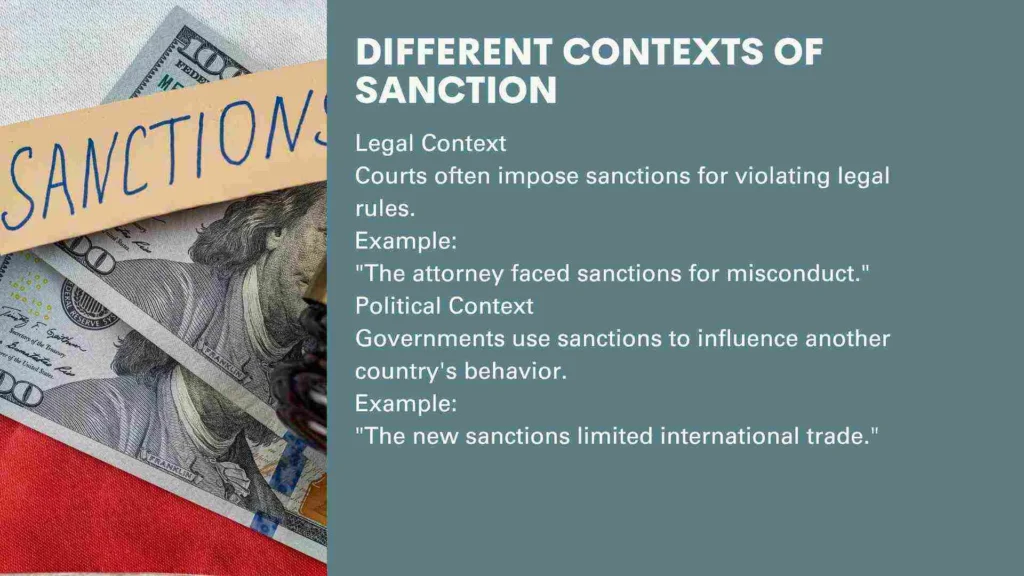
Legal Context
Courts often impose sanctions for violating legal rules.
Example:
“The attorney faced sanctions for misconduct.”
Political Context
Governments use sanctions to influence another country’s behavior.
Example:
“The new sanctions limited international trade.”
Academic Context
Schools may apply sanctions for cheating or misconduct.
Example:
“The student received disciplinary sanctions.”
Workplace Context
Companies sometimes issue sanctions for violating company policies.
Casual Conversation
People occasionally use the word when discussing news or rules.
Example:
“They could face sanctions for breaking the agreement.”
Origin and History of the Term
The word sanction comes from the Latin word sanctio, meaning a decree, law, or authoritative act.
Originally, it referred to something made official by law.
Over time, two meanings developed:
- Official approval
- Official punishment
Although they seem opposite, both meanings involve an authority making a formal decision.
Why Do People Use This Word?
People use sanction because it describes an official action taken by a person or organization with authority.
It is especially common in:
- News reports
- Legal writing
- Government announcements
- Business policies
- Sports regulations
Instead of saying:
- Official punishment
- Government restriction
- Formal approval
people often use the single word sanction.
Emotional & Psychological Meaning Behind This Word
Although sanction is a neutral term, it often creates different emotional reactions depending on the context.
Positive Associations
When it means approval, it can represent:
- Trust
- Permission
- Support
- Progress
Negative Associations
When it refers to punishment, it may suggest:
- Consequences
- Discipline
- Accountability
- Restriction
The emotional meaning depends entirely on how the word is used.
Tone Explanation
The word sanction has a formal and professional tone.
It is commonly found in:
- Legal documents
- Government reports
- News articles
- Academic writing
- Business communication
It is not slang and is rarely used in casual conversations unless discussing current events.
Is It Rude to Say This Word?
No.
Sanction is a neutral English word.
It is appropriate in:
- Professional settings
- School discussions
- Legal conversations
- News reporting
- Business meetings
It is not offensive or disrespectful.
Is This Word Positive, Negative, or Neutral?
The word itself is neutral.
Its emotional tone depends on the meaning:
Positive
When it means:
- Approval
- Authorization
- Permission
Negative
When it means:
- Punishment
- Restrictions
- Penalties
When to Use Sanction
Use sanction when discussing:
- Government restrictions
- Legal penalties
- Official approvals
- Business regulations
- School discipline
- International relations
- Sports penalties
When NOT to Use Sanction
Avoid using sanction when simpler words would be clearer.
Instead of saying:
“The teacher sanctioned my homework.”
Say:
“The teacher approved my homework.”
Likewise, avoid using it if readers might misunderstand whether you mean approval or punishment.
Situations Where You Should Avoid Using This Word
Avoid using sanction:
- In conversations with young children who may not know the word.
- When a simpler word like approve or penalty would avoid confusion.
- If the audience is unfamiliar with legal or political terminology.
Sanction vs. Similar Terms
| Term | Meaning | Common Usage | Key Difference |
| Sanction | Approval or penalty | Law, politics, business | Can mean either approval or punishment |
| Approval | Permission | Everyday and professional use | Only has a positive meaning |
| Penalty | Punishment | Sports, law, school | Always refers to consequences |
| Restriction | Limitation | Government, business | Focuses on limiting actions |
| Ban | Complete prohibition | Rules and laws | Prevents something entirely |
Variations and Related Meanings
Depending on context, sanction can refer to:
1. Economic Sanctions
Restrictions on trade or finance between countries.
2. Legal Sanctions
Penalties imposed by courts.
3. Disciplinary Sanctions
Punishments in schools or workplaces.
4. Trade Sanctions
Limits on imports or exports.
5. Financial Sanctions
Restrictions involving banking or money.
6. International Sanctions
Actions taken by one or more countries against another.
7. Official Sanction
Formal approval by an authority.
8. Government Sanctions
Penalties imposed by a government.
9. Sporting Sanctions
Penalties against athletes or teams.
10. Administrative Sanctions
Disciplinary actions within organizations.
How to Respond When Someone Says “Sanction”
Casual Replies
- What happened?
- Was it a penalty?
- Did they approve it or punish someone?
Funny Replies
- That’s one word with two totally opposite meanings!
- English loves keeping us guessing.
Professional or Mature Replies
- Can you clarify whether you mean approval or a penalty?
- What type of sanction was imposed?
- Was the sanction disciplinary or regulatory?
USA / Western Usage
In the United States, sanction most often refers to:
- Economic sanctions
- Legal penalties
- Business regulations
- Government restrictions
In formal writing, it can also mean official approval, although this use is less common in everyday speech.
Global or Internet Usage Differences
Around the world, sanction has the same two core meanings.
International news often uses the word when discussing:
- Trade restrictions
- Diplomatic relations
- Military conflicts
- Financial measures
On social media, the word usually appears in discussions about politics, economics, or sports rather than as slang.
What Does Sanction Mean in Text?
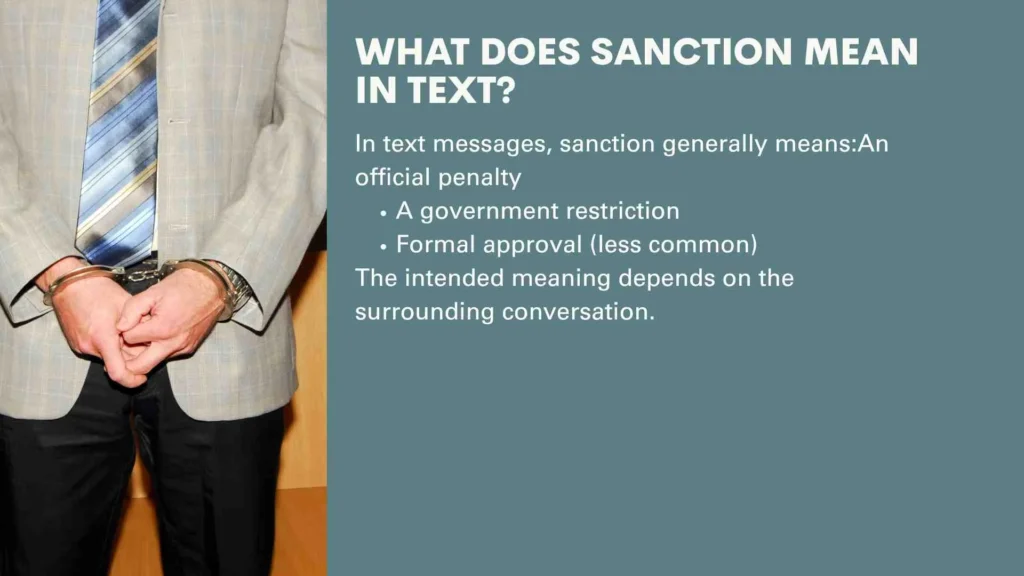
In text messages, sanction generally means:
- An official penalty
- A government restriction
- Formal approval (less common)
The intended meaning depends on the surrounding conversation.
What Does Sanction Mean on TikTok / Instagram?
On TikTok and Instagram, sanction usually refers to:
- Economic sanctions between countries
- Sports penalties
- News about government actions
- School or workplace disciplinary measures
It does not have a special social media meaning.
Is It Rude to Say This?
No.
The word is polite, professional, and widely accepted in formal and informal English.
Why Do People Use This Word?
People use sanction because it describes official decisions made by governments, courts, schools, businesses, or organizations. It is concise and widely recognized in legal, political, and professional contexts.
Frequently Asked Questions
What does sanction mean?
Sanction means either official approval or an official penalty, depending on the context.
Does sanction always mean punishment?
No. Although it’s often used to describe penalties, sanction can also mean official approval or authorization.
What are economic sanctions?
Economic sanctions are trade or financial restrictions imposed by one country or a group of countries to influence another country’s actions.
Is sanction a legal term?
Yes. Courts often use sanctions to describe penalties for violating laws, court orders, or legal procedures.
Why does sanction have two opposite meanings?
The word evolved from a Latin term related to official authority. Over time, it came to refer both to the approval of actions and the enforcement of rules through penalties.
Is sanction a slang word?
No. Sanction is a formal English word commonly used in legal, political, business, and academic settings.
What’s the difference between a sanction and a penalty?
A penalty always refers to punishment. A sanction can mean either punishment or official approval, depending on the context.
Conclusion
Understanding what does sanction mean is easier once you know that it has two opposite but related meanings. It can refer to official approval or authorization, or it can describe a penalty, restriction, or punishment imposed by an authority. The surrounding context tells you which meaning is intended.
Whether you’re reading the news, studying law, discussing international politics, or reviewing workplace policies, knowing the different meanings of sanction will help you understand conversations and documents more accurately.

James Parker is a passionate writer and language enthusiast dedicated to helping readers understand words, meanings, and communication in a simple and effective way. With years of experience in educational writing and vocabulary research, he creates easy-to-understand content that helps students, learners, and readers improve their language skills.
At MeanNings.com, James focuses on providing accurate word meanings, English vocabulary, synonyms, antonyms, and practical language guides. His writing style is clear, informative, and designed for readers of all levels.
James believes that learning language should be simple, engaging, and accessible to everyone. Through his work, he aims to make complex words easier to understand and help readers build confidence in communication.
Books by James Parker
- The Power of Words
- Mastering Everyday Vocabulary
- English Meanings Simplified
 Daniel Brooks