If you’re wondering what segregation means, the simple answer is that segregation means separating people, groups, or things into different categories or places. The term is most commonly associated with the historical separation of people based on race, but it can also refer to separating objects, materials, or responsibilities for practical reasons. Understanding the meaning of segregation helps you better understand history, social issues, workplace practices, and everyday situations.
Quick Meaning
Here are the most common meanings of segregation:
- The separation of people into different groups, often based on race, ethnicity, religion, or gender.
- Keeping groups apart by law, policy, or social custom.
- Separating objects or materials for safety, organization, or recycling.
- Dividing responsibilities or assets in workplaces, banking, or business.
What Does Segregation Mean?
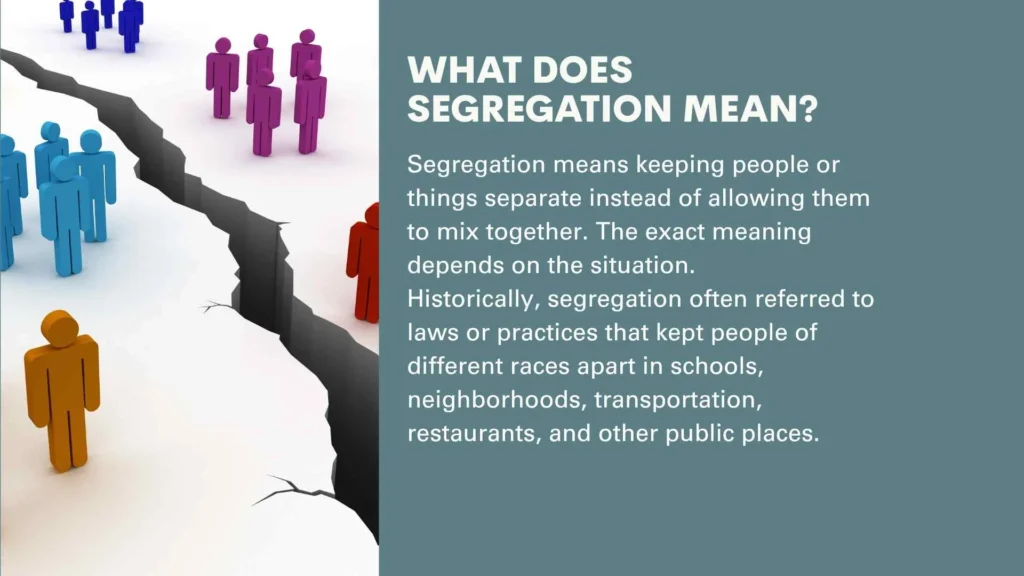
Segregation means keeping people or things separate instead of allowing them to mix together. The exact meaning depends on the situation.
Historically, segregation often referred to laws or practices that kept people of different races apart in schools, neighborhoods, transportation, restaurants, and other public places. Today, the word is also used in practical contexts like waste management, finance, healthcare, and manufacturing.
Simple Definition
In simple words, segregation means separating people or things into different groups or places.
Examples:
- Waste segregation separates recyclable items from regular trash.
- Racial segregation separated people based on race.
- Banks use segregation of funds to protect customer money.
Full Meaning in Simple Words
Think of segregation as keeping things apart for a specific reason.
Sometimes the separation is practical, such as sorting garbage into different bins. In other situations, especially in history, segregation involved unfairly separating people based on race or other personal characteristics.
Examples include:
- Separating paper, glass, and plastic for recycling.
- Separating hazardous chemicals from regular waste.
- Historical racial segregation in public schools.
The context determines whether segregation is simply organizational or a serious social issue.
What Does Segregation Mean in Text?
In text messages, emails, or online conversations, segregation almost always keeps its standard English meaning.
Examples:
“We’re learning about segregation in history class.”
or
“Don’t forget waste segregation before trash pickup.”
Unlike many internet abbreviations, segregation is not slang or a texting acronym.
What Does Segregation Mean on Social Media (TikTok, Instagram, etc.)?
On TikTok, Instagram, Facebook, Reddit, and X (formerly Twitter), the word segregation is usually discussed in relation to:
- American history
- Civil rights
- Politics
- Education
- Environmental protection
- Recycling
- Social justice
Examples include:
- “Today’s history lesson covered school segregation.”
- “Waste segregation is important for protecting the environment.”
- “Understanding segregation helps us learn from history.”
The word is rarely used as slang and almost always keeps its original meaning.
WhatsApp Chat Example
Alex: What chapter are you reading?
Jordan: The one about segregation during the Civil Rights Movement.
Instagram DM Example
Friend: Why is everyone talking about segregation today?
You: A new documentary about American history was released.
TikTok Comment Example
Video: “How recycling works.”
Comment:
Proper waste segregation makes recycling much easier.
Real-Life Meaning and Usage
The word segregation appears in many real-life situations.
It is commonly used in:
- Schools
- Government
- History books
- Hospitals
- Recycling programs
- Banks
- Factories
- Environmental campaigns
Although most people associate segregation with racial history, professionals often use the term in practical settings as well.
Real-Life Situations Where This Term Is Used
History
Students study racial segregation to understand civil rights and equality.
Recycling
Homes and businesses separate waste into categories like plastic, paper, and glass.
Manufacturing
Factories segregate raw materials and hazardous chemicals for safety.
Healthcare
Hospitals separate medical waste from regular trash.
Banking and Finance
Financial institutions segregate customer funds to protect clients’ assets.
Examples of Segregation in Sentences
- The museum explains the history of racial segregation in the United States.
- Proper waste segregation helps improve recycling efforts.
- Schools teach students about segregation during the Civil Rights Movement.
- The factory uses segregation of hazardous materials to improve safety.
- Banks maintain segregation of customer accounts for financial protection.
- The documentary explored segregation in public education.
- Effective waste segregation reduces landfill waste.
Different Contexts of Segregation
Historical Context
Segregation often refers to laws or customs that separated people based on race or ethnicity.
Environmental Context
It describes sorting waste into recyclable and non-recyclable materials.
Workplace Context
Businesses use segregation of duties to reduce fraud and improve accountability.
Medical Context
Hospitals segregate infectious waste from ordinary garbage.
Everyday Context
Families may segregate laundry into whites, colors, and delicate fabrics.
Origin and History of the Term
The word segregation comes from the Latin word segregare, which means to separate from the group.
It entered English centuries ago with the general meaning of separating people or things.
During the 19th and 20th centuries, the word became closely associated with racial segregation, especially in the United States, where laws and customs separated people by race in schools, transportation, housing, and public facilities.
Today, while its historical meaning remains important, segregation is also used in business, healthcare, environmental science, and finance.
Why Do People Use This Word?
People use segregation because it clearly describes separation into different groups.
The word is commonly used when discussing:
- History
- Civil rights
- Waste management
- Banking
- Healthcare
- Manufacturing
- Business procedures
It provides a precise way to describe organized or systematic separation.
Emotional & Psychological Meaning Behind This Word
The emotional impact of segregation depends on the context.
Historical Meaning
When discussing racial segregation, the word may evoke feelings of:
- Inequality
- Injustice
- Exclusion
- Sadness
- Discrimination
Practical Meaning
When referring to waste segregation or workplace procedures, the word usually carries little emotional meaning and simply describes an organizational process.
Tone Explanation
Formal
Segregation is commonly used in:
- Academic writing
- Legal documents
- Government reports
- History textbooks
Informal
People may also use it naturally in conversation.
Example:
“Don’t forget the waste segregation.”
Slang
No.
Segregation is not slang.
Offensive
The word itself is not offensive.
However, discussions about racial segregation involve sensitive historical events and should always be handled respectfully.
Is It Rude to Say This Word?
No.
The word segregation is not rude.
It is a neutral English term used to describe separation. However, because of its connection to discrimination and civil rights history, it should always be used carefully and respectfully.
Is This Word Positive, Negative, or Neutral?
The tone depends entirely on the context.
| Situation | Tone |
| Racial segregation | Negative |
| Waste segregation | Neutral or Positive |
| Financial segregation | Neutral |
| Medical waste segregation | Neutral |
| Safety procedures | Neutral |
When to Use Segregation
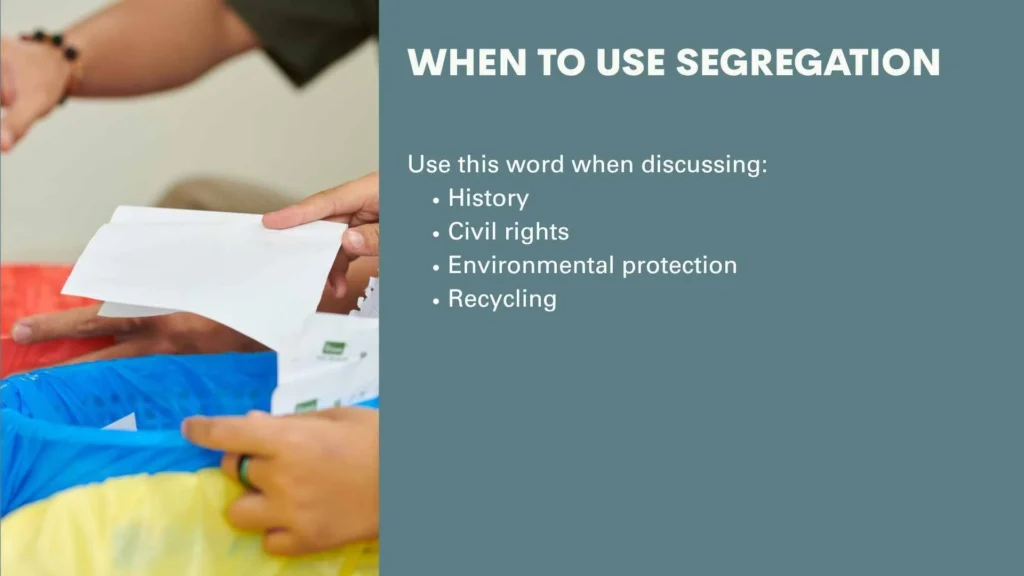
Use this word when discussing:
- History
- Civil rights
- Environmental protection
- Recycling
- Healthcare
- Manufacturing
- Banking
- Workplace procedures
When NOT to Use Segregation
Avoid using segregation when:
- You simply mean organizing items.
- “Sorting” or “grouping” would be clearer.
- The situation doesn’t involve actual separation.
For example, saying “sort the papers” is usually more natural than saying “segregate the papers.”
Situations Where You Should Avoid Using This Word
Avoid using segregation:
- As a joke about historical discrimination.
- To exaggerate minor disagreements.
- In casual comparisons involving sensitive social issues.
Instead, choose words like:
- Sorting
- Organizing
- Separating
- Categorizing
when discussing everyday activities.
Segregation vs Similar Terms
| Term | Meaning | Usage | Key Difference |
| Segregation | Separation into groups | History, business, recycling | Often systematic or formal |
| Separation | Keeping things apart | Everyday language | Broader and less specific |
| Classification | Organizing into categories | Science, education | Focuses on grouping rather than separating |
| Sorting | Arranging by type | Daily activities | Practical and informal |
| Isolation | Being apart from others | Medicine, psychology | Focuses on being alone rather than grouped |
Variations and Related Meanings
Racial Segregation
The separation of people based on race.
School Segregation
The separation of students into different schools or classrooms based on race or other characteristics.
Residential Segregation
Communities or neighborhoods separated by race, income, or ethnicity.
Waste Segregation
Sorting trash into recyclable, compostable, and non-recyclable materials.
Occupational Segregation
Certain jobs being dominated by particular genders or groups.
Gender Segregation
Keeping males and females in separate spaces or activities.
Religious Segregation
Separating people based on religious beliefs.
Financial Segregation
Keeping customer funds separate from business operating funds.
Segregation of Duties
Dividing responsibilities among employees to reduce errors and fraud.
Medical Waste Segregation
Separating infectious waste from regular hospital waste.
How to Respond When Someone Uses “Segregation”
Casual Replies
- I understand what you mean.
- That’s an important topic.
- It depends on the context.
- Can you explain more?
Funny Replies
Because segregation often refers to serious historical or social topics, humorous responses are generally not appropriate. If the discussion is about recycling or organizing materials, a light comment like, “My recycling bins are more organized than my closet!” may be acceptable.
Professional or Mature Replies
- That’s an important historical topic.
- Thank you for explaining.
- Context makes a big difference when using this word.
- It’s important to understand both the historical and practical meanings.
USA / Western Usage
In the United States, segregation is strongly connected to the history of racial discrimination and the Civil Rights Movement.
Today, Americans also use the word in professional settings, including:
- Waste segregation
- Segregation of duties
- Financial segregation
- Medical waste segregation
The historical meaning remains the most widely recognized.
Global or Internet Usage Differences
Globally, the meaning of segregation remains largely the same.
However, the focus may vary:
- In the United States, discussions often center on race and civil rights.
- In other countries, segregation may refer to religion, caste, ethnicity, gender, or urban planning.
- On social media, the term commonly appears in conversations about history, politics, education, environmental protection, and social justice.
Frequently Asked Questions
What does segregation mean in simple words?
Segregation means separating people or things into different groups or places.
What does segregation mean in history?
In history, segregation refers to laws or practices that separated people based on race, especially in schools, housing, transportation, and public facilities.
What does segregation mean in text?
In text messages, segregation keeps its standard meaning of separation. It is not an internet abbreviation or slang.
What does segregation mean on TikTok or Instagram?
On social media, the word is commonly used in discussions about history, civil rights, education, politics, and recycling. It maintains its original meaning.
Is segregation always about race?
No. While racial segregation is the most recognized meaning, the term can also refer to separating waste, financial assets, workplace duties, or materials.
Is segregation a negative word?
It depends on the context. Racial segregation has a negative historical meaning, while waste segregation and financial segregation are neutral or positive because they improve organization and safety.
Why is segregation important to learn about?
Learning about segregation helps people understand history, promote equality, and recognize how the concept is used in modern industries and everyday life.
Conclusion
Understanding what does segregation mean is important because the word has both historical and practical meanings. At its core, segregation means keeping people or things separate into different groups. While it is most often associated with the history of racial discrimination and the fight for civil rights in the United States, it is also commonly used today in areas like recycling, healthcare, banking, manufacturing, and workplace management.
By understanding the different contexts of segregation, you can better interpret conversations, news stories, academic materials, and professional documents. Always consider the context, as the meaning and emotional impact of the word can vary greatly depending on how it is used.