If you’ve ever been asked what does simplify mean in math, it means rewriting a mathematical expression into its simplest equivalent form without changing its value. In other words, you make the expression easier to read, solve, or understand while keeping the answer exactly the same.
Whether you’re working with fractions, algebra, exponents, or equations, learning how to simplify is one of the most important math skills. In this guide, you’ll discover the meaning of what does simplify mean in math, how it’s used in school and everyday conversations, examples, common mistakes, and much more.
What Does Simplify Mean in Math (Quick Meaning)
Here are the most common meanings of what does simplify mean in math:
- Rewrite an expression in its simplest form without changing its value.
- Reduce a mathematical problem by combining like terms or performing operations.
- Make calculations easier by removing unnecessary complexity.
- Express the answer in the clearest mathematical form.
If you’re asking what does simplify mean in math, it means making a math expression as simple as possible while keeping its value exactly the same.
What Does Simplify Mean in Math?
In mathematics, to simplify means changing an expression into an easier or shorter form without changing what it represents.
For example:
- 8 + 5 = 13
- 12/20 = 3/5
- 4x + 3x = 7x
- 2 × (3 + 4) = 14
Each example becomes simpler, but the mathematical value stays the same.
Simplifying is different from changing the answer. You’re only expressing it in the simplest possible way.
Full Meaning in Simple Words
Think of simplifying like cleaning your room.
Everything is still there, but it’s better organized and easier to understand.
Math works the same way.
Instead of leaving a long expression like:
5 + 8 + 2 + 5
You simplify it to:
20
Or instead of writing:
10/20
You simplify it to:
1/2
Nothing changes except the way it’s written.
The meaning of what does simplify mean in math is simply making math easier without changing the actual value.
Common Ways to Simplify in Math
Students simplify many different kinds of math problems.
Simplifying Fractions
Reduce fractions by dividing the numerator and denominator by their greatest common factor.
Example:
- 18/24 → 3/4
Simplifying Algebra
Combine like terms.
Example:
- 5x + 2x = 7x
Simplifying Exponents
Apply exponent rules.
Example:
- x² × x³ = x⁵
Simplifying Square Roots
Find perfect square factors.
Example:
- √36 = 6
Simplifying Expressions
Follow the order of operations (PEMDAS/BODMAS).
Example:
- 3 + 4 × 2
- Simplified answer: 11
What Does Simplify Mean in Text?
Outside the classroom, simplify usually means to make something easier to understand or do.
Examples include:
- Simplify instructions
- Simplify a process
- Simplify your schedule
- Simplify an explanation
Text Message Example
Emma: Can you simplify this math problem for me?
Jake: Sure! Let’s break it into smaller steps.
What Does Simplify Mean on Social Media?
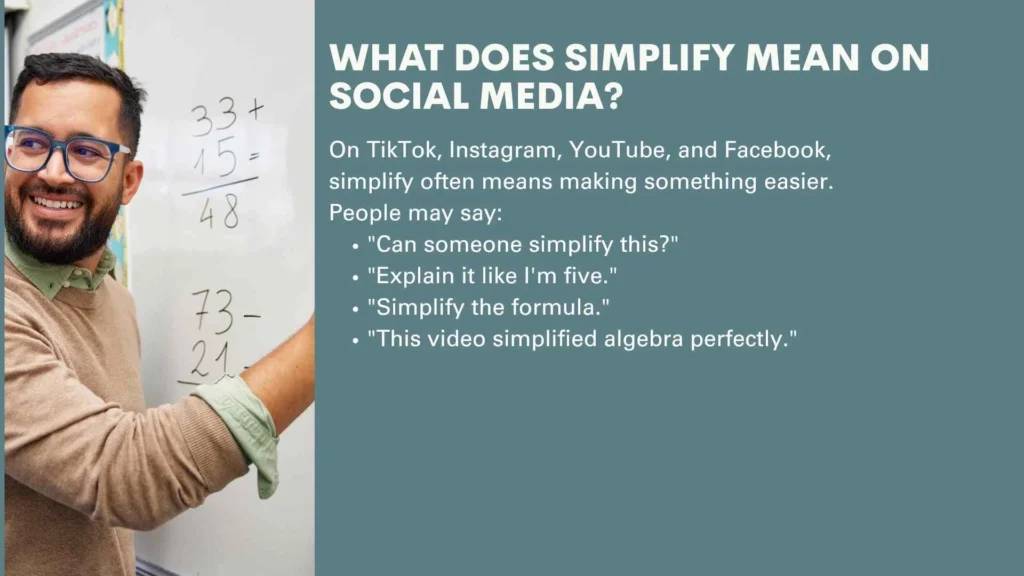
On TikTok, Instagram, YouTube, and Facebook, simplify often means making something easier.
People may say:
- “Can someone simplify this?”
- “Explain it like I’m five.”
- “Simplify the formula.”
- “This video simplified algebra perfectly.”
Educational creators frequently use the word in math tutorials and study tips.
Platform-Based Examples
WhatsApp Chat Example
Alex: What does simplify mean in math?
Taylor: It means making the problem easier without changing the answer.
Instagram DM Example
Friend: I’m stuck on simplifying fractions.
You: Divide both numbers by their greatest common factor.
TikTok Comment Example
“This teacher finally simplified algebra so I understand it!”
Real-Life Meaning and Usage
Although simplifying is a math term, the idea appears everywhere.
People simplify:
- Instructions
- Recipes
- Budgets
- Schedules
- Computer code
- Business reports
- Scientific explanations
The goal is always the same make something easier while keeping its original meaning.
Real-Life Situations Where This Term Is Used
You may hear “simplify” in situations like:
- A teacher explaining homework
- A parent helping with maths
- A tutor solving algebra
- A business manager improving workflows
- A writer making an article easier to read
- A programmer simplifying code
In all these cases, the idea is reducing complexity.
Examples of What Does Simplify Mean in Math in Sentences
Here are some natural examples.
- My teacher asked us to simplify the fraction before finding the answer.
- You should simplify the algebraic expression first.
- Can you simplify this equation for me?
- We learned how to simplify square roots today.
- Simplifying the problem made it much easier to solve.
- The calculator gave the answer, but I still needed to simplify it.
- Always simplify fractions if possible.
Different Contexts of Simplify
Casual Conversation
People use simplify to mean making something easier.
Example:
“Can you simplify your explanation?”
Academic Context
Teachers and textbooks use simplify when solving mathematical expressions.
Online Learning
Educational websites and videos often teach students how to simplify equations, fractions, and algebra.
Workplace
Professionals simplify reports, presentations, and workflows to improve understanding.
Origin and History of the Term
The word simplify comes from the Latin word simplex, meaning “single” or “plain.”
It entered English centuries ago and gradually became common in mathematics as educators looked for ways to describe reducing expressions into their simplest form.
Today, simplify is one of the first mathematical action words students learn.
Why Do People Use This Word?
People use the word simplify because it describes making something easier without changing its meaning.
In math, simplifying helps students:
- Solve problems faster
- Avoid mistakes
- Compare answers more easily
- Understand patterns
- Prepare for advanced mathematics
Outside math, it saves time and improves communication.
Emotional & Psychological Meaning Behind This Word
The word simplify often creates positive feelings.
People associate it with:
- Less stress
- Better understanding
- Confidence
- Organization
- Clear thinking
Students often feel less overwhelmed once a difficult problem has been simplified into smaller steps.
Tone Explanation
The tone of simplify depends on the conversation.
Formal
Very common in classrooms, textbooks, and academic writing.
Informal
Frequently used in everyday speech.
Slang
No. It is a standard English word.
Professional
Common in business, science, education, and technology.
Offensive
Not at all.
Is It Rude to Say This Word?
No.
“Simplify” is a polite and neutral word.
However, saying “Let me simplify it for you” could sound patronizing if it suggests the other person is incapable of understanding. A kinder alternative is:
- “Would it help if I explained it another way?”
- “Let’s work through it together.”
Is This Word Positive, Negative, or Neutral?
Generally, simplify has a positive meaning.
| Tone | Meaning |
| Positive | ✓ Usually |
| Neutral | Sometimes |
| Negative | Rarely |
Most people see simplifying as helpful and practical.
When to Use What Does Simplify Mean in Math
Use the term when:
- Reducing fractions
- Combining like terms
- Solving equations
- Applying exponent rules
- Simplifying radicals
- Writing answers in their simplest form
- Teaching mathematics
When NOT to Use What Does Simplify Mean in Math
Avoid using “simplify” when:
- You are changing the actual value of an expression.
- You are estimating instead of calculating.
- You are solving a word problem without reducing expressions.
- The expression is already in its simplest form.
Remember, simplifying never changes the mathematical value.
Situations Where You Should Avoid Using This Word
You should avoid saying “simplify” if:
- You actually mean “solve.”
- You are rounding numbers.
- You are making assumptions instead of calculating.
- You are changing the meaning of information rather than making it clearer.
For example:
- Simplify: 6/12 → 1/2 ✓
- Not Simplify: 6/12 → 0.4 ✗ (incorrect)
Comparison Table
| Term | Meaning | Usage | Key Difference |
| Simplify | Make an expression easier without changing its value | Math and everyday language | Keeps the value the same |
| Solve | Find the final answer | Equations and problems | Produces the unknown value |
| Reduce | Make smaller or shorter | Fractions, writing, size | Often focuses on decreasing amount |
| Evaluate | Calculate a numerical value | Expressions | Finds the final result after substitution |
| Factor | Break into multiplication parts | Algebra | Opposite process of expanding |
Variations and Related Meanings
Here are some related forms and meanings.
- Simplify a fraction – Reduce to lowest terms.
- Simplify an expression – Combine terms and perform operations.
- Simplify an equation – Remove unnecessary complexity before solving.
- Simplify radicals – Reduce square roots or cube roots.
- Simplify exponents – Apply exponent rules.
- Simplify algebra – Combine like terms and reduce expressions.
- Simplify in everyday English – Make something easier to understand.
- Simplified form – The final easiest version.
- Simplification – The process of making something simpler.
- Simple form – A clear, reduced version of an expression.
How to Respond
Casual Replies
- “It means making the math easier.”
- “Just write it in the simplest form.”
- “Nothing changes—you just make it shorter.”
Funny Replies
- “It’s like giving your homework a haircut!”
- “Math likes things neat and tidy.”
- “Think of it as cleaning up numbers.”
Professional or Mature Replies
- “Simplifying means rewriting the expression in its lowest or most efficient form while keeping the same value.”
- “The goal is to remove unnecessary steps without changing the result.”
Cultural Usage
USA / Western Usage
In American schools, students begin learning to simplify in elementary school.
Teachers commonly ask students to:
- Simplify fractions
- Simplify expressions
- Simplify radicals
- Simplify algebraic equations
The concept appears in standardized tests, homework, and college entrance exams.
Global and Internet Usage
Around the world, the word has the same basic meaning.
Whether students follow American, British, Canadian, Australian, or international curricula, simplifying means expressing a mathematical expression in its simplest equivalent form.
Online learning platforms, educational YouTube channels, and tutoring apps also use the term extensively.
What Does Simplify Mean on TikTok and Instagram?
Educational creators often post short tutorials showing how to simplify math problems.
Popular content includes:
- Simplifying fractions in seconds
- Algebra shortcuts
- Exponent tricks
- Radical simplification
- Step-by-step homework help
A common comment is:
“This finally simplified algebra for me!”
Frequently Asked Questions
What does simplify mean in math?
It means rewriting a mathematical expression in its simplest equivalent form without changing its value.
Does simplify mean solve?
Not always. Simplifying makes an expression easier, while solving finds the final answer to a problem or equation.
How do you simplify fractions?
Divide both the numerator and denominator by their greatest common factor until no further reduction is possible.
Why is simplifying important in math?
It makes calculations easier, reduces mistakes, and helps you understand mathematical relationships more clearly.
Can you simplify decimals?
Sometimes. Decimals are usually evaluated rather than simplified, although they can be rewritten in equivalent forms, such as fractions, when appropriate.
What is the difference between simplify and reduce?
In math, reducing often refers specifically to fractions, while simplifying applies to many kinds of mathematical expressions.
Is simplify only used in math?
No. The word is also used in everyday English to mean making something easier to understand, explain, or complete.
Conclusion
Understanding what does simplify mean in math is essential for success in mathematics. Simplifying means rewriting an expression into its easiest equivalent form without changing its value. Whether you’re reducing fractions, combining like terms, simplifying radicals, or applying exponent rules, the goal is always to make the expression clearer and easier to work with.
Beyond mathematics, the word simplify also means making ideas, tasks, or processes easier to understand. By mastering this concept, you’ll solve problems more efficiently, communicate more clearly, and build a stronger foundation for future learning.

James Parker is a passionate writer and language enthusiast dedicated to helping readers understand words, meanings, and communication in a simple and effective way. With years of experience in educational writing and vocabulary research, he creates easy-to-understand content that helps students, learners, and readers improve their language skills.
At MeanNings.com, James focuses on providing accurate word meanings, English vocabulary, synonyms, antonyms, and practical language guides. His writing style is clear, informative, and designed for readers of all levels.
James believes that learning language should be simple, engaging, and accessible to everyone. Through his work, he aims to make complex words easier to understand and help readers build confidence in communication.
Books by James Parker
- The Power of Words
- Mastering Everyday Vocabulary
- English Meanings Simplified
 Daniel Brooks