What does tangible mean? In simple words, tangible means something that is real, physical, or can be touched. It can also describe results or evidence that are clear, noticeable, and easy to understand, even if they can’t be physically held.
Whether you hear the word at work, in school, or online, understanding the meaning of tangible helps you use it correctly in everyday conversations and professional settings.
What Does Tangible Mean (Quick Meaning)
If you’re searching for what does tangible mean, here are the most common meanings:
- Something you can physically touch or hold, like a book or a phone.
- Something that is real or clearly noticeable, such as tangible results or progress.
- Concrete rather than imaginary, making it easy to see or understand.
- Having a measurable or visible effect, especially in business, education, or daily life.
The definition of tangible is something that is physical, real, or clearly evident. It often refers to objects you can touch or results you can easily see and measure.
What Does Tangible Mean?
The word tangible describes something that exists in a real, physical form or something that has clear, noticeable evidence.
For example:
- A laptop is a tangible object because you can touch it.
- Better test scores are tangible results because you can clearly measure the improvement.
Unlike ideas or emotions, tangible things are concrete and easy to recognize.
Full Meaning in Simple Words
In everyday language, tangible means:
- Real
- Physical
- Easy to see
- Easy to measure
- Not imaginary
Think of it this way:
- A bicycle is tangible because you can ride and touch it.
- Happiness is not tangible because it’s a feeling, not a physical object.
However, people also say things like “tangible benefits” or “tangible progress.” In these cases, they mean the improvements are obvious and measurable.
What Does Tangible Mean in Text?
In text messages, tangible usually keeps its normal English meaning.
Example
Alex: “Did all that practice actually help?”
Jamie: “Yes, I’m finally seeing tangible results.”
Meaning: The improvements are real and noticeable.
People may also text:
- “We need tangible evidence.”
- “I want tangible proof.”
- “There has been tangible progress.”
What Does Tangible Mean on Social Media (TikTok, Instagram, etc.)?
On social media, tangible is often used to describe real achievements, visible progress, or physical products.
Common topics include:
- Fitness transformations
- Business success
- Personal growth
- Financial goals
- Product reviews
WhatsApp Chat Example
Friend: “Is your new study routine working?”
You: “Yes! I’m seeing tangible improvements in my grades.”
Instagram DM Example
“After six months, the business finally has tangible results.”
Meaning: The success is now real and measurable.
TikTok Comment Example
“The workout plan gives tangible results if you stay consistent.”
Meaning: The improvements are clearly visible.
Real-Life Meaning and Usage
You’ll hear tangible in many areas of daily life, including:
- Business
- Education
- Healthcare
- Finance
- Marketing
- Personal development
For example:
- Tangible assets
- Tangible evidence
- Tangible benefits
- Tangible improvements
- Tangible goals
Real-Life Situations Where This Term Is Used
At Work
A manager asks for tangible results from a marketing campaign.
In School
A teacher wants tangible proof that students have improved.
In Business
Companies talk about tangible assets like buildings, equipment, and inventory.
In Healthcare
Doctors look for tangible signs that treatment is working.
In Everyday Life
Someone says,
“I can finally see tangible progress after months of saving money.”
Examples of Tangible in Sentences
- We saw tangible improvements after changing our strategy.
- The company owns many tangible assets.
- There is tangible evidence supporting the claim.
- Her hard work produced tangible results.
- The new training program had a tangible impact on productivity.
- I prefer tangible books over digital versions.
- The charity made a tangible difference in the community.
Different Contexts of Tangible
Casual Conversation
People use it to describe something real or obvious.
Example:
“I’m finally seeing tangible progress.”
Business
Very common.
Example:
“The company invested in tangible assets.”
Academic Setting
Teachers may ask students for tangible evidence to support an argument.
Legal Context
Lawyers present tangible evidence, such as documents or physical objects.
Online Communication
People discuss tangible results from diets, workouts, investments, or business ideas.
Origin and History of the Term
The word tangible comes from the Latin word tangere, meaning “to touch.”
It entered English in the 1500s and originally referred to objects that could be physically touched.
Over time, its meaning expanded to include things that are clearly noticeable or measurable, even if they are not physical.
Why Do People Use This Word?
People use tangible because it clearly describes something that is:
- Real
- Measurable
- Visible
- Practical
- Proven
Instead of saying,
“We made progress,”
someone might say,
“We made tangible progress,”
which emphasizes that the improvement is clear and easy to see.
Emotional & Psychological Meaning Behind This Word
The word tangible often creates feelings of:
- Confidence
- Certainty
- Trust
- Achievement
- Security
People feel more motivated when they can see tangible results because visible progress reinforces their efforts.
Tone Explanation
Formal
Yes.
Very common in business, education, and professional writing.
Informal
Also common in everyday conversations.
Example:
“I finally have tangible proof.”
Slang
No.
Tangible is a standard English word.
Offensive
No.
It is completely neutral.
Is It Rude to Say This Word?
No.
The word tangible is polite, professional, and appropriate in almost every situation.
Is This Word Positive, Negative, or Neutral?
Generally neutral, though it’s often used positively.
Positive
- Tangible success
- Tangible improvement
- Tangible benefits
Neutral
- Tangible object
- Tangible evidence
It rarely has a negative meaning.
When to Use Tangible
Use tangible when talking about:
- Physical objects
- Clear evidence
- Measurable success
- Real improvements
- Practical outcomes
- Business assets
When NOT to Use Tangible
Avoid using tangible when describing:
- Emotions
- Dreams
- Opinions
- Ideas (unless referring to their visible effects)
- Abstract concepts without clear evidence
For example:
❌ “Love is tangible.”
✅ “Love has tangible effects on people’s lives.”
Situations Where You Should Avoid Using This Word
Don’t use tangible if:
- The outcome cannot be measured.
- The concept is purely imaginary.
- There is no evidence or physical presence.
Tangible vs Similar Words
| Word | Meaning | Usage | Key Difference |
| Tangible | Physical or clearly measurable | Business, education, daily life | Can be touched or clearly proven |
| Concrete | Specific and definite | Writing and communication | Focuses on being clear rather than physical |
| Physical | Existing in material form | Science and everyday use | Refers only to material objects |
| Visible | Able to be seen | Everyday conversation | Doesn’t necessarily mean touchable |
| Intangible | Cannot be touched | Business and legal contexts | Opposite of tangible |
Possible Meanings and Variations
Depending on the context, tangible may refer to:
- Physical object
- Tangible evidence
- Tangible assets
- Tangible results
- Tangible benefits
- Tangible progress
- Tangible proof
- Tangible improvements
- Real outcomes
- Measurable success
How to Respond When Someone Says “We Need Tangible Results”
Casual Replies
- “I’m working on it.”
- “You’ll see the results soon.”
- “We’re making progress.”
Professional Replies
- “We’ll provide measurable outcomes.”
- “We’ll present clear evidence.”
- “The report will include tangible results.”
Encouraging Replies
- “The progress is becoming more visible.”
- “We’re heading in the right direction.”
USA / Western Usage
In the United States, tangible is widely used in:
- Business meetings
- Schools
- Legal documents
- Financial reports
- Healthcare
- Marketing
Americans often use the word to describe real progress, measurable success, and physical property.
Global or Internet Usage Differences
Across English-speaking countries, tangible has nearly the same meaning.
Online, it’s commonly used when discussing:
- Fitness results
- Financial growth
- Business performance
- Educational improvement
- Personal achievements
What Does Tangible Mean in Slang?
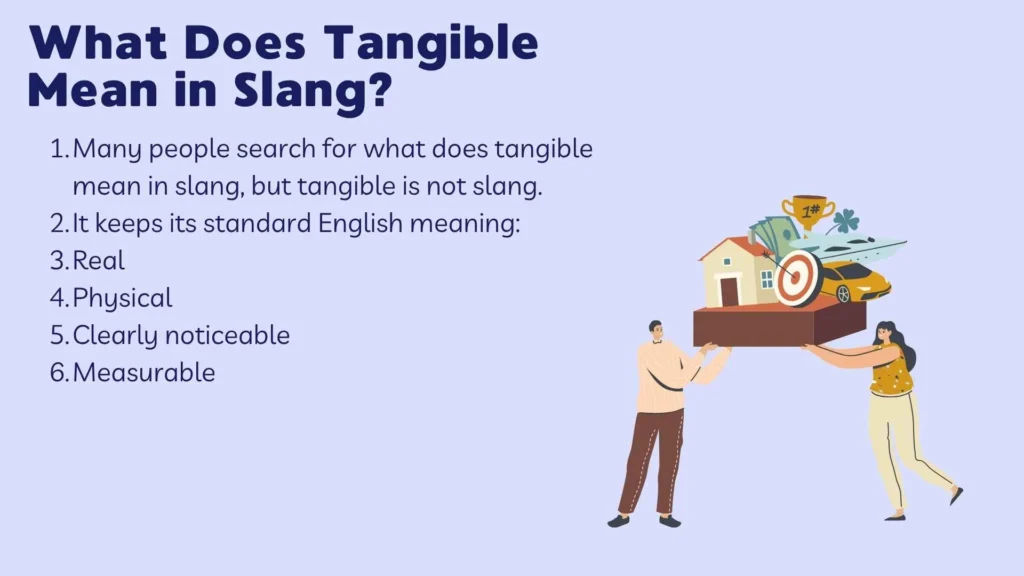
Many people search for what does tangible mean in slang, but tangible is not slang.
It keeps its standard English meaning:
- Real
- Physical
- Clearly noticeable
- Measurable
What Does Tangible Mean in Text?
In text messages, tangible means something is real, obvious, or supported by clear evidence.
Example:
“I finally have tangible proof.”
Meaning:
“I now have clear evidence.”
What Does Tangible Mean on TikTok / Instagram?
On TikTok and Instagram, people often use tangible words to describe visible improvements or real achievements.
Example:
“After three months, I’m seeing tangible muscle growth.”
Meaning: The progress is obvious and measurable.
Frequently Asked Questions
What does tangible mean in simple words?
It means something that is real, physical, or easy to see and measure.
What is a tangible example?
A car, house, laptop, or book are all tangible because you can physically touch them.
What is the opposite of tangible?
The opposite is intangible, which refers to things that cannot be touched, such as ideas, emotions, or reputation.
What does tangible mean in business?
It often refers to physical assets, such as buildings, machinery, equipment, and inventory.
Can results be tangible?
Yes. Tangible results are improvements that are clear, measurable, and easy to recognize.
Is tangible a positive word?
Usually yes, especially when describing success, progress, or benefits. However, the word itself is neutral.
Is tangible the same as physical?
Not exactly. All physical objects are tangible, but tangible can also describe measurable outcomes, while physical only refers to material objects.
Conclusion
Understanding what does tangible mean makes it easier to describe things that are real, physical, or clearly noticeable. Whether you’re talking about tangible assets in business, tangible evidence in school, or tangible results in everyday life, the word emphasizes something concrete and measurable. Unlike abstract ideas or emotions, tangible things can be touched or supported by clear proof. Learning how to use this versatile word correctly will improve both your vocabulary and your communication in personal, academic, and professional settings.

James Parker is a passionate writer and language enthusiast dedicated to helping readers understand words, meanings, and communication in a simple and effective way. With years of experience in educational writing and vocabulary research, he creates easy-to-understand content that helps students, learners, and readers improve their language skills.
At MeanNings.com, James focuses on providing accurate word meanings, English vocabulary, synonyms, antonyms, and practical language guides. His writing style is clear, informative, and designed for readers of all levels.
James believes that learning language should be simple, engaging, and accessible to everyone. Through his work, he aims to make complex words easier to understand and help readers build confidence in communication.
Books by James Parker
- The Power of Words
- Mastering Everyday Vocabulary
- English Meanings Simplified
 Daniel Brooks