If you’re wondering what does transcribe mean, the simple answer is that to transcribe means to convert spoken words, audio, or video into written text. The word can also refer to copying written information accurately or rewriting content in another format. Understanding what transcribe means is useful in school, business, healthcare, journalism, legal work, and everyday communication.
Quick Meaning
Here are the most common meanings of what does transcribe mean:
- Convert speech into written text (most common meaning)
- Copy written material accurately from one source to another
- Create a written record of a conversation, interview, or meeting
- Rewrite information into another format while preserving the original meaning
What Does Transcribe Mean?
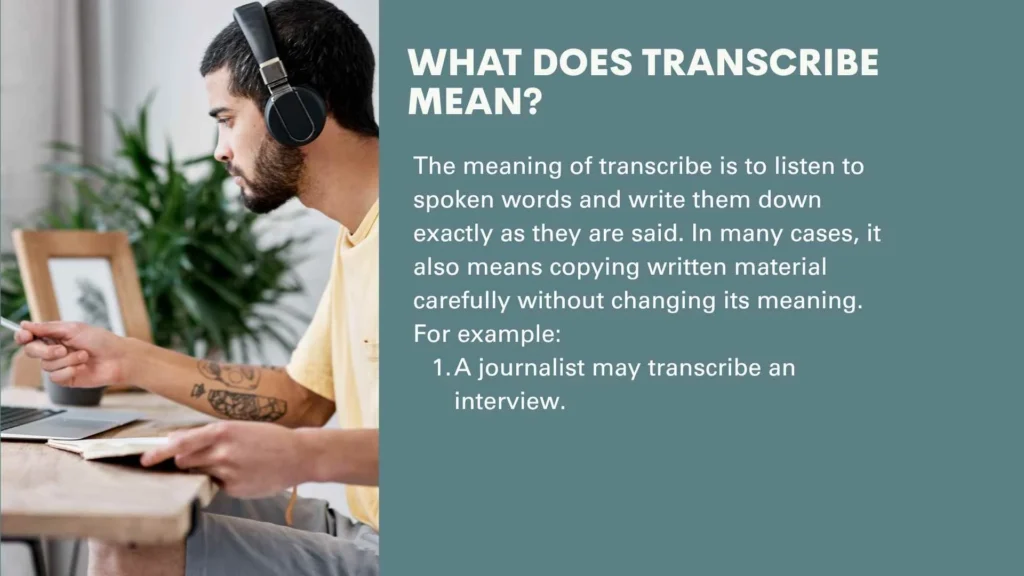
The meaning of transcribe is to listen to spoken words and write them down exactly as they are said. In many cases, it also means copying written material carefully without changing its meaning.
For example:
- A journalist may transcribe an interview.
- A student may transcribe classroom notes.
- A doctor may use software to transcribe patient recordings into medical records.
Today, transcription is often done using AI software, but people still review the text to ensure accuracy.
Full Meaning in Simple Words
In simple words, transcribe means turning spoken information into written words.
Imagine your teacher records a lesson. Later, someone listens to the recording and types everything into a document. That process is called transcribing.
Think of it like this:
- Someone talks.
- You listen carefully.
- You type or write exactly what you hear.
That’s transcription.
Sometimes, transcribe can also mean copying information from one document into another without changing it.
What Does Transcribe Mean in Text?
When someone uses the word transcribe in a text message or email, they usually mean:
- Write down what someone said.
- Convert an audio recording into text.
- Copy information accurately.
Examples:
- “Can you transcribe this voice note?”
- “I’ll transcribe the meeting later.”
- “Please transcribe the interview before tomorrow.”
Unlike many internet words, transcribe is not slang. It keeps the same meaning in texting as it does in professional settings.
What Does Transcribe Mean on Social Media (TikTok, Instagram, etc.)?
On TikTok, Instagram, YouTube, and other platforms, transcribe usually refers to creating captions or subtitles for videos.
Creators often say things like:
- “I transcribed the entire podcast.”
- “Can someone transcribe this video?”
- “Auto-transcribe isn’t always accurate.”
Many content creators transcribe videos to make them accessible to more viewers, including people who are deaf or hard of hearing.
WhatsApp Chat Example
Alex: Can you send me the meeting notes?
Sarah: Sure! I’ll transcribe the recording tonight.
Instagram DM Example
Friend: I couldn’t hear everything in your Reel.
You: No problem. I’ll transcribe the audio for you.
TikTok Comment Example
“Can someone transcribe what she said at 0:45? I couldn’t understand it.”
Real-Life Meaning and Usage
The word transcribe appears in many everyday situations.
People transcribe:
- Interviews
- Podcasts
- Business meetings
- Medical appointments
- Court hearings
- School lectures
- YouTube videos
- Voice memos
Without transcription, finding information in long recordings would be much harder.
Real-Life Situations Where This Term Is Used
In Education
Students transcribe lectures and recorded lessons into study notes.
In Healthcare
Medical professionals transcribe patient consultations for accurate records.
In Law
Court reporters transcribe everything said during legal proceedings.
In Journalism
Reporters transcribe interviews before writing articles.
In Business
Companies transcribe meetings so employees can review important decisions later.
In Content Creation
Video creators add transcriptions and captions to improve accessibility and SEO.
Examples of “Transcribe” in Sentences
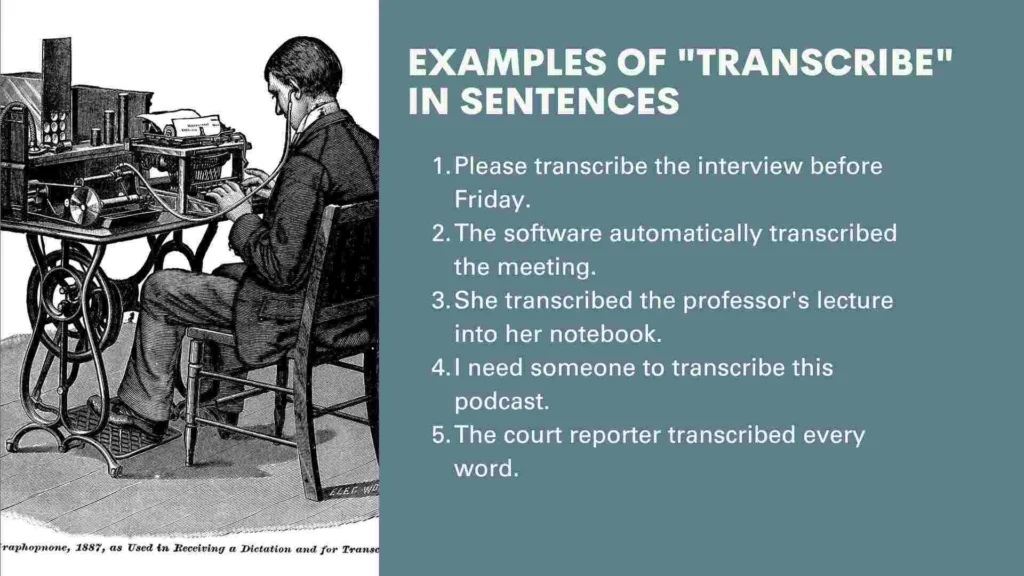
- Please transcribe the interview before Friday.
- The software automatically transcribed the meeting.
- She transcribed the professor’s lecture into her notebook.
- I need someone to transcribe this podcast.
- The court reporter transcribed every word.
- We transcribed the voice message into an email.
- The AI tool transcribed the video within minutes.
Different Contexts of “Transcribe”
| Context | Meaning |
| Education | Writing lecture notes from speech |
| Healthcare | Creating medical records from dictation |
| Law | Recording courtroom conversations |
| Journalism | Writing interview transcripts |
| Business | Documenting meetings |
| Technology | AI converting speech into text |
| Everyday Life | Writing what someone says |
Origin and History of the Term
The word transcribe comes from the Latin word transcribere, which means to copy across or write over.
Before computers existed, people manually transcribed books, letters, speeches, and historical documents.
Today, advanced speech-recognition technology can automatically transcribe audio, although human proofreading is still important for accuracy.
Why Do People Use This Word?
People use the word transcribe because it describes an important process of turning spoken information into written text.
Transcription helps people:
- Save important conversations
- Search information quickly
- Improve accessibility
- Keep accurate records
- Share information easily
It’s a simple word for a valuable task.
Emotional & Psychological Meaning Behind This Word
Although transcribe is mostly a practical word, it can also represent:
- Preserving memories
- Recording important stories
- Capturing family history
- Keeping conversations accurate
Many people transcribe interviews with grandparents or loved ones to preserve their voices and experiences for future generations.
Tone Explanation
Formal
Most common.
Examples:
- Please transcribe the meeting.
- The assistant transcribed the interview.
Informal
Friends also use it casually.
Example:
- Can you transcribe this voice note?
Slang
No.
Transcribe is not considered slang.
Offensive
Not at all.
The word is professional and respectful.
Is It Rude to Say This Word?
No.
The word transcribe is completely neutral and polite.
It can be used in:
- Schools
- Offices
- Hospitals
- Legal settings
- Social media
- Everyday conversations
Is This Word Positive, Negative, or Neutral?
The word is generally neutral.
However, the surrounding sentence may create a positive or negative tone.
Positive
- She volunteered to transcribe the interviews.
Neutral
- Please transcribe this recording.
Negative
- The software failed to transcribe the audio correctly.
When to Use “Transcribe”
Use transcribe when talking about:
- Audio recordings
- Videos
- Meetings
- Interviews
- Voice messages
- Podcasts
- Court hearings
- Medical dictation
It’s also appropriate when discussing copying written information accurately.
When NOT to Use “Transcribe”
Avoid using transcribe when you actually mean:
- Translate into another language
- Summarize information
- Rewrite using different words
- Edit or improve writing
Transcription means recording information accurately, not changing its meaning.
Situations Where You Should Avoid Using This Word
Don’t use transcribe if someone is:
- Creating a summary
- Writing an opinion
- Translating Spanish into English
- Editing grammar
- Rewriting content creatively
Instead, use words like summarize, translate, or rewrite, depending on the task.
Comparison Table
| Term | Meaning | Usage | Key Difference |
| Transcribe | Convert speech into text | Audio, interviews, meetings | Keeps the original wording as closely as possible |
| Translate | Change one language into another | Multilingual communication | Changes language, not just format |
| Rewrite | Express ideas differently | Writing and editing | Uses new wording instead of copying exactly |
| Summarize | Shorten key points | Reports and articles | Leaves out details and focuses on the main ideas |
Variations and Related Meanings
Here are common variations and related forms of transcribe:
- Transcription – The written document created from speech.
- Transcript – The finished written record.
- Transcribing – The ongoing process.
- Transcribed – Completed transcription.
- Auto-transcribe – AI automatically converts speech into text.
- Manual transcription – A person types everything.
- Audio transcription – Converting recordings into text.
- Video transcription – Writing spoken words from videos.
- Speech-to-text – Technology that transcribes spoken language.
- Verbatim transcription – Recording every word exactly as spoken.
How to Respond
Casual Replies
- Sure, I’ll transcribe it.
- Give me a few minutes.
- I’ll type it up for you.
Funny Replies
- Only if the audio isn’t from another planet!
- Hopefully nobody talks over each other!
- My keyboard is ready!
Professional or Mature Replies
- Certainly. I’ll prepare an accurate transcript.
- I’ll transcribe the recording and send it shortly.
- I’ll review the transcript for accuracy before sharing it.
USA / Western Usage
In the United States, transcribe is commonly used in:
- Schools
- Businesses
- Hospitals
- News organizations
- Legal offices
- Universities
With the growth of AI tools, many companies now automatically transcribe meetings, phone calls, and webinars.
Global or Internet Usage Differences
The meaning of transcribe remains consistent worldwide.
However, online platforms increasingly use automatic transcription for:
- Video captions
- Podcast transcripts
- Meeting notes
- Accessibility features
- Search engine optimization (SEO)
Creators across the world rely on transcription to reach larger audiences.
What Does Transcribe Mean in Text?
In text messages, transcribe simply means to write down spoken words.
Examples:
- “Can you transcribe this voicemail?”
- “I’ll transcribe the lecture later.”
- “Please transcribe the interview exactly.”
There is no special texting or slang meaning.
What Does Transcribe Mean on TikTok / Instagram?
On TikTok and Instagram, transcribe usually refers to:
- Adding captions to videos
- Creating subtitles
- Writing out spoken dialogue
- Making videos accessible
Many creators ask followers to transcribe difficult-to-hear audio in the comments.
Is It Rude to Say This?
No.
The word transcribe is professional, respectful, and appropriate in nearly every situation.
It is widely used in education, healthcare, journalism, and business.
Why Do People Use This Word?
People use transcribe because written records are easier to:
- Read
- Search
- Share
- Store
- Translate later
- Review for important details
As voice recordings become more common, transcription has become an essential skill and technology.
Frequently Asked Questions
What does transcribe mean?
It means converting spoken words or audio into written text or accurately copying written material.
What is the difference between transcribe and translate?
Transcribe changes speech into text without changing the language, while translate changes one language into another.
Does transcribe mean copy?
Sometimes. It can mean copying written material accurately, but it most commonly refers to converting speech into text.
What does transcribe mean in texting?
It means writing out what someone said in a voice message, recording, or conversation. It is not slang.
What does transcription mean?
A transcription is the finished written version of spoken words.
Can AI transcribe audio?
Yes. Many AI tools can automatically transcribe audio and video recordings, though human editing often improves accuracy.
Why is transcription important?
Transcription makes information easier to read, search, share, and understand while improving accessibility for all users.
Conclusion
Understanding what does transcribe mean is useful in today’s digital world. Whether you’re turning a podcast into text, creating captions for a video, recording a classroom lecture, or documenting a business meeting, transcribe simply means converting spoken words into written form or accurately copying information. It is a professional, neutral term used across education, healthcare, journalism, law, business, and social media. Knowing how and when to use this word will help you communicate more clearly and understand modern technology that relies on transcription every day.