
The word discrete means separate, distinct, or individually different from something else. It describes people, objects, ideas, or values that are treated as individual units instead of being connected or continuous.
While the basic definition is simple, the meaning of discrete can change slightly depending on the subject, workplace, or industry. For example, you’ll see it used in math, computer science, business, engineering, and everyday conversations.
Knowing the correct meaning helps you avoid confusing discrete with the similar-looking word discreet, which has a completely different definition. Whether you came across the term in a textbook, at work, online, or during a conversation, understanding the context makes all the difference.
This guide explains the definition in plain English, shows how the word is used in different fields, compares it with related terms, and includes real-life examples so you can use discrete with confidence.
What Does Discrete Mean? (Quick Meaning)
Here are the most common meanings of discrete:
- Separate or distinct from other things
- Individual and countable rather than continuous
- Careful and private in actions or communication
- Not attracting attention or keeping something confidential
These are the most common definitions people mean when asking about the meaning of discrete.
What Does Discrete Mean?
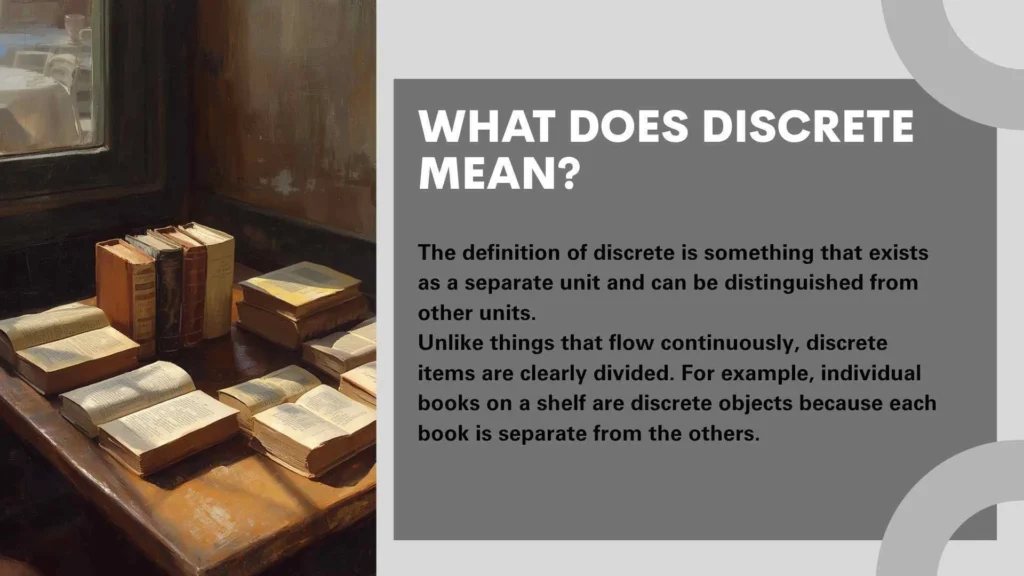
The definition of discrete is something that exists as a separate unit and can be distinguished from other units.
Unlike things that flow continuously, discrete items are clearly divided. For example, individual books on a shelf are discrete objects because each book is separate from the others.
In another sense, a person can be described as discrete when they handle information carefully and maintain privacy.
What does discrete mean in computer
In computer science, discrete refers to something that exists as separate, distinct units rather than as a continuous flow. The term is commonly used to describe hardware components, mathematical structures, and systems that process individual values instead of continuous signals.
One of the most common examples is a discrete graphics card (GPU). Unlike an integrated graphics processor built into the CPU, a discrete GPU is a separate piece of hardware with its own memory and processing power. This makes it better for gaming, video editing, 3D rendering, and AI workloads.
The word discrete also appears in discrete mathematics, which is a foundation of computer science. It studies countable structures such as:
- Graphs
- Trees
- Sets
- Logic
- Algorithms
- Boolean algebra
Computers themselves are considered discrete systems because they store and process information as binary digits (0s and 1s), not continuous values.
Real-life examples
- A gaming PC uses a discrete graphics card for higher performance.
- A programmer studies discrete mathematics to design efficient algorithms.
- Digital circuits process discrete signals, switching between on (1) and off (0).
Understanding the meaning of discrete in computers helps explain why digital technology works with separate data values instead of continuous information. Whether discussing hardware, software, networking, or programming, the term usually emphasizes that data, components, or operations are individually distinguishable rather than blended together.
What does discrete mean in physics
In physics, discrete means that something exists in separate, individual values or units instead of changing smoothly or continuously. A discrete quantity cannot take every possible value between two points—it changes in distinct steps.
The concept is especially important in quantum physics, where certain physical properties are quantized. For example, electrons in an atom occupy discrete energy levels. An electron cannot exist halfway between two allowed energy levels. Instead, it jumps from one level to another by absorbing or releasing energy.
In contrast, many everyday measurements are continuous. For example, the speed of a moving car or the temperature of water can change gradually over a wide range of values.
Real-life examples
- Electrons move between discrete energy levels inside atoms.
- A photon carries a discrete packet of energy called a quantum.
- Counting the number of particles in a sample produces discrete data, while measuring their mass gives continuous data.
Key ideas related to discrete physics include:
- Quantum mechanics
- Energy levels
- Quantization
- Atomic structure
- Digital measurements
Knowing the difference between discrete and continuous helps students understand many scientific concepts. While classical physics often describes continuous motion, modern physics shows that some properties of nature exist only in specific, separate states.
Discrete or discreet
Discrete and discreet are two commonly confused English words because they are pronounced similarly, but they have completely different meanings. Choosing the correct spelling depends on the context.
Discrete means separate, distinct, or individually identifiable. It is used in mathematics, science, technology, and everyday English when referring to things that are independent from one another.
Examples:
- The project has three discrete phases.
- A computer uses a discrete GPU.
- Researchers analyzed several discrete variables.
Discreet, on the other hand, means careful, tactful, or keeping something private. It describes people or actions involving confidentiality or good judgment.
Examples:
- She was discreet about her friend’s personal information.
- The hotel offers discreet customer service.
- He handled the situation in a discreet manner.
Easy way to remember
- Discrete = Separate
- Discreet = Secret or tactful
Notice that discreet contains two “e”s together, reminding many people of the word keep (keeping a secret).
Real-life examples
- Separate files are discrete documents.
- A lawyer remains discreet with confidential client information.
- A survey contains several discrete response options.
Understanding the distinction helps improve writing accuracy and prevents one of the most common spelling mistakes in English. Although the words sound alike, their meanings are entirely different.
What does discrete mean in research
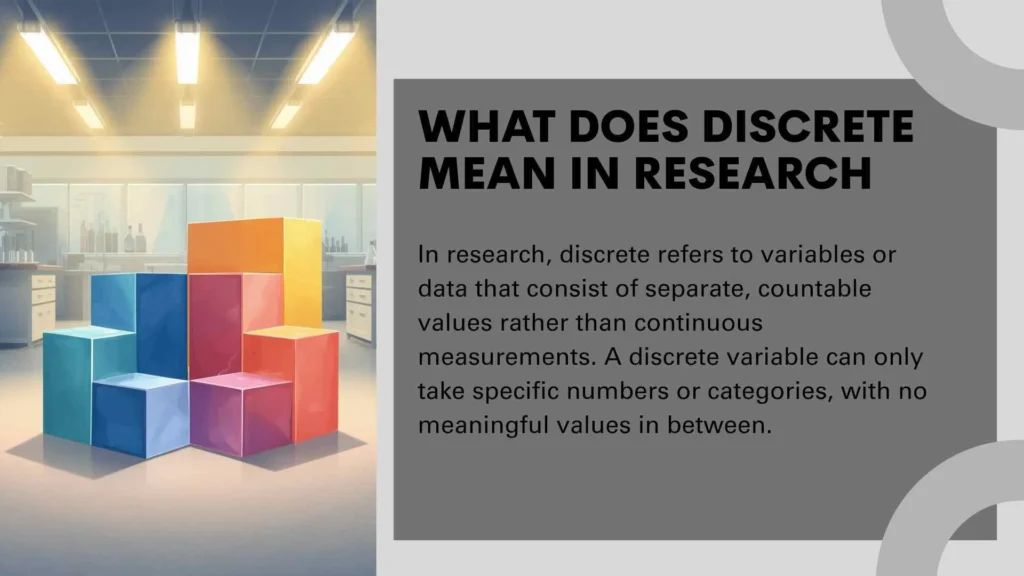
In research, discrete refers to variables or data that consist of separate, countable values rather than continuous measurements. A discrete variable can only take specific numbers or categories, with no meaningful values in between.
Researchers often classify data into discrete and continuous variables because each requires different statistical methods.
Common examples of discrete variables include:
- Number of students in a classroom
- Number of cars owned by a family
- Number of survey responses
- Number of hospital visits in a year
Unlike continuous variables, discrete variables cannot include fractions in many situations. For example, you can have 3 participants, but not 3.7 participants.
Real-life examples
- A researcher counts the number of books each student reads every month.
- A health study records the number of doctor visits for each participant.
- A business survey measures how many products customers purchase.
Discrete data is frequently analyzed using:
- Frequency tables
- Probability distributions
- Count data models
- Bar charts
- Statistical hypothesis testing
Researchers choose the appropriate analysis depending on whether the data is discrete or continuous. Correctly identifying a discrete variable improves data accuracy, statistical validity, and interpretation of research findings.
Does discrete mean secret
No, discrete does not mean secret. This is one of the most common misunderstandings because discrete is often confused with the similar-looking word discreet.
The word discrete means separate, distinct, or individually identifiable. It describes things that are independent from one another rather than connected or continuous.
For example:
- The company divided the project into discrete tasks.
- The software stores data in discrete units.
If you want to describe something that is private, confidential, or kept secret, the correct word is discreet.
For example:
- She was discreet about the surprise party.
- Doctors remain discreet when discussing patient information.
- The company handled the investigation in a discreet manner.
Real-life comparison
- Discrete rooms = Separate rooms.
- Discreet meeting = A private meeting.
- Discrete categories = Clearly divided groups.
- Discreet behavior = Careful and confidential behavior.
Although people sometimes mistakenly use discrete when they mean discreet, dictionaries and style guides treat them as two different words with separate meanings. Remember this simple rule:
- Discrete = Separate
- Discreet = Secret or careful
Using the correct spelling makes your writing clearer and more professional.
Discrete person meaning
A discrete person is generally not a standard English expression. If someone is described as discrete, it usually means they are seen as an independent or separate individual, not that they are private or secretive.
However, many people actually intend to say discreet person, which refers to someone who is careful, tactful, and able to keep confidential information.
If “discrete person” is used literally
It may mean a person who is:
- Distinct from others
- Viewed as an individual
- Separate in identity or role
This usage is uncommon in everyday conversation.
If the intended word is “discreet”
A discreet person is someone who:
- Respects privacy
- Avoids sharing confidential information
- Speaks carefully in sensitive situations
- Shows good judgment
Real-life examples
- A therapist is expected to be discreet with client information.
- Every employee is a discrete member of the organization with individual responsibilities.
- A trusted friend is often appreciated for being discreet.
If you see the phrase discrete person, check the context carefully. In many cases, the writer accidentally meant discreet person, which is the more common and correct expression when describing someone’s behavior.
Discrete meaning example
Discrete means separate, distinct, or individually identifiable. It describes things that are divided into individual parts instead of forming one continuous whole.
The word is widely used in everyday English, mathematics, science, computer science, and research.
Example sentences
- The report is divided into several discrete sections.
- The company manages its departments as discrete business units.
- The scientist studied discrete data collected from surveys.
- Each apartment is a discrete living space with its own entrance.
- The software processes discrete pieces of information.
Real-life examples
In education
A teacher counts the number of students in each class. Since students are counted individually, the data is discrete.
In technology
A gaming computer uses a discrete graphics card, which is separate from the processor.
In everyday life
A shopping mall contains many discrete stores, each operating independently.
Remember the meaning
Think of discrete as meaning:
- Separate
- Distinct
- Individual
- Independent
- Countable
A simple memory trick is: Discrete = Distinct pieces. Whenever something can be separated into individual units instead of forming one continuous whole, the word discrete is usually the correct choice.
Full Meaning in Simple Words
In simple terms, discrete means separate, distinct, or private.
Think of it this way:
- A group of individual apples is discrete because you can count them one by one.
- A person who keeps a secret and doesn’t share private information is being discrete.
- Separate categories in a survey are discrete options.
The word often emphasizes individuality, separation, or confidentiality.
What Does Discrete Mean in Text?
When used in texting, discrete usually keeps its standard English meaning.
Someone may use it to describe:
- Being careful with private information
- Keeping a conversation confidential
- Handling a situation without drawing attention
Example Text Message
Person A: “Can you keep this between us?”
Person B: “Of course, I’ll be discrete about it.”
In this example, “discrete” means careful and private.
What Does Discrete Mean on Social Media (TikTok, Instagram, etc.)?
On platforms like TikTok, Instagram, Facebook, and X, the word discrete is often used when discussing privacy or subtle behavior.
People may use it when they want:
- Privacy in relationships
- Confidential communication
- Low-profile interactions
- Secret plans or surprises
Unlike many internet slang terms, discrete is not primarily slang. It usually retains its standard dictionary meaning online.
WhatsApp Chat Example
Friend 1: “I’m planning a surprise birthday party.”
Friend 2: “Don’t worry, I’ll be discrete and won’t tell anyone.”
Instagram DM Example
User A: “Can you keep our conversation private?”
User B: “Absolutely. I’ll stay discrete.”
TikTok Comment Example
Comment: “The way she handled that situation was really discrete and professional.”
Here, the commenter means the person acted carefully and without creating unnecessary attention.
Real-Life Meaning and Usage
The word discrete appears in many areas of daily life.
Common uses include:
- Keeping personal information private
- Separating data into categories
- Discussing mathematics or computer science
- Describing careful social behavior
- Managing confidential workplace matters
Because it has multiple meanings, context helps determine exactly what someone intends.
Real-Life Situations Where This Term Is Used
Workplace Conversations
Managers may ask employees to be discrete when discussing sensitive company information.
Relationships
People often use the term when asking friends to keep personal matters private.
Education
Teachers and students encounter discrete concepts in mathematics and statistics.
Healthcare
Medical professionals must be discrete when handling patient information.
Technology
Programmers often discuss discrete data and discrete systems.
Examples of Discrete in Sentences
Here are some examples of discrete in everyday sentences:
- The survey divided participants into discrete age groups.
- Please be discrete when discussing this matter.
- The computer stores information in discrete units.
- Each house on the street is a discrete property.
- She handled the issue in a discrete and professional manner.
- The graph shows discrete data points rather than a continuous trend.
- We need discrete categories for the research project.
Different Contexts of Discrete
Academic Context
In education, discrete often means separate and countable.
Example:
- Discrete mathematics studies distinct mathematical structures.
Business Context
In business, discrete often means confidential or handled carefully.
Example:
- The company conducted a discrete investigation.
Casual Conversation
People use it to mean private or not obvious.
Example:
- Let’s be discrete about the surprise.
Technology Context
In computing, discrete components operate independently.
Example:
- A discrete graphics card functions separately from integrated graphics.
Online Context
On social media, it usually means private, subtle, or confidential.
Origin and History of the Term
The word discrete comes from the Latin word discretus, meaning “separated” or “distinguished.”
It entered English through Old French and Middle English, carrying the idea of things being distinct from one another.
Over time, the word developed two major uses:
- Separate or individually identifiable
- Careful and prudent in behavior
Both meanings remain common today.
Why Do People Use This Word?
People use discrete because it communicates precision.
It can quickly explain that:
- Things are separate rather than connected
- Information should remain private
- Someone is acting carefully and professionally
- Data can be counted individually
The word is useful because it conveys both separation and discretion depending on the context.
Emotional & Psychological Meaning Behind This Word
Psychologically, the word often suggests:
- Trustworthiness
- Responsibility
- Respect for privacy
- Professionalism
- Self-control
When someone is described as discrete, people often view them as reliable and respectful of boundaries.
Tone Explanation
The tone of the word discrete is generally:
| Tone Type | Description |
| Formal | Common in professional and academic settings |
| Informal | Sometimes used in everyday conversations |
| Slang | No |
| Offensive | No |
| Professional | Yes |
| Respectful | Yes |
The word carries a mature and thoughtful tone.
Is It Rude to Say This Word?
No, discrete is not rude.
It is considered a polite and professional word in most situations.
People often use it positively when praising someone for being careful or respectful of privacy.
Is This Word Positive, Negative, or Neutral?
The word is generally neutral to positive.
Positive Uses
- Being trustworthy
- Respecting privacy
- Acting professionally
Neutral Uses
- Describing separate objects
- Discussing mathematics or data
Negative Uses
Negative usage is uncommon unless used sarcastically.
When to Use Discrete
Use the word when:
- Discussing separate items or categories
- Referring to countable data
- Talking about privacy
- Describing careful behavior
- Writing professionally
Examples
- “The data consists of discrete values.”
- “Please be discrete with this information.”
When NOT to Use Discrete
Avoid using it when:
- You mean “continuous”
- You are referring to something connected or flowing
- Simpler words like “private” would be clearer for your audience
Situations Where You Should Avoid Using This Word
You may want to avoid the word when:
- Speaking to very young children
- Writing extremely informal content
- Communicating with audiences unfamiliar with academic vocabulary
In such cases, words like “private,” “separate,” or “careful” may be easier to understand.
Comparison Table: Discrete vs Similar Terms
| Term | Meaning | Usage | Key Difference |
| Discrete | Separate or private | Academic and everyday use | Emphasizes separation or confidentiality |
| Separate | Not joined together | Everyday conversation | More general term |
| Distinct | Clearly different | Formal and academic writing | Focuses on uniqueness |
| Private | Not for public knowledge | Social and professional situations | Focuses only on confidentiality |
| Independent | Not controlled by others | Business and personal contexts | Focuses on autonomy |
Variations and Related Meanings of Discrete
Here are some related meanings and variations:
- Separate units
- Distinct categories
- Individual values
- Countable data
- Confidential behavior
- Private communication
- Independent components
- Distinguishable elements
- Isolated objects
- Carefully managed information
Each variation shares the idea of separation, individuality, or privacy.
How to Respond When Someone Uses This Word
Casual Replies
- “Got it, I’ll keep it private.”
- “No worries, I won’t mention it.”
- “I’ll keep that to myself.”
Funny Replies
- “My lips are sealed!”
- “I’m basically a human vault.”
- “Secret mission accepted.”
Professional or Mature Replies
- “Thank you for trusting me.”
- “I’ll handle the matter confidentially.”
- “The information will remain private.”
Cultural Usage of Discrete
USA and Western Usage
In the United States and other Western countries, discrete commonly appears in:
- Education
- Business communication
- Professional settings
- Privacy discussions
People often understand both meanings of the word.
Global and Internet Usage
Online communities worldwide generally use discrete in the same way.
However, many internet users mistakenly confuse discrete with discreet.
Discrete vs Discreet
This is a common source of confusion:
- Discrete = Separate or distinct
- Discreet = Careful, private, and tactful
Many people accidentally use one when they mean the other.
What Does Discrete Mean in Text?
In texting, the word typically means:
- Private
- Careful
- Confidential
- Separate
The intended meaning depends on the conversation.
What Does Discrete Mean on TikTok and Instagram?
On TikTok and Instagram, discrete usually refers to:
- Keeping something secret
- Maintaining privacy
- Acting subtly
- Avoiding public attention
It is not a special social media slang term.
Is It Rude to Say This?
No. The word is considered respectful, professional, and socially acceptable.
In fact, it often carries a positive impression because it suggests responsibility and trustworthiness.
Why Do People Use This Word?
People use the word because it efficiently communicates:
- Separation
- Individuality
- Privacy
- Professionalism
- Confidentiality
It is especially useful when discussing sensitive matters or clearly defined categories.
Frequently Asked Questions
What does discrete mean in simple words?
In simple words, discrete means separate, distinct, or private depending on the situation.
What does discrete mean in text messages?
In text messages, it usually means being careful, private, or confidential.
Is discrete a positive word?
Yes. It is generally viewed as a neutral or positive word.
What is the difference between discrete and discreet?
Discrete means separate or distinct, while discreet means careful and private.
What does discrete mean in mathematics?
In mathematics, discrete refers to countable and separate values rather than continuous ones.
Is discrete slang?
No. Discrete is a standard English word and not internet slang.
Can discrete describe a person?
Yes. In some contexts, it can describe someone who acts carefully and respects privacy, although “discreet” is often the more precise spelling for that meaning.
Conclusion
Understanding what does discrete mean is important because the word appears in everyday conversations, academic subjects, technology, business communication, and social media. Most commonly, it refers to something that is separate, distinct, or individually identifiable. In other contexts, people use it to describe behavior that is careful, private, and respectful of confidentiality. By understanding the context in which the word is used, you can easily recognize its intended meaning and use it correctly in your own communication.
Also Check These Posts:
- What Does Friday the 13th Mean? Meaning, Origin, Superstitions, and Modern Usage
- What Does ‘ Mean in Measurement? Complete Meaning, Usage, Examples, and Guide
- What Does the 100 Emoji Mean? Clear Meaning And Definitions