The word indent can mean several different things depending on the situation, but it usually refers to creating space at the beginning of a line of text, placing a special order for goods, or preparing a formal request in business and supply chain processes. The exact meaning depends on where you see the term, whether it’s in writing, retail, manufacturing, or the workplace.
Knowing the correct indent meaning can help you avoid confusion, especially when reading documents, following formatting instructions, or working with inventory and purchasing. While the definition changes across industries, the idea behind the term is easy to understand once you see it in context.
This guide breaks down each meaning in simple language, explains where the word is commonly used, and shares real-life examples to make everything clear. Keep reading to discover the full explanation and learn how indent is used in everyday English, business, and professional settings.
What Does Indent Mean?(Quick Meaning)
Here are the most common meanings of indent:
- Writing: Leave a space at the beginning of a paragraph.
- Formatting: Move text inward from the margin.
- Physical Object: Create a dent or notch in a surface.
- Business: Place a special order for goods or products.
This quick definition answers the common question: “What does indent mean?”
What Does Indent Mean?
An indent is a space inserted between the margin and the beginning of a line of text. It helps separate paragraphs and improve readability.
For example:
Normal paragraph:
This paragraph starts directly at the margin.
Indented paragraph:
This paragraph begins slightly inward from the margin.
In everyday language, indent can also mean creating a small hollow, mark, or depression in an object.
Full Meaning in Simple Words
In simple terms, indent means to move something slightly inward.
Depending on the situation, it can mean:
- Starting a paragraph with extra space.
- Making a dent in a surface.
- Setting something back from the edge.
- Ordering products through a special purchasing arrangement.
Most people encounter the term while writing essays, reports, books, or online documents.
What Does Indent Mean in Urdu
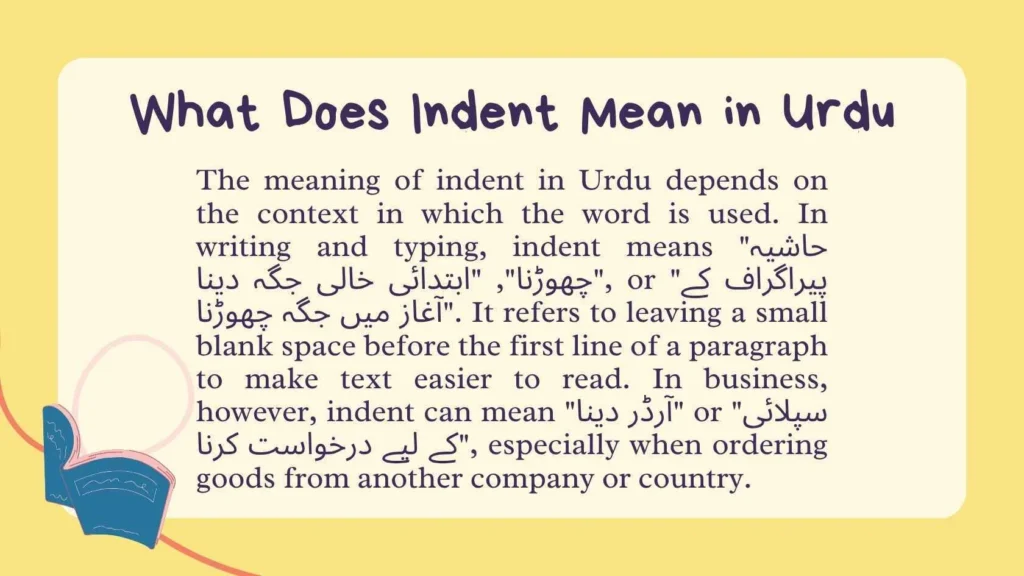
The meaning of indent in Urdu depends on the context in which the word is used. In writing and typing, indent means “حاشیہ چھوڑنا”, “ابتدائی خالی جگہ دینا”, or “پیراگراف کے آغاز میں جگہ چھوڑنا”. It refers to leaving a small blank space before the first line of a paragraph to make text easier to read. In business, however, indent can mean “آرڈر دینا” or “سپلائی کے لیے درخواست کرنا”, especially when ordering goods from another company or country.
The word has different meanings because it is used in several fields, including writing, printing, education, business, and inventory management.
Here are a few common Urdu meanings:
- Writing: ابتدائی خالی جگہ دینا
- Business: آرڈر دینا یا درآمدی آرڈر
- Printing: متن کو اندر کی طرف لے جانا
Real-Life Examples
- A teacher tells students to indent the first line of every paragraph in their essay.
- A company places an indent with a supplier to import electronic products.
- A graphic designer uses paragraph indentation to improve the appearance of a brochure.
Understanding the correct Urdu meaning depends on the sentence. If the discussion is about writing, it refers to spacing before a paragraph. If it is about trade or purchasing, it usually means placing an order for products.
Indent Meaning in Business
In business, an indent is a formal order placed by a buyer requesting goods from a supplier, manufacturer, or exporter. It is commonly used in international trade, wholesale purchasing, and import-export businesses. Instead of buying products already in stock, a company may submit an indent asking the supplier to manufacture or ship specific goods.
An indent usually includes important details such as:
- Product names
- Quantity required
- Quality specifications
- Delivery schedule
- Payment terms
- Shipping instructions
Businesses use indent orders to ensure they receive exactly what they need while reducing inventory costs. It also helps suppliers plan production more efficiently.
Real-Life Examples
- A clothing retailer sends an indent to a factory for 5,000 custom-designed T-shirts.
- A supermarket places an indent with an overseas supplier for imported food products.
- A construction company submits an indent for specialized building materials before a project begins.
Business professionals may also use the term indent agent, which refers to a person or company that connects buyers with manufacturers and earns a commission on successful orders.
Related terms include purchase order, supplier agreement, procurement, wholesale order, import order, and trade documentation. Although similar to a purchase order, an indent is often associated with international sourcing and customized product requests.
Indent a Paragraph Meaning
To indent a paragraph means to leave a small blank space before the first line of a paragraph. This formatting style helps readers easily recognize where a new paragraph begins and makes the text more organized and readable.
Indenting paragraphs is common in:
- Books
- School essays
- Research papers
- Novels
- Printed documents
Most word processors, such as Microsoft Word and Google Docs, allow users to create paragraph indents automatically instead of pressing the space bar multiple times.
There are different types of paragraph indents:
- First-line indent – Only the first line moves inward.
- Hanging indent – The first line stays at the margin while the remaining lines are indented.
- Left and right indent – The entire paragraph shifts inward from one or both margins.
Real-Life Examples
- A student indents every paragraph in an English assignment following MLA formatting.
- An author uses first-line indents throughout a novel.
- A researcher applies hanging indents when formatting references in APA style.
Indenting paragraphs improves readability and creates a professional appearance. Many academic and publishing style guides recommend using proper paragraph indentation instead of leaving extra blank lines between paragraphs.
Indent Order Meaning
An indent order is a written request sent by a buyer asking a supplier or manufacturer to provide specific goods according to agreed specifications. It is widely used in wholesale purchasing, manufacturing, and international trade when products need to be produced or sourced before delivery.
Unlike buying products directly from existing inventory, an indent order often involves custom production or special procurement. It acts as an official purchasing document that clearly communicates the buyer’s requirements.
A typical indent order contains:
- Product descriptions
- Required quantity
- Technical specifications
- Delivery location
- Expected delivery date
- Payment conditions
This document reduces misunderstandings between buyers and suppliers and helps both parties track the purchasing process.
Real-Life Examples
- A hospital places an indent order for new medical equipment.
- A retailer submits an indent order for seasonal products several months before the holidays.
- A manufacturing company sends an indent order for machine parts needed in production.
Related business terms include purchase request, purchase order, supplier contract, procurement process, and inventory planning. While similar to a purchase order, an indent order is especially common when goods are imported or manufactured after receiving the request.
Indent Form Meaning
An indent form is a document used to request goods, materials, equipment, or services within an organization or from an external supplier. It provides written approval for purchasing items and ensures that every request follows company procedures.
Many businesses, schools, hospitals, factories, and government offices use indent forms as part of their purchasing system.
An indent form typically includes:
- Name of the requester
- Department
- Item description
- Quantity required
- Purpose of the request
- Required delivery date
- Approval signatures
Using an indent form helps organizations maintain accurate purchasing records, control expenses, and prevent unauthorized buying.
Real-Life Examples
- An office employee fills out an indent form to request new laptops.
- A school submits an indent form for classroom furniture.
- A factory manager completes an indent form before ordering raw materials.
Modern companies often use digital indent forms through procurement software instead of paper documents. These electronic forms speed up approvals and improve record keeping while reducing paperwork.
Indent Book Meaning
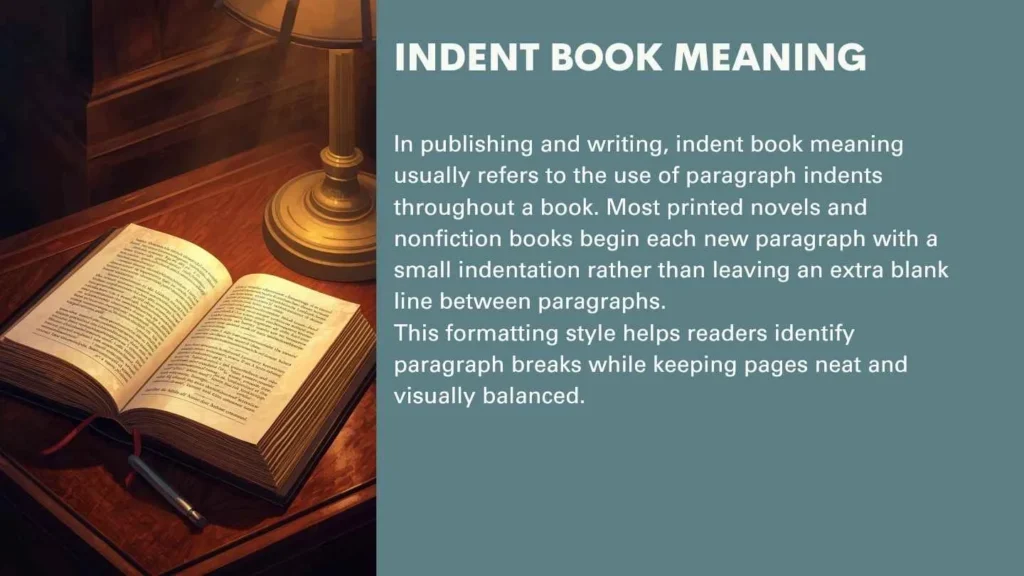
In publishing and writing, indent book meaning usually refers to the use of paragraph indents throughout a book. Most printed novels and nonfiction books begin each new paragraph with a small indentation rather than leaving an extra blank line between paragraphs.
This formatting style helps readers identify paragraph breaks while keeping pages neat and visually balanced.
Books commonly use:
- First-line paragraph indents
- Consistent spacing throughout chapters
- Special formatting for dialogue and quotations
Some digital books and websites may replace paragraph indents with extra spacing, but traditional printed books still rely heavily on indentation.
Real-Life Examples
- A novelist formats every paragraph with a first-line indent before publishing the manuscript.
- A publishing company checks paragraph indents during the editing process.
- A self-published author uses automatic paragraph indentation in Microsoft Word before converting the file into an eBook.
The phrase may also occasionally appear in older trade contexts referring to an order book for indent transactions, but in modern searches it most often relates to book formatting and paragraph indentation.
Indent Item Meaning
An indent item is a product, material, or supply requested through an indent or procurement process. Instead of referring to the entire order, the term focuses on each individual product listed within the request.
Every indent item normally includes details such as:
- Product name
- Item code
- Quantity
- Unit price
- Specifications
- Supplier information
Organizations use indent items to track purchasing, inventory, and stock movement more accurately.
Real-Life Examples
- A hospital lists gloves, syringes, and masks as separate indent items.
- A construction company records cement, steel rods, and bricks as individual indent items.
- A school’s purchasing department enters computers, projectors, and printers as separate indent items on one indent request.
Managing indent items carefully helps businesses avoid duplicate purchases, maintain inventory levels, and simplify financial reporting. Procurement software often assigns each indent item a unique identification number to improve tracking throughout the purchasing cycle.
Related terms include inventory item, purchase item, stock item, material request, and procurement record.
Indent Stock Meaning
Indent stock refers to products that are ordered specifically for a customer instead of being kept as regular inventory. Businesses usually purchase these items only after receiving a confirmed customer request, especially when the products are expensive, customized, or imported.
Unlike regular stock that is always available in a warehouse, indent stock often has a longer delivery time because it must be sourced or manufactured after the order is placed.
Common examples of indent stock include:
- Specialized industrial machinery
- Imported medical equipment
- Custom furniture
- Luxury vehicles
- Unique electronic components
Real-Life Examples
- A car dealership orders a custom vehicle as indent stock after a customer selects specific features.
- A medical supplier imports specialized laboratory equipment as indent stock for a hospital.
- A furniture company manufactures custom office desks only after receiving a confirmed order.
Using indent stock helps businesses reduce storage costs and avoid excess inventory. However, customers usually need to wait longer for delivery because production or shipping begins only after the order is confirmed. This approach is common in industries where products are highly customized or purchased in smaller quantities.
What Does Indent Mean in Text?
When people use the word indent in text editing, word processing, or digital documents, they usually mean adding space before a paragraph.
For example:
- “Please indent the first line.”
- “The essay requires a half-inch indent.”
- “Use the Tab key to indent the paragraph.”
In text formatting, indenting helps readers identify where a new paragraph begins.
WhatsApp Chat Example
Friend 1: Why does your document look different?
Friend 2: I indented the paragraphs to make them easier to read.
Instagram DM Example
User A: Your article looks professional.
User B: Thanks! I used proper headings and indents.
TikTok Comment Example
Comment: Can someone explain why the paragraphs are spaced like that?
Reply: They’re indented to improve readability.
What Does Indent Mean on Social Media (TikTok, Instagram, etc.)?
On social media, the word indent generally keeps its standard meaning related to formatting and layout.
Content creators may use it when discussing:
- Writing tips
- School assignments
- Content formatting
- Graphic design
- Caption organization
Unlike many internet slang terms, indent is not commonly used as slang on TikTok or Instagram. It usually refers to formatting text properly.
TikTok Usage Example
“Don’t forget to indent your paragraphs when writing college essays.”
Instagram Usage Example
“Clean formatting and proper indents make posts easier to read.”
Real-Life Meaning and Usage
The meaning of indent becomes clearer when seen in everyday situations.
Common real-life uses include:
- Writing school essays
- Formatting business reports
- Publishing books
- Creating professional documents
- Designing websites
- Making physical dents in materials
Whether you’re a student, writer, teacher, or office worker, you’ve likely encountered indents regularly.
Real-Life Situations Where This Term Is Used
Academic Writing
Teachers often require students to indent the first line of each paragraph.
Office Documents
Businesses use indents to create professional-looking reports.
Publishing
Book publishers use indentation to separate paragraphs.
Graphic Design
Designers may indent text to improve visual balance.
Manufacturing
A machine may indent metal by pressing a shape into it.
Business Orders
Companies sometimes use the term indent for special product orders.
Examples of Indent in Sentences
Here are some examples of indent in sentences:
- Please indent the first line of every paragraph.
- The editor asked me to indent the quotation.
- A heavy object indented the soft surface.
- The teacher deducted points because I forgot to indent.
- The manufacturer agreed to indent the goods from overseas.
- The metal sheet was indented during shipping.
- Proper indents make long documents easier to read.
Different Contexts of Indent
Academic Context
Students use indents in essays, research papers, and assignments.
Professional Context
Businesses use indents in reports, proposals, and presentations.
Publishing Context
Books and magazines often use paragraph indents.
Design Context
Graphic designers use indentation to organize visual content.
Manufacturing Context
Indent may refer to pressing or marking a material.
Business Context
Indent can describe ordering products through a supplier.
Origin and History of the Term
The word indent comes from the Latin word dent meaning “tooth.”
Historically, legal agreements were sometimes written on a single sheet and cut with a jagged or toothed edge. These documents became known as “indentures.”
Over time, the word evolved to describe:
- Toothed edges
- Notches or dents
- Spaces set inward
- Special commercial orders
Today, the writing-related meaning is the most widely recognized.
Why Do People Use This Word?
People use the word indent because it clearly describes moving something inward or creating a space.
In writing, indentation serves several purposes:
- Improves readability
- Separates paragraphs
- Creates professional formatting
- Helps organize information
- Guides readers through content
Without proper indentation, large blocks of text can look overwhelming.
Emotional & Psychological Meaning Behind This Word
Although indent is primarily a formatting term, it has subtle psychological effects.
Indented paragraphs can:
- Make text feel more organized
- Reduce visual stress
- Improve reading flow
- Create a sense of structure
- Help readers process information more comfortably
Well-formatted content often appears more trustworthy and professional.
Tone Explanation
Formal Usage
Common in:
- Academic papers
- Business reports
- Books
- Professional documents
Informal Usage
Can appear in casual discussions about writing or formatting.
Slang Usage
Indent is generally not a slang term.
Offensive Usage
The word is not considered offensive.
Is It Rude to Say This Word?
No, indent is not rude.
It is a neutral and professional word used in education, business, publishing, and everyday communication.
People use it regularly without any negative implications.
Is This Word Positive, Negative, or Neutral?
The word indent is generally neutral.
| Tone Type | Classification |
| Positive | Sometimes when discussing good formatting |
| Negative | Rarely |
| Neutral | Most common usage |
Most uses simply describe formatting or positioning.
When to Use Indent
Use the word indent when:
- Formatting paragraphs
- Discussing document design
- Giving writing instructions
- Describing a dent or notch
- Talking about business ordering systems
Examples:
- “Indent the first line.”
- “The surface became indented.”
- “The company will indent the products.”
When NOT to Use Indent
Avoid using indent when:
- You mean spacing between lines.
- You mean margins in general.
- You mean paragraph breaks without indentation.
- Another word describes the situation more accurately.
For example, “spacing” and “indentation” are not always the same thing.
Situations Where You Should Avoid Using This Word
You may want to avoid the word when:
- Your audience is unfamiliar with formatting terminology.
- Simpler words like “space” or “move inward” are clearer.
- Technical writing terms may confuse readers.
In such cases, explaining the concept can be more helpful.
Comparison Table: Indent vs Similar Terms
| Term | Meaning | Usage | Key Difference |
| Indent | Move text inward from the margin | Writing and formatting | Creates space at the beginning |
| Margin | Blank space around page edges | Document layout | Defines page boundaries |
| Spacing | Distance between lines or elements | Formatting | Controls gaps, not paragraph starts |
| Alignment | Positioning text left, center, or right | Design and writing | Controls overall placement |
| Tab | Keyboard function creating space | Typing | Often used to create an indent |
Variations and Meanings of Indent
Here are several possible meanings or variations of the keyword:
1. First-Line Indent
Only the first line moves inward.
2. Hanging Indent
The first line stays at the margin while following lines are indented.
3. Left Indent
Entire paragraph shifts right.
4. Right Indent
Entire paragraph shifts left from the right margin.
5. Paragraph Indent
Used at the start of a paragraph.
6. Physical Indent
A dent or depression in an object.
7. Business Indent
A special order placed through suppliers.
8. Automatic Indent
Created by software formatting tools.
9. Manual Indent
Added by a user through formatting controls.
10. Text Indentation
General formatting that moves text inward.
How to Respond When Someone Mentions Indent
Casual Replies
- “Got it, I’ll indent the paragraph.”
- “Thanks for the formatting tip.”
- “I’ll fix the indentation.”
Funny Replies
- “My paragraphs are socially distancing from the margin!”
- “Time to give that paragraph some personal space.”
- “The Tab key is about to get some work.”
Professional or Mature Replies
- “Thank you for the correction. I’ll update the formatting.”
- “I’ll ensure the document follows proper indentation rules.”
- “The formatting will be revised accordingly.”
Cultural Usage
USA / Western Usage
In the United States, indent is commonly taught in:
- Elementary schools
- High schools
- Colleges
- Professional workplaces
Most Americans associate the word with writing and document formatting.
Global and Internet Usage
Globally, the meaning remains largely the same.
However:
- Some countries emphasize paragraph spacing over indentation.
- Online platforms may automatically remove indents.
- Social media users often focus more on line breaks than traditional paragraph indentation.
What Does Indent Mean in Text?
In text, indent means adding space at the beginning of a line or paragraph to improve organization and readability.
This is the most common meaning of the term today.
What Does Indent Mean on TikTok / Instagram?
On TikTok and Instagram, indent typically refers to:
- Formatting advice
- Writing tutorials
- Content creation tips
- Academic writing discussions
It is not usually used as internet slang.
Is It Rude to Say This?
No. The word indent is completely neutral and appropriate in:
- School settings
- Business communication
- Social media discussions
- Professional writing
Why Do People Use This Word?
People use indent because it helps describe:
- Text formatting
- Visual organization
- Professional document design
- Physical dents or impressions
- Special business orders
It is a practical and widely understood term.
FAQs
What does indent mean in writing?
It means leaving space at the beginning of a paragraph to improve readability and organization.
What does indent mean in text formatting?
It means moving text inward from the page margin.
What does indent mean in Microsoft Word?
It refers to formatting options that move text away from the left or right margin.
Is indent the same as spacing?
No. Indentation affects paragraph position, while spacing affects distance between lines or paragraphs.
What is a hanging indent?
A hanging indent leaves the first line at the margin while indenting all following lines.
Why do schools require indentation?
Indentation helps separate paragraphs and makes essays easier to read.
What does indent mean in business?
In business, an indent can refer to a special order placed through a supplier or intermediary.
Conclusion
Understanding what does indent mean is important for writing, formatting, education, and professional communication. Most commonly, an indent is a space added at the beginning of a paragraph to improve readability and organization. However, the word can also refer to a dent in a surface or a special business order. Whether you’re formatting an essay, creating a report, or learning document design, knowing the meaning of indent helps you communicate more clearly and present information in a professional way.
Also Check These Posts:
- What Does Fetus Mean? Simple Definition, Usage, and Real-Life Examples
- What Does Mortality Mean? Simple Definition, Usage, and Real-Life Examples

James Parker is a passionate writer and language enthusiast dedicated to helping readers understand words, meanings, and communication in a simple and effective way. With years of experience in educational writing and vocabulary research, he creates easy-to-understand content that helps students, learners, and readers improve their language skills.
At MeanNings.com, James focuses on providing accurate word meanings, English vocabulary, synonyms, antonyms, and practical language guides. His writing style is clear, informative, and designed for readers of all levels.
James believes that learning language should be simple, engaging, and accessible to everyone. Through his work, he aims to make complex words easier to understand and help readers build confidence in communication.
Books by James Parker
- The Power of Words
- Mastering Everyday Vocabulary
- English Meanings Simplified
 Daniel Brooks