What Does Chance of Rain Mean? If your weather app says there’s a 40% chance of rain, it doesn’t mean it will rain for 40% of the day or cover 40% of your area. It simply means there’s a certain probability that measurable rain will occur at your location during the forecast period.
This weather forecast term often causes confusion because many people interpret it the wrong way. Understanding the chance of rain, also called the probability of precipitation (PoP), can help you decide whether to carry an umbrella, plan outdoor activities, or prepare for changing weather conditions.
While the basic definition is straightforward, meteorologists calculate this percentage using several weather factors, and the meaning can vary depending on the forecast and local conditions. Keep reading to learn exactly how the chance of rain is calculated, what different percentages really mean, and see real-life examples that make weather forecasts much easier to understand.
If you’ve ever checked a weather app and wondered, what does chance of rain mean, you’re not alone. A chance of rain refers to the probability that measurable rain will fall at a specific location during the forecast period. For example, a 20% chance of rain means there’s a 20% probability that your location will receive measurable rainfall—not that it will rain for 20% of the day or cover 20% of the area.
What Does Chance of Rain Mean? (Quick Meaning)
Here are the most common meanings of chance of rain:
- Weather forecast probability: The likelihood that measurable rain will fall at your location during a forecast period.
- Rain prediction: A percentage that shows how confident meteorologists are that rain will occur.
- Planning tool: Helps people decide whether to carry an umbrella, postpone outdoor activities, or prepare for wet weather.
- Forecast guidance: Indicates the possibility of rain, not the amount, duration, or intensity.
What Does Chance of Rain Mean?
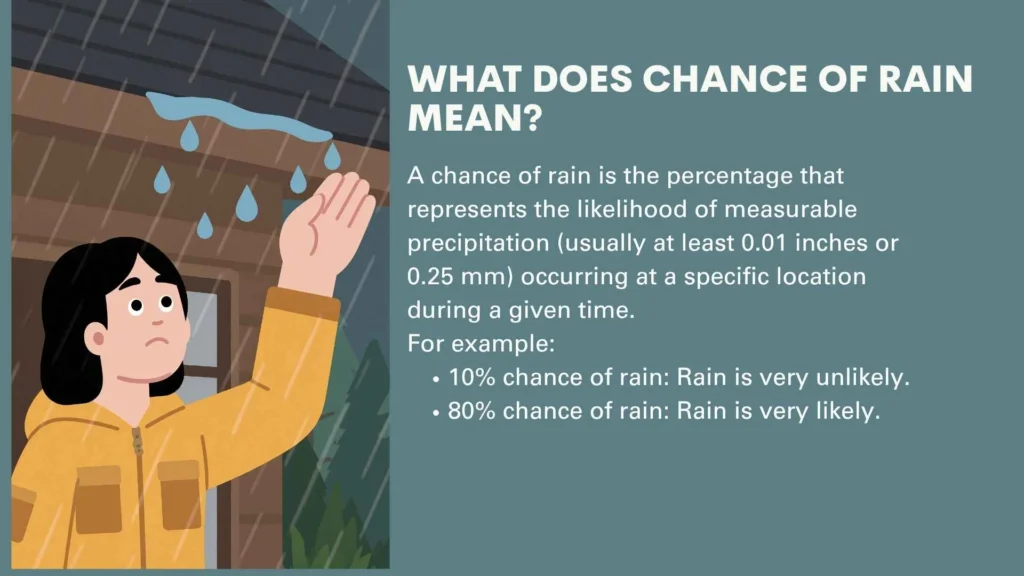
A chance of rain is the percentage that represents the likelihood of measurable precipitation (usually at least 0.01 inches or 0.25 mm) occurring at a specific location during a given time.
For example:
- 10% chance of rain: Rain is very unlikely.
- 30% chance of rain: Rain is possible but not expected in most cases.
- 50% chance of rain: Rain is just as likely as not.
- 80% chance of rain: Rain is very likely.
This percentage does not tell you:
- How long it will rain.
- How hard it will rain.
- What percentage of the day will be rainy.
- How much of the city will get rain.
Instead, it simply tells you how likely rain is to occur where you are.
Full Meaning in Simple Words
In simple terms, a chance of rain answers one question:
“How likely is it that rain will fall where I am?”
Imagine your weather app says there’s a 40% chance of rain this afternoon.
That means there’s a moderate possibility that your location will receive measurable rain during that time period.
It doesn’t mean:
- It will rain for 40% of the afternoon.
- It will rain across 40% of the city.
- You’ll definitely experience light rain.
It simply means the forecast predicts a 40% probability of rainfall.
What Does Chance of Rain Mean in Text?
In text messages, chance of rain keeps its standard weather-related meaning. It is not slang or an internet abbreviation.
People commonly use it while discussing plans.
Example:
“There’s a 60% chance of rain tomorrow. Let’s move the picnic indoors.”
Meaning: Rain is fairly likely, so it’s better to prepare.
Another example:
“Only a 10% chance of rain. We should be fine.”
Meaning: Rain is unlikely.
What Does The Percentage Of Rain Mean On iPhone
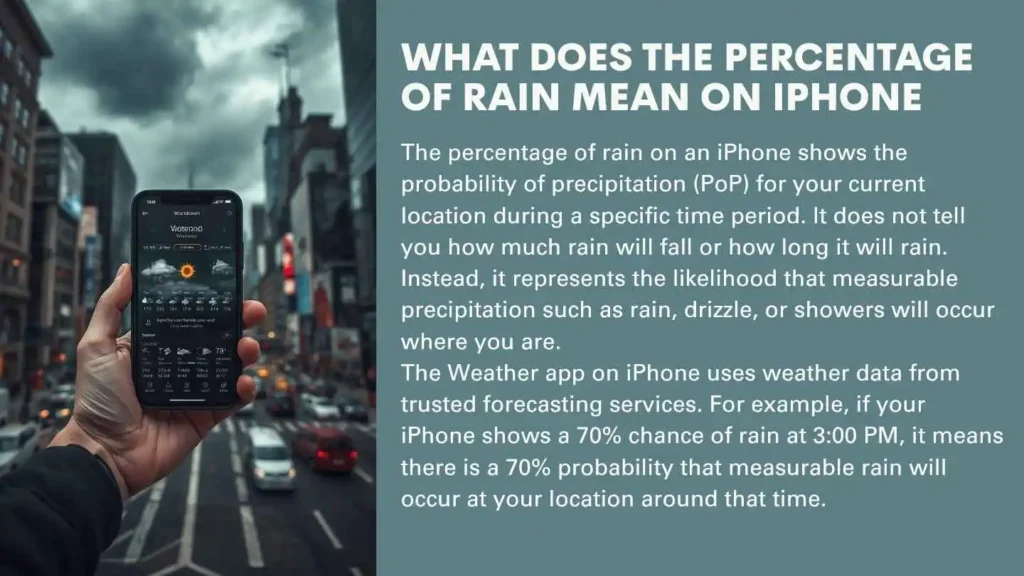
The percentage of rain on an iPhone shows the probability of precipitation (PoP) for your current location during a specific time period. It does not tell you how much rain will fall or how long it will rain. Instead, it represents the likelihood that measurable precipitation such as rain, drizzle, or showers will occur where you are.
The Weather app on iPhone uses weather data from trusted forecasting services. For example, if your iPhone shows a 70% chance of rain at 3:00 PM, it means there is a 70% probability that measurable rain will occur at your location around that time.
Many people mistakenly believe the percentage tells them how much of the day will be rainy or how heavy the rain will be. That is not correct. The percentage only reflects the chance of precipitation.
Here are a few examples:
- 20% chance of rain: Rain is possible but not very likely.
- 50% chance of rain: Rain is just as likely as dry weather.
- 90% chance of rain: Rain is very likely, so carrying an umbrella is a good idea.
Real-life examples:
- You check your iPhone before leaving for work and see a 30% chance of rain. You might skip the umbrella if you’re willing to take a small risk.
- Before a soccer game, your iPhone shows an 80% chance of rain, so you decide to postpone the match.
- While traveling, a 100% chance of rain helps you prepare with waterproof clothing.
Always combine the rain percentage with other weather details like radar, temperature, wind, and hourly forecasts for the most accurate picture.
Does The Percentage Of Rain Mean The Area
No, the percentage of rain does not mean the percentage of an area that will receive rain. This is one of the most common weather myths. The percentage shown in weather forecasts represents the chance of measurable precipitation at your specific location, not the portion of a city, county, or state that will be wet.
Meteorologists calculate the probability of precipitation using weather models, atmospheric conditions, and forecast confidence. While weather maps may show rain covering different parts of a region, the percentage you see is personalized for your location.
For example:
- A 40% chance of rain does not mean 40% of your town will get rain.
- A 70% chance of rain does not mean it will rain for 70% of the day.
- It simply means there is a 70% probability that measurable precipitation will occur where you are.
Real-life examples:
- Your friend across town experiences heavy rain while your neighborhood stays dry, even though both of you saw a 50% chance of rain.
- A storm moves around your area without reaching your home despite a 30% forecast.
- A weather app shows rain over only part of the city, but your location still has a high chance because the storm is expected to pass nearby.
To understand where rain will actually fall, check weather radar maps along with the precipitation percentage. Radar shows the movement and location of rain clouds, while the percentage tells you how likely rain is at your specific location.
What Does 90% Chance Of Rain Mean
A 90% chance of rain means there is a very high probability that measurable precipitation will occur at your location during the forecast period. While it is still not an absolute guarantee, rain is considered highly likely.
Meteorologists use the probability of precipitation to express forecast confidence. A 90% forecast indicates that weather conditions strongly support rainfall, so it is wise to prepare for wet weather.
Keep in mind that a 90% chance of rain does not tell you:
- How long the rain will last.
- Whether it will be light or heavy.
- The exact time the rain will begin.
It only tells you that measurable rain is very likely somewhere during the forecast period at your location.
Real-life examples:
- You have an outdoor wedding planned, and the forecast shows a 90% chance of rain. Renting a tent is a smart decision.
- You see 90% before your evening commute and decide to carry an umbrella.
- A hiking trip is scheduled, but a 90% forecast encourages you to postpone it.
Even with a high percentage, rainfall amounts can vary. You may experience a brief shower, steady rain, or thunderstorms depending on local weather conditions.
For better planning, check hourly forecasts, radar images, wind conditions, and weather alerts. Together, these provide a more complete picture than the rain percentage alone.
Chance Of Precipitation Vs Chance Of Rain
The chance of precipitation and chance of rain are closely related, but they are not always exactly the same. Chance of precipitation refers to the likelihood of any measurable precipitation, while chance of rain specifically refers to rainfall.
Precipitation includes several forms of moisture, such as:
- Rain
- Snow
- Sleet
- Freezing rain
- Hail
If temperatures are above freezing, a weather app may simply display “chance of rain” because rain is the expected type of precipitation. During winter, however, the forecast may instead mention snow or a general chance of precipitation.
For example:
- A 60% chance of precipitation in winter may mean snow instead of rain.
- A 60% chance of rain clearly indicates rainfall is expected.
- Both percentages describe the probability that measurable precipitation will occur.
Real-life examples:
- In July, a 70% chance of precipitation usually means rain showers.
- During January, the same percentage may indicate snowfall.
- Mountain regions may experience rain in valleys but snow at higher elevations under the same precipitation forecast.
Understanding this difference helps you prepare appropriately. Instead of only checking the percentage, also look at the forecast description and temperature. These details tell you whether to carry an umbrella, wear waterproof boots, or prepare for snowy roads.
What Does 50% Chance Of Rain Mean
A 50% chance of rain means there is an equal likelihood that measurable precipitation will occur at your location during the forecast period. In simple terms, rain is just as likely as dry weather.
This percentage does not mean it will rain for half the day or cover half the area. It simply reflects the probability that your location will receive measurable rainfall.
Weather forecasts use sophisticated computer models, satellite data, radar, and meteorological observations to estimate this probability.
A 50% chance often means you should be prepared for changing weather conditions.
Real-life examples:
- You’re planning a picnic with a 50% rain forecast. Bringing an umbrella or choosing a covered location is a good idea.
- Before going for a run, you check the forecast and decide to carry a lightweight rain jacket.
- A school sports event may continue as planned but have a backup indoor option.
Remember that weather conditions can change quickly. A 50% forecast could result in:
- No rain at all.
- A brief passing shower.
- Steady rainfall for part of the forecast period.
Checking hourly weather forecasts and live radar can help you determine whether the rain is expected early, late, or throughout the day. This gives you a much clearer understanding than the percentage alone.
Does Chance Of Precipitation Mean Snow
Yes, the chance of precipitation can mean snow if temperatures are cold enough. Precipitation is a broad weather term that includes all forms of water falling from the atmosphere, not just rain.
Common types of precipitation include:
- Rain
- Snow
- Sleet
- Freezing rain
- Hail
Whether precipitation falls as rain or snow depends mainly on the air temperature from the clouds to the ground.
For example:
- If temperatures remain below freezing, precipitation is more likely to fall as snow.
- If temperatures are above freezing, it usually falls as rain.
- During changing weather conditions, it may begin as snow and change into rain.
Real-life examples:
- A forecast showing a 70% chance of precipitation with temperatures below 32°F (0°C) usually suggests snow is likely.
- Ski resorts often monitor precipitation forecasts to estimate fresh snowfall.
- During winter storms, weather apps may replace “chance of rain” with “chance of snow.”
To know exactly what type of precipitation is expected, always read the full weather forecast instead of relying only on the percentage. Forecast descriptions, temperatures, wind chill, and winter weather alerts provide important context that helps you prepare for travel and outdoor activities.
What Does 80% Chance Of Rain Mean
An 80% chance of rain means there is a strong likelihood that measurable rainfall will occur at your location during the forecast period. Although it is not a guarantee, rain is considered very likely.
An 80% forecast usually indicates that atmospheric conditions strongly favor precipitation. Many people use this percentage as a signal to adjust outdoor plans or carry rain gear.
However, the percentage does not explain:
- Rain intensity.
- Rain duration.
- Exact rainfall totals.
Real-life examples:
- You’re heading to a concert, and the forecast shows an 80% chance of rain. Bringing a raincoat is a smart choice.
- A family barbecue may be moved indoors because rain is expected.
- Cyclists often delay rides when the forecast reaches 80%.
An 80% chance can still produce different weather outcomes. Some locations may receive heavy rain, while others experience only a brief shower. Weather systems are constantly changing, which is why forecasts can occasionally be updated throughout the day.
For the best planning, combine the probability of rain with hourly forecasts, weather radar, and local weather alerts. This gives you a clearer picture of when rain is most likely and how it could affect your plans.
100 Percent Chance Of Rain Meaning
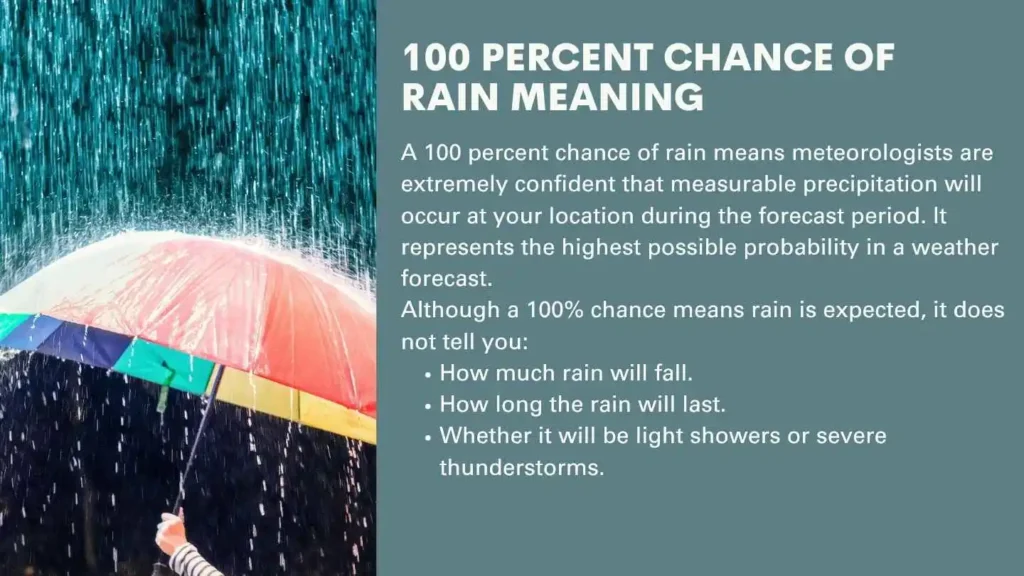
A 100 percent chance of rain means meteorologists are extremely confident that measurable precipitation will occur at your location during the forecast period. It represents the highest possible probability in a weather forecast.
Although a 100% chance means rain is expected, it does not tell you:
- How much rain will fall.
- How long the rain will last.
- Whether it will be light showers or severe thunderstorms.
A brief shower that produces measurable rainfall is enough for the forecast to be considered accurate.
Real-life examples:
- Your morning forecast shows a 100% chance of rain, so you leave home with an umbrella and waterproof shoes.
- A construction crew delays outdoor work because rain is virtually certain.
- An amusement park visitor prepares for wet conditions throughout the day.
Even with a 100% forecast, rainfall amounts can vary widely. Some storms produce only a few minutes of light rain, while others bring hours of heavy rainfall or thunderstorms.
To understand the full forecast, also review rainfall totals, hourly precipitation timing, weather radar, wind speed, and any severe weather warnings. These details help you know not just if it will rain, but how the weather may affect your day.
What Does Chance of Rain Mean on Social Media (TikTok, Instagram, etc.)?
On social media, the phrase usually appears in weather updates, travel posts, outdoor adventure content, and memes.
Sometimes creators joke about weather forecasts that predict rain but never deliver.
Examples include:
- Fitness creators planning outdoor workouts.
- Travelers discussing vacation weather.
- Event organizers updating followers.
- Meme pages making fun of unpredictable forecasts.
Unlike many internet expressions, chance of rain has the same meaning online as it does in official weather forecasts.
Platform-Based Examples
WhatsApp Chat Example
Emma: Should we go hiking tomorrow?
Ryan: There’s only a 15% chance of rain, so I think we’re good.
Instagram DM Example
Friend: Are you still going to the beach?
You: Yes! The forecast shows just a 10% chance of rain.
TikTok Comment Example
“The app said 20% chance of rain, but I still got soaked!”
Meaning: The forecast showed a low probability, but rain still happened at that location.
Real-Life Meaning and Usage
People use chance of rain every day to make decisions.
Common situations include:
- Planning outdoor weddings
- Scheduling sports events
- Going camping
- Traveling
- Gardening
- Walking pets
- Washing cars
- Family picnics
- Construction projects
- Outdoor concerts
Weather forecasts help reduce surprises, even though they aren’t perfect.
Real-Life Situations Where This Term Is Used
Here are some examples:
Before Traveling
People check the chance of rain before packing clothes.
During Sports
Coaches decide whether games should continue.
Outdoor Events
Event planners may rent tents if rain is likely.
Daily Commute
Commuters decide whether to carry umbrellas.
Gardening
Gardeners adjust watering schedules based on the forecast.
Examples of Chance of Rain in Sentences
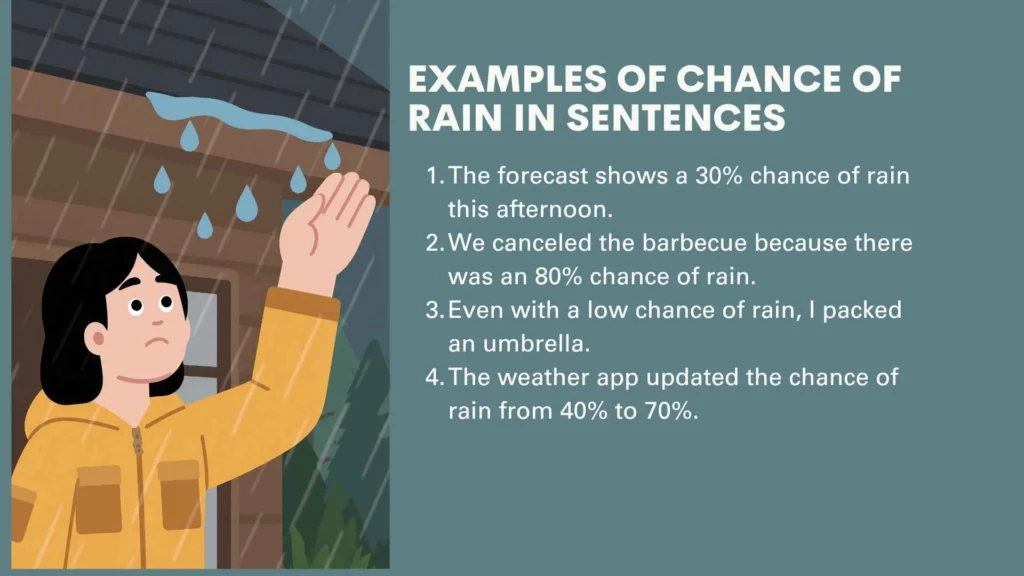
- The forecast shows a 30% chance of rain this afternoon.
- We canceled the barbecue because there was an 80% chance of rain.
- Even with a low chance of rain, I packed an umbrella.
- Tomorrow has almost no chance of rain, so it should be sunny.
- The weather app updated the chance of rain from 40% to 70%.
- Farmers closely watch the chance of rain during planting season.
- The baseball game continued despite a small chance of rain.
Different Contexts of Chance of Rain
Weather Forecasts
Meteorologists use it to express rainfall probability.
Casual Conversation
Friends mention it when making plans.
News Reports
TV weather forecasts frequently discuss the chance of rain.
Travel Planning
Travelers use it to prepare for weather conditions.
Online Discussions
People often compare weather apps and forecast accuracy.
Origin and History of the Term
The idea behind the chance of rain comes from modern meteorology.
As weather forecasting improved during the 20th century, meteorologists began using Probability of Precipitation (PoP) to communicate uncertainty more clearly.
Rather than saying it “might rain,” forecasts started using percentages like 20%, 50%, or 80%, making predictions easier to understand.
Today, nearly every weather service around the world uses some form of precipitation probability.
Why Do People Use This Word?
People use the phrase because it helps them:
- Plan outdoor activities
- Decide what to wear
- Carry umbrellas
- Protect valuable equipment
- Schedule events
- Travel safely
- Prepare for changing weather
It’s one of the most useful pieces of information in a weather forecast.
Emotional & Psychological Meaning Behind This Word
Although chance of rain is a weather term, it often influences emotions.
For example:
- A low chance of rain may create excitement for outdoor plans.
- A high chance of rain can cause disappointment before events.
- Gardeners may feel hopeful.
- Travelers may feel anxious about delays.
Weather forecasts often affect expectations before the day even begins.
Tone Explanation
The phrase chance of rain is:
| Tone | Applies? |
| Formal | ✔ Yes |
| Informal | ✔ Yes |
| Scientific | ✔ Yes |
| Slang | ✘ No |
| Offensive | ✘ No |
| Professional | ✔ Yes |
It works in everyday conversation as well as official weather reports.
Is It Rude to Say This Word?
No.
The phrase is completely neutral and polite.
It’s used by:
- Meteorologists
- Teachers
- News anchors
- Friends
- Families
- Travelers
- Businesses
There is no offensive or negative meaning attached to it.
Is This Word Positive, Negative, or Neutral?
The phrase is neutral.
Whether people see it positively or negatively depends on their plans.
For example:
- Farmers may welcome rain.
- Beachgoers may dislike it.
- Gardeners may be happy.
- Event organizers may worry.
When to Use Chance of Rain
Use this phrase when discussing:
- Weather forecasts
- Outdoor plans
- Travel
- Sporting events
- Gardening
- Daily planning
- Safety preparations
When NOT to Use Chance of Rain
Avoid using the phrase when discussing:
- Snow forecasts specifically (unless talking about precipitation generally)
- Climate trends
- Emotional situations
- Internet slang
- Non-weather topics
Situations Where You Should Avoid Using This Phrase
Don’t use chance of rain to describe:
- Someone’s mood
- Business risks
- Financial predictions
- Sports odds
- Random guesses unrelated to weather
Use words like possibility, likelihood, or probability instead.
Chance of Rain Compared With Similar Weather Terms
| Term | Meaning | Common Usage | Key Difference |
| Chance of Rain | Probability of measurable rainfall | Daily forecasts | Focuses on the likelihood of rain |
| Probability of Precipitation (PoP) | Scientific forecast percentage | Meteorology | Official technical term behind chance of rain |
| Rain Forecast | Prediction that rain is expected | Weather reports | Broader term that may include timing and intensity |
| Scattered Showers | Rain in some areas but not all | Forecast discussions | Describes rain coverage, not probability |
| Rain Expected | Rain is likely | Public forecasts | Stronger wording than a percentage chance |
Possible Meanings and Variations
Depending on the forecast, you may see:
- Chance of rain
- Slight chance of rain
- Isolated showers
- Scattered showers
- Rain likely
- Showers expected
- Probability of precipitation (PoP)
- Risk of rain
- Afternoon showers
- Rain possible
Each phrase provides slightly different information about the likelihood or coverage of rainfall.
How to Respond When Someone Mentions Chance of Rain
Casual Replies
- I’ll bring an umbrella just in case.
- Hopefully it stays dry.
- Good thing you checked the forecast.
- Let’s keep an eye on the weather.
Funny Replies
- Time to trust my lucky umbrella!
- Watch—it’ll rain only after I wash my car.
- Forecast says 20%, but my shoes disagree.
Professional or Mature Replies
- Let’s prepare a backup indoor option.
- We should monitor the updated forecast.
- It would be wise to plan for possible rain.
USA / Western Usage
In the United States, weather forecasts almost always express rainfall using percentages.
Examples include:
- 20% chance of rain
- 40% chance of showers
- 70% chance of thunderstorms
Most Americans rely on these forecasts when planning daily activities, travel, sports, and outdoor events.
Global and Internet Usage Differences
Many countries also use rainfall percentages, although some weather services emphasize descriptive phrases like:
- Rain likely
- Possible showers
- Light rain expected
On social media worldwide, users often share screenshots of forecasts or joke about inaccurate rain predictions.
What Does Chance of Rain Mean in Text?
When someone writes chance of rain in a text, they simply mean the weather forecast predicts a certain probability of rainfall.
Example:
“There’s a 70% chance of rain tonight.”
Meaning: Rain is fairly likely during the evening.
What Does Chance of Rain Mean on TikTok or Instagram?
On TikTok and Instagram, the phrase usually appears in:
- Travel reels
- Camping videos
- Outdoor workout posts
- Weather updates
- Vacation planning
- Funny weather memes
Its meaning stays the same as in official weather forecasts.
Is It Rude to Say It?
No.
The phrase is completely respectful, neutral, and appropriate in all situations.
Why Do People Use This Phrase?
People use chance of rain because it provides a simple way to understand weather uncertainty.
Instead of making absolute predictions, forecasters communicate how likely rain is, helping people make informed decisions about their day.
Frequently Asked Questions (FAQs)
What does chance of rain actually mean?
It means the probability that measurable rain will fall at your location during the forecast period.
Does a 20% chance of rain mean it will rain for 20% of the day?
No. It means there is a 20% probability that measurable rain will occur at your location.
Does 50% chance of rain mean half the city will get rain?
No. The percentage refers to the likelihood of rain at a specific location, not the area covered.
What is the difference between chance of rain and scattered showers?
Chance of rain describes the probability of rainfall, while scattered showers describe how rain may be distributed across an area.
Is a 70% chance of rain considered high?
Yes. A 70% chance means rain is likely, so it’s a good idea to prepare.
Why do weather forecasts sometimes predict rain that never happens?
Weather forecasting is based on probabilities. A high percentage means rain is likely, but it is never guaranteed.
Should I carry an umbrella if there’s a 30% chance of rain?
It depends on your plans, but carrying a small umbrella is often a smart precaution if you’ll be outdoors for an extended period.
Conclusion
Understanding what does chance of rain mean helps you make smarter decisions every day. Rather than predicting exactly when or how long it will rain, the percentage tells you the probability of measurable rainfall at your location during a specific time period. Whether you’re planning a picnic, traveling, commuting, or attending an outdoor event, knowing how to interpret a chance of rain forecast allows you to prepare with confidence. The next time you see a weather app showing a 20%, 50%, or 80% chance of rain, you’ll know exactly what that forecast is telling you—and what it isn’t.
Also Check These Posts:
- What Does Sustained Mean? Meaning, Uses, Examples, and Complete Guide
- What Does Indent Mean? Definition, Uses, and Everyday Examples
- What Does Haze Mean in Weather? Full Meaning, Examples, and Usage Guide

James Parker is a passionate writer and language enthusiast dedicated to helping readers understand words, meanings, and communication in a simple and effective way. With years of experience in educational writing and vocabulary research, he creates easy-to-understand content that helps students, learners, and readers improve their language skills.
At MeanNings.com, James focuses on providing accurate word meanings, English vocabulary, synonyms, antonyms, and practical language guides. His writing style is clear, informative, and designed for readers of all levels.
James believes that learning language should be simple, engaging, and accessible to everyone. Through his work, he aims to make complex words easier to understand and help readers build confidence in communication.
Books by James Parker
- The Power of Words
- Mastering Everyday Vocabulary
- English Meanings Simplified
 Daniel Brooks