Gatekeeping means trying to control who gets access to something—like information, hobbies, communities, or opportunities.
It usually happens when someone says others are “not real fans” or tries to exclude people from joining a group.
Have you ever shared your interest in something—like a movie, music artist, or game—and someone responded, “You’re not a real fan”? That’s a classic example of what does gatekeeping mean in everyday life.
This term often confuses people because it shows up everywhere—text messages, social media, group chats, and even real-life conversations. Sometimes it’s obvious, but other times it’s subtle and harder to recognize.
In this guide, you’ll learn the full meaning of gatekeeping, how people use it online, and when it’s okay—or not okay—to use it.
What Does Gatekeeping Mean in Text?
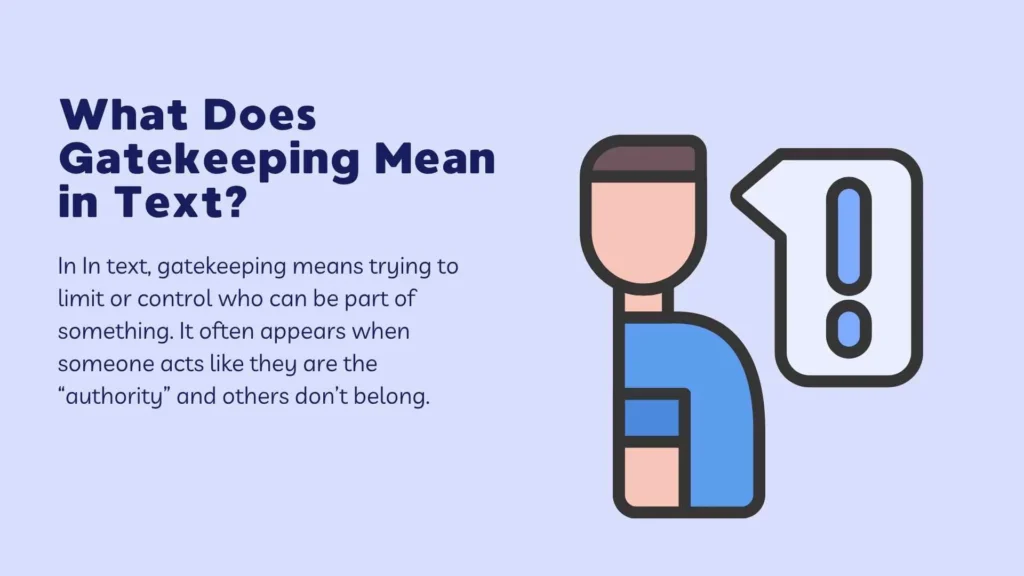
In text, gatekeeping means trying to limit or control who can be part of something. It often appears when someone acts like they are the “authority” and others don’t belong.
Simple Explanation:
- Someone claims only certain people can enjoy or understand something
- They question others’ knowledge or experience
- They make others feel excluded
Examples:
- “You just started listening to that band? You’re not a real fan.”
- “Only true gamers understand this level.”
- “You didn’t read the book, so you can’t have an opinion.”
Quick Recap:
- Gatekeeping = controlling access
- Often negative or exclusionary
- Common in fandoms, hobbies, and online groups
What Does Gatekeeping Mean in Business
Gatekeeping in business means controlling who gets access to information, resources, opportunities, customers, or decision-makers. A gatekeeper is a person or system that decides what passes through and what does not.
Gatekeeping can help a business stay organized and protect sensitive information, but it can also slow communication or limit innovation if taken too far.
In many companies, gatekeepers include executive assistants, HR managers, purchasing departments, and customer service teams. They filter requests, approve access, and make sure only qualified people move forward.
Common forms of business gatekeeping include:
- Screening job applications before they reach hiring managers.
- Approving vendor proposals before executives review them.
- Restricting access to confidential business data.
- Managing customer inquiries before they reach the sales team.
Here are some real-life examples:
- A receptionist asks visitors to sign in before allowing them to meet the CEO.
- An HR recruiter reviews hundreds of resumes and only forwards the best candidates.
- An IT department limits employee access to confidential financial records.
Good gatekeeping protects company resources, improves security, and saves time. However, excessive gatekeeping may create unnecessary delays, discourage employee ideas, or make customers feel ignored.
Business leaders should balance protection with transparency. Employees should know why certain processes exist and how to request access when needed. This creates trust while keeping important information secure.
Overall, gatekeeping in business is about managing access responsibly. When used fairly, it improves efficiency, protects company interests, and supports better decision-making without preventing collaboration.
Gatekeeping Meaning Relationship
Gatekeeping in a relationship means one partner controls access to certain parts of the relationship, decisions, emotions, or even family members. This behavior can happen intentionally or unintentionally and often affects communication and trust.
Relationship gatekeeping is not always harmful. Sometimes a partner sets healthy boundaries to protect privacy or emotional well-being. However, unhealthy gatekeeping happens when one person constantly controls information, limits the other person’s involvement, or decides who can participate in important matters.
Common signs include:
- One partner makes all major decisions alone.
- A parent limits the other parent’s involvement with the children.
- Someone refuses to share important information or feelings.
- One partner controls access to friends or family members.
Real-life examples:
- A husband manages all financial accounts without telling his wife how the money is spent.
- A parent refuses to let the other parent attend school meetings.
- One partner always speaks for the other during family gatherings.
Healthy relationships rely on openness, mutual respect, and shared decision-making. While everyone deserves personal boundaries, constant gatekeeping can create resentment and emotional distance.
If gatekeeping becomes a problem, honest communication is the first step. Couples may benefit from discussing expectations, responsibilities, and trust. In more serious situations, relationship counseling can help both partners develop healthier communication habits.
In short, gatekeeping in relationships refers to controlling access, participation, or information. Whether it is healthy or unhealthy depends on the reason behind the behavior and its effect on both partners.
Gatekeeping Meaning TikTok
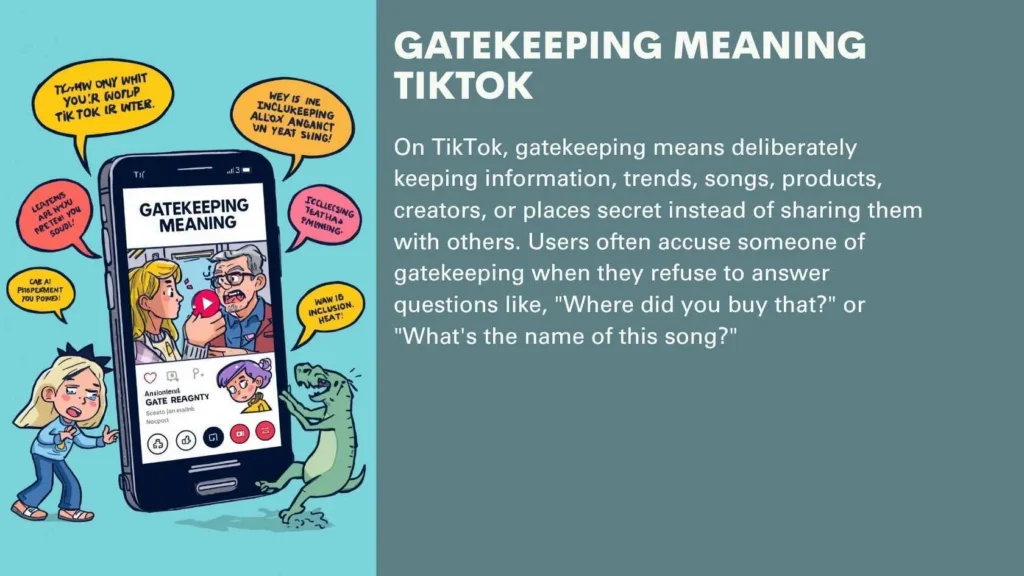
On TikTok, gatekeeping means deliberately keeping information, trends, songs, products, creators, or places secret instead of sharing them with others. Users often accuse someone of gatekeeping when they refuse to answer questions like, “Where did you buy that?” or “What’s the name of this song?”
The term has become popular because TikTok encourages users to discover new fashion, music, restaurants, beauty products, and hidden locations. When creators avoid revealing these details, viewers may comment, “Stop gatekeeping.”
Common examples include:
- Refusing to share the brand of an outfit.
- Hiding the name of a trending song.
- Not revealing the location of a beautiful vacation spot.
- Avoiding questions about skincare products.
Real-life examples:
- A creator posts a stylish jacket but ignores hundreds of comments asking where it came from.
- Someone shares an aesthetic café without mentioning its name.
- A video features a catchy song but the creator mutes or edits the audio to keep others from finding it.
Sometimes people gatekeep for personal reasons. They may want to protect a small business, avoid overcrowding a hidden location, or keep a unique style from becoming too common. Other times, viewers see it as selfish or unnecessary.
On TikTok, the word is often used jokingly, but it can also start debates about sharing knowledge online. Some believe information should be shared freely, while others think people have the right to keep certain discoveries private.
Overall, gatekeeping on TikTok means intentionally withholding information that others want to know.
What Does Gatekeeping Mean in Family Court
In family court, gatekeeping usually refers to one parent controlling or limiting the other parent’s access to their child. Courts often examine whether this behavior is protecting the child’s safety or unfairly interfering with the other parent’s parental rights.
Gatekeeping can be positive or negative depending on the situation.
Positive gatekeeping happens when a parent:
- Protects a child from abuse or neglect.
- Follows court orders for supervised visitation.
- Sets reasonable safety boundaries.
Negative gatekeeping occurs when a parent:
- Refuses visitation without a valid reason.
- Blocks phone calls or video chats.
- Hides school or medical information.
- Tries to damage the child’s relationship with the other parent.
Examples include:
- A parent refuses to tell the other parent about a school event despite a shared custody agreement.
- One parent repeatedly cancels scheduled visits without explanation.
- A parent follows a court order that limits contact because of proven safety concerns.
Family court judges consider the child’s best interests when evaluating gatekeeping behavior. If one parent intentionally interferes with the child’s relationship with the other parent, it may influence custody or visitation decisions.
However, not every restriction is considered harmful gatekeeping. If there is evidence of domestic violence, substance abuse, or serious safety concerns, limiting access may be appropriate.
In family law, gatekeeping focuses on balancing child safety with both parents’ legal rights and responsibilities.
Gatekeeping Information Meaning
Gatekeeping information means controlling who can access, receive, or share certain information. It involves deciding what information is released, when it is shared, and who is allowed to see it.
Information gatekeeping exists in many areas, including workplaces, schools, healthcare, government, journalism, and social media. Sometimes it protects privacy or security, while other times it can prevent transparency.
Common reasons for information gatekeeping include:
- Protecting confidential business data.
- Preventing the spread of false information.
- Maintaining customer privacy.
- Following legal or security requirements.
Real-life examples:
- A hospital only shares patient records with authorized medical staff.
- A company keeps its product designs confidential before launch.
- A manager delays sharing important updates with employees until they are officially approved.
Information gatekeeping becomes problematic when people hide facts to gain power, manipulate others, or prevent informed decisions. This may create confusion, mistrust, and poor communication.
In journalism, editors act as information gatekeepers by deciding which stories are published. On social media, platform algorithms can also act as gatekeepers by determining what content users see.
Good information gatekeeping balances privacy, security, and transparency. People should receive the information they legitimately need while sensitive data remains protected.
Overall, information gatekeeping means managing the flow of information. Whether it is viewed positively or negatively depends on why the information is being controlled and whether the restriction is fair.
Gatekeeping Examples
Gatekeeping happens whenever someone controls access to information, people, opportunities, or resources. It can be helpful when protecting safety or privacy, but it can also become unfair if it excludes others without good reason.
Here are several common gatekeeping examples:
Workplace
- An HR manager decides which resumes reach the hiring manager.
- A supervisor refuses to share training opportunities with certain employees.
Relationships
- One partner controls all financial information.
- A parent limits the other parent’s involvement without a valid reason.
Social Media
- A creator refuses to reveal the name of a product everyone is asking about.
- Someone hides the location of a popular travel destination.
Music
- Fans avoid sharing the name of an underground artist because they want to keep the fan community small.
Education
- A professor requires students to complete prerequisite courses before joining an advanced class.
Healthcare
- Doctors protect confidential medical records and only share them with authorized people.
Real-life situations include:
- A receptionist screens visitors before they meet company executives.
- A family member refuses to pass along important information to relatives.
- A moderator approves which posts appear in an online community.
Not every example is negative. Gatekeeping often protects privacy, security, or quality standards. Problems arise when someone uses gatekeeping to gain control, exclude others unfairly, or withhold useful information without a legitimate reason.
Understanding these examples makes it easier to recognize when gatekeeping serves a helpful purpose and when it becomes harmful.
Does Gatekeeping Mean Hiding
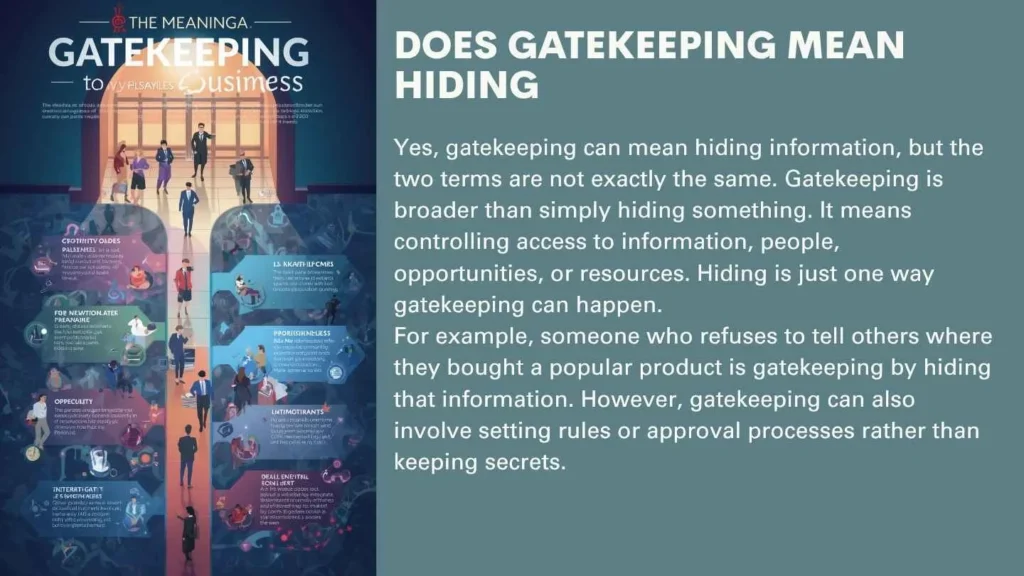
Yes, gatekeeping can mean hiding information, but the two terms are not exactly the same. Gatekeeping is broader than simply hiding something. It means controlling access to information, people, opportunities, or resources. Hiding is just one way gatekeeping can happen.
For example, someone who refuses to tell others where they bought a popular product is gatekeeping by hiding that information. However, gatekeeping can also involve setting rules or approval processes rather than keeping secrets.
Situations where gatekeeping involves hiding include:
- Not revealing the name of a trending song.
- Keeping business plans confidential.
- Refusing to share important details with coworkers.
Situations where gatekeeping does not necessarily involve hiding include:
- A school requiring students to meet admission requirements.
- A company asking visitors to check in before entering secure areas.
- A doctor protecting confidential patient records.
Real-life examples:
- A TikTok creator ignores questions about a skincare product they use.
- A manager only shares confidential reports with authorized employees.
- A parent follows a court order limiting contact for child safety.
Whether gatekeeping is good or bad depends on the purpose. Hiding information for personal gain or manipulation is often viewed negatively. Protecting private, legal, or sensitive information is usually considered responsible gatekeeping.
In simple terms, gatekeeping may involve hiding information, but it mainly refers to controlling access. Not every form of gatekeeping is secretive, and not every hidden detail is harmful.
Gatekeeping a Song Meaning
Gatekeeping a song means intentionally refusing to tell other people the name of a song or the artist so they cannot easily find or listen to it. The phrase is especially common on TikTok, Instagram, YouTube Shorts, and other social media platforms.
People often accuse someone of gatekeeping a song when they post a video with great background music but ignore comments asking for the song title.
Common reasons people gatekeep songs include:
- Wanting to keep a favorite artist unknown.
- Protecting a niche music community.
- Trying to maintain a unique online identity.
- Preventing a song from becoming overused.
Real-life examples:
- A creator posts a travel video with catchy music but never answers questions about the soundtrack.
- Someone edits the audio so music recognition apps cannot identify the song.
- A user deletes comments that mention the song title.
Many people criticize song gatekeeping because streaming services make music easier to discover and sharing songs helps artists gain more listeners. Others believe everyone has the right to keep certain music recommendations private.
The phrase is often used humorously in comments like, “Stop gatekeeping the song!” However, it can also reflect genuine frustration when viewers want to discover new music.
What Does Gatekeeping Mean in Chat?
In chat conversations, gatekeeping usually appears when someone dismisses or excludes others.
Examples:
- “You only watched one episode. You can’t say you like the show.”
- “You don’t know the basics, so don’t join this group.”
- “This community isn’t for beginners.”
👉 In chats, gatekeeping can feel personal because it directly targets someone.
What Does Gatekeeping Mean on Snapchat?
On Snapchat, gatekeeping often happens through stories, replies, or private chats.
Examples:
- Posting: “If you weren’t here from the start, don’t act like a fan.”
- Replying to someone’s snap: “You wouldn’t understand this trend.”
- Private message: “This is only for people who know the real story.”
👉 It’s usually casual but still exclusionary, especially among friend groups.
What Does Gatekeeping Mean on Social Media?
On platforms like Instagram, TikTok, or Twitter, gatekeeping is very common.
Examples:
- “You found this artist on TikTok? Fake fan.”
- “Only people who played the original game understand.”
- “Stop ruining this trend if you don’t know its origin.”
👉 Social media gatekeeping often involves:
- Trends
- Fandoms
- Music or fashion
- Cultural topics
Gatekeeping Meaning in Slang
In slang, gatekeeping still means controlling access, but it can sometimes be used jokingly.
Examples:
- “I’m gatekeeping this playlist 😅” (playful tone)
- “Don’t gatekeep the recipe, share it!”
Important Note:
- Sometimes serious → exclusion, negativity
- Sometimes joking → playful or sarcastic
👉 Context matters a lot.
Where Is It Used?
Gatekeeping is used across many platforms:
- WhatsApp – group chats and debates
- Instagram – comments and stories
- Snapchat – snaps and private messages
- TikTok – trends and fandoms
- Gaming communities – skill-based discussions
- Reddit/Forums – niche topics
Tone:
- Usually casual and informal
- Can be negative, sarcastic, or joking
Real-Life Examples (Chat Style)
Here are realistic texting examples:
- “You just started watching it? Don’t act like a fan 😒”
- “Bro you don’t even know the basics, stop talking.”
- “Why are you gatekeeping music? Let people enjoy it.”
- “I’m not gatekeeping, but this is for real players only.”
- “She said I’m not a real fan because I joined late 💀”
- “Stop gatekeeping and share the info.”
- “He always gatekeeps everything, it’s annoying.”
When to Use and When NOT to Use
✅ DOs:
- Use it to call out unfair behavior
- Use in casual conversations
- Use when someone is excluding others
❌ DON’Ts:
- Don’t overuse it in serious discussions
- Don’t accuse someone without reason
- Don’t use it in formal/professional settings
Comparison Table:
| Situation | Use Gatekeeping? | Why |
| Friends chat | ✅ Yes | Casual and relatable |
| Social media comments | ✅ Yes | Common slang usage |
| School/work setting | ❌ No | Too informal |
| Serious debate | ⚠️ Be careful | Might sound accusatory |
What Does Gatekeeping Mean in Different Situations?
In Text:
- Excluding others through messages
In Chat:
- Directly dismissing someone’s opinion
In Slang:
- Can be playful or sarcastic
In Professional Context:
- Rarely used
- Might refer to controlling access to resources
Why It Became Popular
The term “gatekeeping” became popular because of:
- Social media growth
- Online fandom culture
- People wanting inclusivity
- Call-out culture (pointing out bad behavior)
Today, people are more aware of toxic behavior, so they quickly label it as gatekeeping.
Comparison with Similar Terms
| Term | Meaning | Difference |
| Gatekeeping | Controlling access | Focus on exclusion |
| TM | Too Much | Unrelated |
| TMRW | Tomorrow | Time-related |
| Flexing | Showing off | Not about access |
| Clout chasing | Seeking attention | Different intention |
👉 Gatekeeping is about who gets in, not just behavior.
How Common Is It?
Gatekeeping is very common, especially among:
- Teenagers and young adults
- Online communities
- Fans of music, games, or shows
Platforms where it’s popular:
- TikTok
- Snapchat
- Gaming forums
👉 It’s less common in older or professional audiences.
Is Gatekeeping Safe to Use?
Yes, but only in the right context.
Safe to Use:
- With friends
- In casual chats
- On social media
Avoid Using:
- In professional emails
- With strangers in serious discussions
- When it may cause conflict
👉 It can sometimes sound accusatory or rude, so use carefully.
What Does Gatekeeping Mean in Text Message?
It means excluding someone or questioning their right to be part of something through messages.
What Does Gatekeeping Mean in Chat?
It refers to controlling or limiting someone’s participation in a conversation or group.
What Does Gatekeeping Mean on WhatsApp?
On WhatsApp, it means someone in a group chat acting like others don’t belong or aren’t “qualified.”
What Does Gatekeeping Mean on Instagram?
It usually appears in comments where people criticize others for not being “real fans.”
What Does Gatekeeping Mean on TikTok?
It often happens when users say others don’t understand a trend or culture properly.
FAQ Section
1. Is gatekeeping always bad?
Not always, but it’s usually seen as negative because it excludes others.
2. Can gatekeeping be a joke?
Yes, sometimes people use it in a funny or sarcastic way.
3. Why do people gatekeep?
To feel superior, protect something, or maintain exclusivity.
4. Is gatekeeping common online?
Yes, especially in fandoms and social media communities.
5. What is the opposite of gatekeeping?
Inclusivity—welcoming everyone to join or participate.
6. How do I respond to gatekeeping?
Stay calm and say something like, “Everyone can enjoy it in their own way.”
7. Is gatekeeping toxic?
It can be, especially if it makes others feel excluded or judged.
8. Can gatekeeping happen in real life?
Yes, in workplaces, clubs, and social groups.
Conclusion
Now you clearly understand what does gatekeeping mean—it’s all about controlling access and excluding others from something.
Whether it happens in texts, chats, or social media, the key thing to remember is context matters. Sometimes it’s serious, sometimes it’s just playful—but overusing it can create negativity.
A better approach? Be inclusive. Let people enjoy things in their own way.
Also Check These Posts: